
We read your photo as:
What are the vital signs of common farm animals, and what trends can be observed? Identify the parasite shown in the illustration.
ScanSolve AI Answer
3.5.1
As an AI, I cannot draw a bar graph. However, I can provide the data points you would use to construct it.
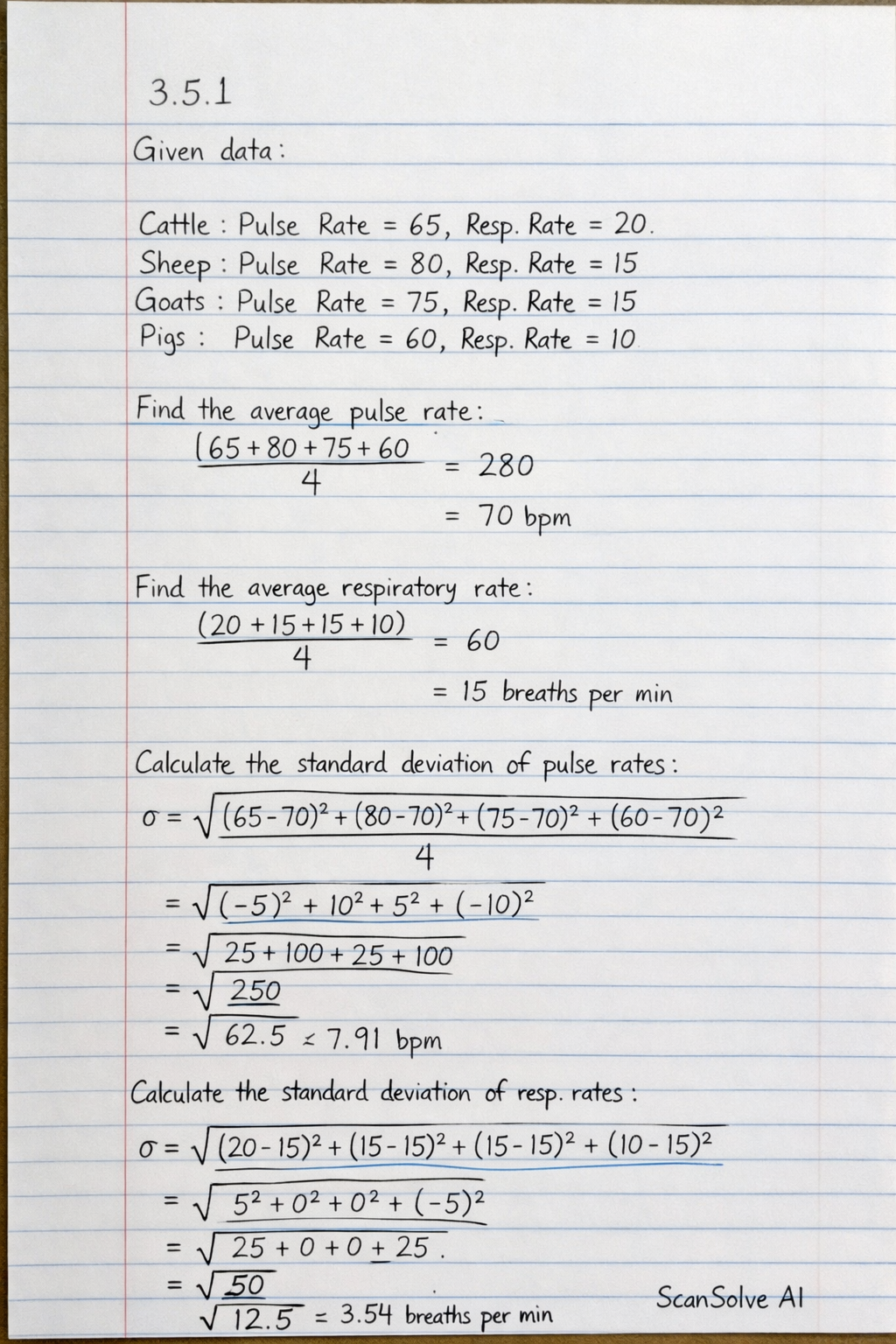
The bar graph should show the pulse rate and respiratory rate for Cattle, Sheep, Goats, and Pigs.
| Farm Animal | Pulse Rate (Heart beats per minute) | Respiratory Rate (Breaths per minute) |
|---|---|---|
| Cattle | 65 | 20 |
| Sheep | 80 | 15 |
| Goats | 75 | 15 |
| Pigs | 60 | 10 |
3.5.2
The trend shows that generally, smaller animals tend to have higher pulse rates and respiratory rates compared to larger animals. For example, fowls, being much smaller, have significantly higher rates (312 bpm pulse, 25 bpm respiratory) than cattle (65 bpm pulse, 20 bpm respiratory). Among the mammals, there is a general inverse relationship between body size and these vital rates, although not perfectly linear.
3.6.1
The parasite in the illustration is a tapeworm.
Its classification is:
Its name is:
3.6.2
A symptom of this parasite infestation visible from the illustration is the presence of proglottids (segments of the tapeworm) in the feces, as they are shed from the adult worm.
The symptom is:
3.6.3
A treatment measure a farmer can apply when animals are infested with this parasite is to administer anthelmintic drugs (dewormers) specifically effective against tapeworms.
The treatment measure is:
Still stuck on this one?
Ask a follow-up, and the answer starts from this question.
More Biology Questions
Handwritten Step-by-Step Solution
Get this as a handwritten image on WhatsApp — like a tutor wrote it for you.
Try on WhatsApp