
We read your photo as:
The worldwide zoonosis affecting many wild and domestic animals and Humans acquire the infection by contact with the urine of infected animals.
ScanSolve AI Answer
Answer
Here are the answers to the multiple-choice questions:
6. The question asks for "the most purulence specimen during microbiology test". Saliva, sputum, and cerebrospinal fluid (CSF) can all be purulent specimens depending on the infection. Given that all options can be purulent, "all are correct" is the most appropriate answer for this broadly phrased question.
The correct option is D.
- D) all are correct
7. The question asks for "the most significant streptococcal pathogen causing food poisoning infection worldwide". Streptococcus species are not typically known as significant causes of food poisoning (which is more commonly associated with Staphylococcus aureus, Clostridium perfringens, Salmonella, etc.). However, if forced to choose from the given options, Streptococcus pyogenes can cause foodborne illness, particularly pharyngitis or scarlet fever, if food is contaminated. While not typical "food poisoning" symptoms, it is the most significant pathogen among the Streptococcus options.
The correct option is A.
- A) S pyogenes
8. Coagulase-positive staphylococci are considered the most pathogenic species within the Staphylococcus genus. The primary coagulase-positive species is Staphylococcus aureus.
The correct option is A.
- A) S aureus
9. The question asks to identify the bacterium that is not Gram-positive.
- Staphylococcus Aureus is Gram-positive.
- Streptococcus Pneumoniae is Gram-positive.
- Haemophilus influenza is a Gram-negative coccobacillus.
- Staphylococcus Epidermidis is Gram-positive. The correct option is C.
- C) Haemophilus influenza
10. Swarming growth is a characteristic spreading motility observed on agar surfaces, most notably associated with the Gram-negative bacterium Proteus.
The correct option is B.
- B) Proteus
11. The description of an infection causing upper respiratory tract, nasopharyngeal, cutaneous symptoms, fever, sore throat, and malaise strongly points to Diphtheria, caused by Corynebacterium diphtheriae.
The correct option is A.
- A) Diphtheria
12. The question asks for the bacterium that is not non-spore forming, meaning it is spore-forming.
- Escherichia coli, Streptococcus, and Leptospira are all non-spore forming.
- Clostridium species are well-known spore-forming bacteria. The correct option is B.
- B) Clostridium
13. Mannitol Salt Agar (MSA) is a medium that contains a high concentration of salt, making it selective for salt-tolerant organisms like Staphylococcus. It also contains mannitol and a pH indicator, allowing it to differentiate between mannitol fermenters (e.g., S. aureus) and non-fermenters (e.g., S. epidermidis).
The correct option is C.
- C) Both "A" and "B"
14. An enrichment medium is designed to promote the growth of specific microorganisms while inhibiting others. Selenite F broth is a commonly used enrichment medium for the isolation of Salmonella from clinical and food samples.
The correct option is D.
- D) Selenite F broth
15. The description of a worldwide zoonosis affecting animals and humans, acquired by contact with the urine of infected animals, is characteristic of Leptospirosis, caused by Leptospira species.
The correct option is A.
- A) Leptospirosis
Try one yourself
A new problem that tests the same skill.
Still stuck on this one?
Ask a follow-up, and the answer starts from this question.
More Biology Questions
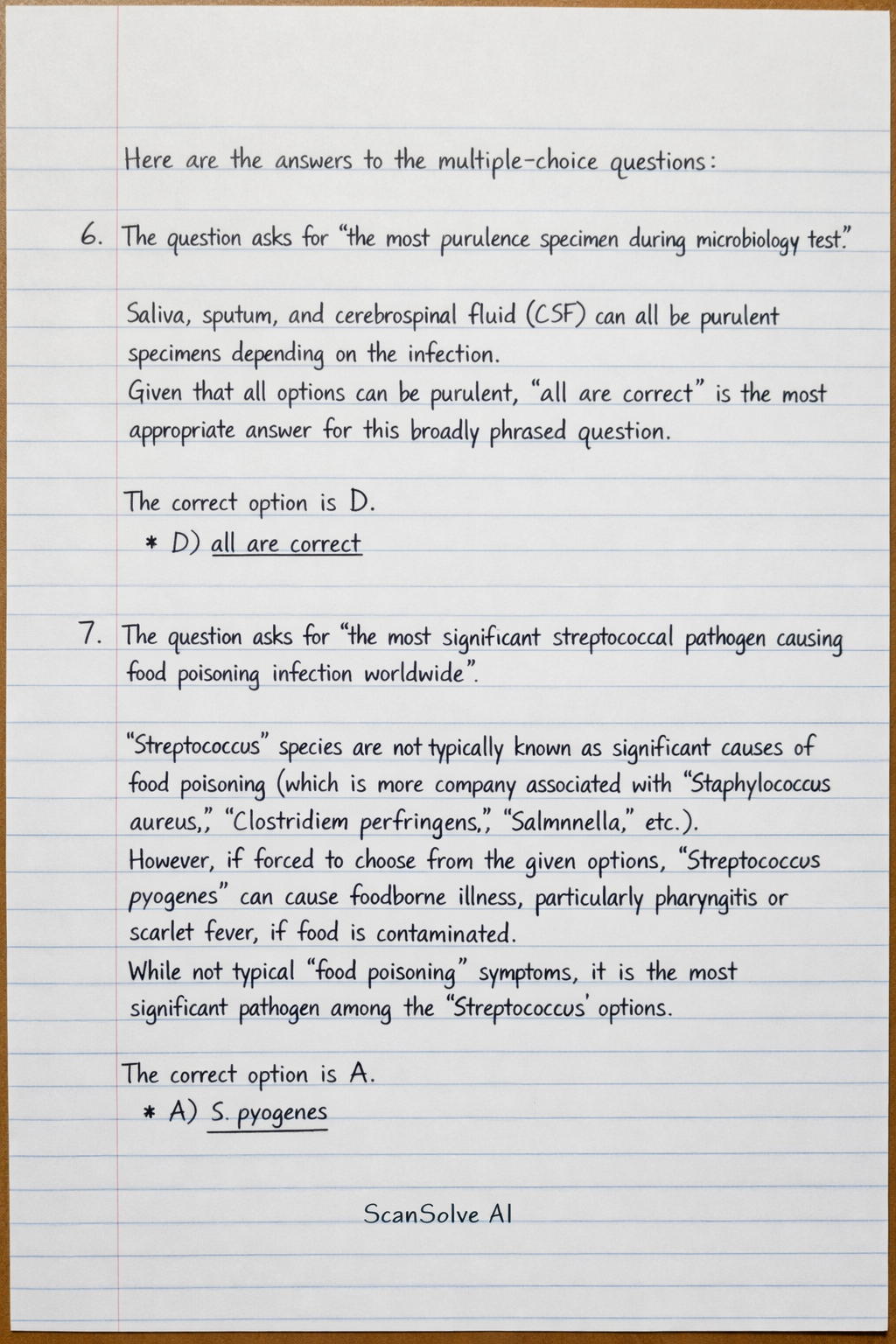
Handwritten Step-by-Step Solution
Get this as a handwritten image on WhatsApp — like a tutor wrote it for you.
Try on WhatsApp