
We read your photo as:
Describe three adaptations of the heart. Distinguish between population and community. Discuss environmental factors affecting the rate of transpiration.
ScanSolve AI Answer
Step-by-step solution
3 stepsAnswer Question 1.
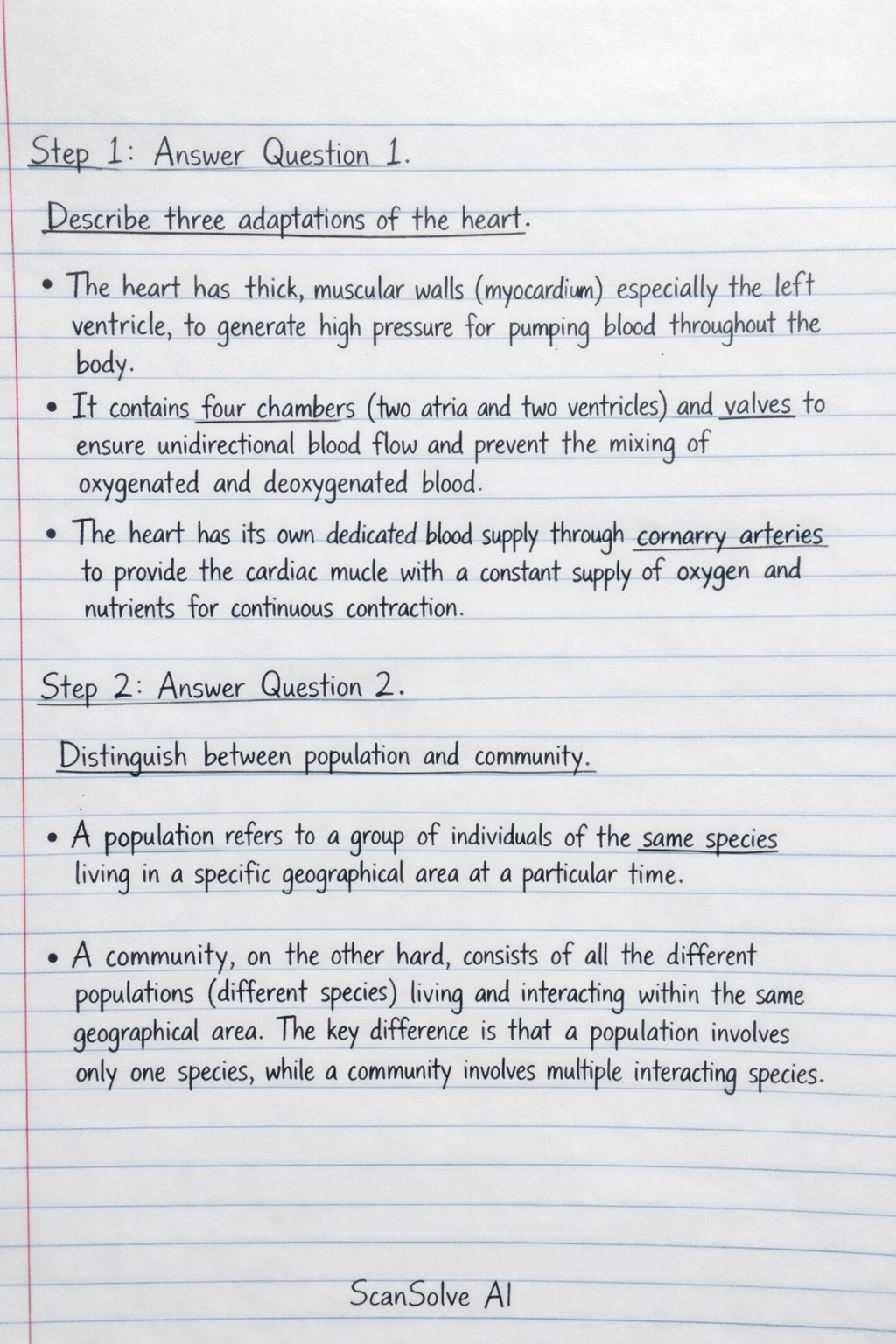
Describe three adaptations of the heart.
- The heart has thick, muscular walls (myocardium), especially the left ventricle, to generate high pressure for pumping blood throughout the body.
- It contains four chambers (two atria and two ventricles) and valves to ensure unidirectional blood flow and prevent the mixing of oxygenated and deoxygenated blood.
- The heart has its own dedicated blood supply through coronary arteries to provide the cardiac muscle with a constant supply of oxygen and nutrients for continuous contraction.
Answer Question 2.
Distinguish between population and community.
A population refers to a group of individuals of the same species living in a specific geographical area at a particular time. A community, on the other hand, consists of all the different populations (different species) living and interacting within the same geographical area. The key difference is that a population involves only one species, while a community involves multiple interacting species.Answer Question 3.
Discuss environmental factors affecting the rate of transpiration.
- Temperature: An increase in temperature increases the kinetic energy of water molecules, leading to a higher rate of evaporation from the leaf surface and thus a faster rate of transpiration.
- Humidity: Lower humidity in the surrounding air creates a steeper water potential gradient between the inside of the leaf and the outside, increasing the rate of water vapor diffusion out of the stomata.
- Wind speed: Increased wind speed removes the layer of saturated water vapor immediately surrounding the leaf, maintaining a steep water potential gradient and thereby increasing the rate of transpiration.
- Light intensity: Higher light intensity generally causes stomata to open wider to facilitate photosynthesis, which in turn increases the surface area for water vapor to escape, leading to a higher transpiration rate.
Still stuck on this one?
Ask a follow-up, and the answer starts from this question.
More Biology Questions
Handwritten Step-by-Step Solution
Get this as a handwritten image on WhatsApp — like a tutor wrote it for you.
Try on WhatsApp