
We read your photo as:
What do you understand by pollination? Outline five causes of self-pollination in flowers. State five advantages and five disadvantages of self-pollination.
Biology
ScanSolve AI Answer
Here are the solutions to your biology questions.
1. Seed bearing plants
-
a) What do you understand by pollination? Pollination is the transfer of pollen grains from the anther (male reproductive part) to the stigma (female receptive part) of a flower. This process is crucial for sexual reproduction in flowering plants, leading to fertilization and subsequent seed formation.
-
b) Outline five causes of self-pollination in flowers.
- Bisexual flowers: The flower contains both functional male (stamens) and female (pistil) reproductive organs.
- Homogamy: The anthers and stigma of the same flower mature simultaneously, allowing pollen to be transferred directly.
- Cleistogamy: Flowers remain closed, preventing cross-pollination and ensuring self-pollination (e.g., in some violets).
- Position of anthers and stigma: The anthers are positioned directly above or very close to the stigma, facilitating pollen transfer within the same flower.
- Wind or insect absence: In environments where pollinators are scarce or wind is minimal, self-pollination becomes a more reliable reproductive strategy.
-
c) State five advantages and five disadvantages of self-pollination.
- Advantages:
- Ensures seed production even when pollinators are scarce or absent.
- Preserves desirable traits in a lineage, as there is no genetic mixing.
- Requires less energy from the plant for producing nectar, scent, or large petals.
- More reliable in certain environments, as it doesn't depend on external agents.
- Helps maintain genetic purity over generations.
- Disadvantages:
- Leads to reduced genetic variation, making the population less adaptable to environmental changes.
- Increases the risk of inbreeding depression, where harmful recessive traits become more common.
- Reduces vigor and fertility over successive generations.
- Limits the ability of the species to evolve and adapt to new conditions.
- May lead to accumulation of deleterious mutations.
- Advantages:
Was this helpful?
Still stuck on this one?
Ask a follow-up, and the answer starts from this question.
Got a different question?Ask your own question
More Biology Questions
QIdentify and describe the functions of flower parts I-VII, state the type of pollination, and…QIdentify and explain the functions of the parts of a flower, and describe its pollination type and…QIdentify and describe the parts of a flower diagram, its pollination, and its advantages.QLabel the parts of the flower (anther, filament, stigma, petal, ovule, pedicel, sepal) and describe…QIdentify the parts of a flower (I-VII) and describe their functions. What is the likely mode of…
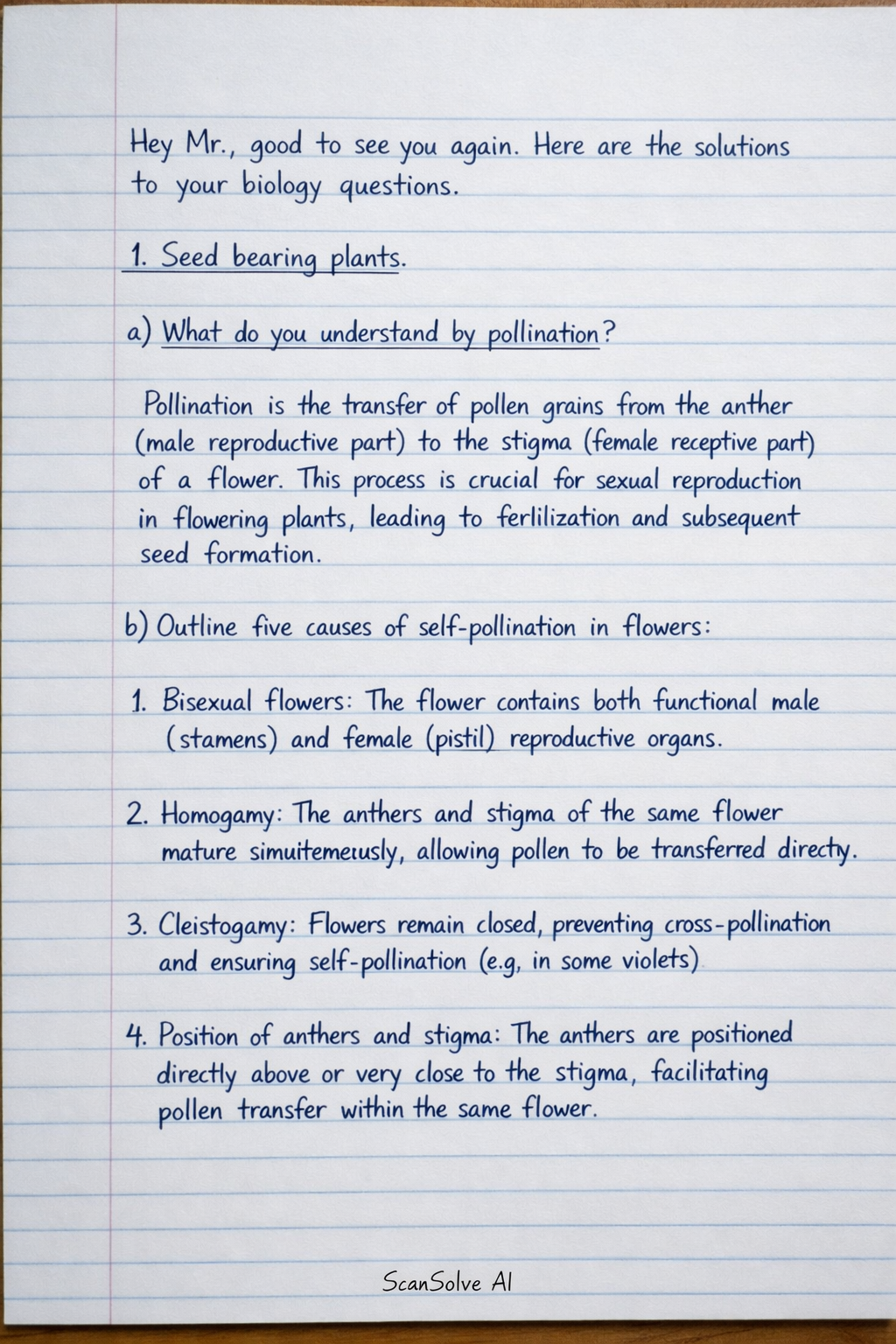
Handwritten Step-by-Step Solution
Get this as a handwritten image on WhatsApp — like a tutor wrote it for you.
Try on WhatsApp