
We read your photo as:
A) Explain the concept of consumerism to the company's management.
ScanSolve AI Answer
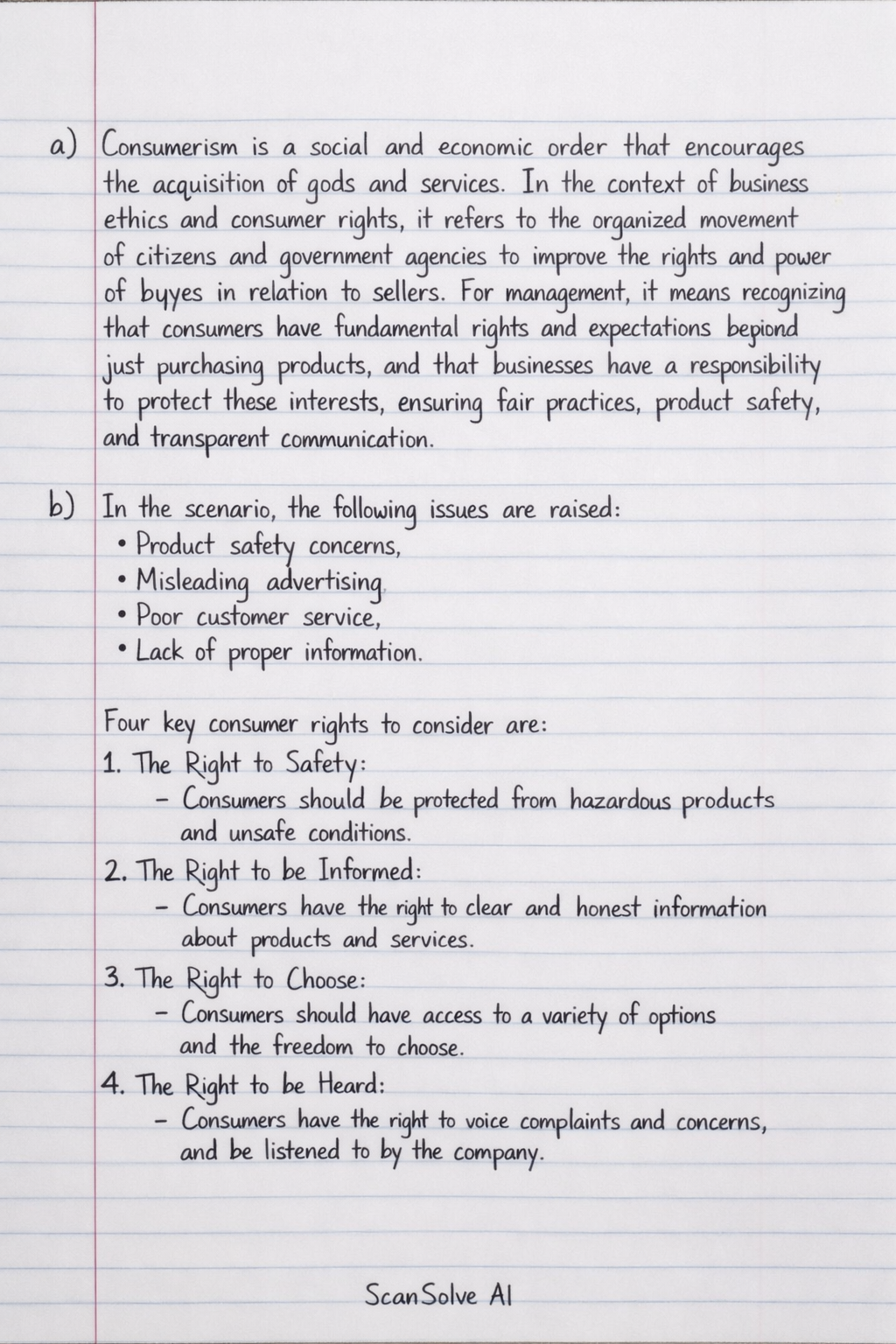
a) Explain the concept of consumerism to the company's management.
Consumerism is a social and economic order that encourages the acquisition of goods and services. In the context of business ethics and consumer rights, it refers to the organized movement of citizens and government agencies to improve the rights and power of buyers in relation to sellers. For management, it means recognizing that consumers have fundamental rights and expectations beyond just purchasing products, and that businesses have a responsibility to protect these interests, ensuring fair practices, product safety, and transparent communication.
b) Examine the issues raised in the scenario and discuss four (4) key consumer rights that should guide the company's dealings with its customers.
The scenario highlights several critical issues:
- Misleading product labels and lack of clear information on ingredients directly violate consumers' right to accurate information.
- Poor response to customer complaints indicates a failure to address consumer grievances effectively and respect their right to be heard.
- Public criticism and concerns from consumer advocacy groups underscore a broader erosion of trust and a failure to meet societal expectations regarding consumer protection.
To address these issues, the company should be guided by the following four key consumer rights:
-
Right to be Informed: Consumers have the right to be provided with accurate, clear, and complete information about products and services. This includes ingredients, nutritional facts, potential allergens, usage instructions, and any risks. The company must ensure its product labels are truthful and transparent, directly addressing the issue of misleading labels and lack of ingredient information.
-
Right to Safety: Consumers have the right to be protected against products, production processes, and services that are hazardous to health or life. While not explicitly stated as a safety issue, misleading labels or unclear ingredients in a beverage product can pose health risks (e.g., for individuals with allergies). The company must ensure its products are safe for consumption and that all relevant safety information is clearly communicated.
-
Right to be Heard (or Right to Redress): Consumers have the right to express their interests and concerns, and to have those concerns considered in the formulation and execution of business policies. This also includes the right to seek and obtain fair settlement of just claims, including compensation for misrepresentation, shoddy goods, or unsatisfactory services. The company's poor response to complaints violates this right, and it must establish effective and accessible channels for customer feedback and complaint resolution.
-
Right to Consumer Education: Consumers have the right to acquire knowledge and skills needed to make informed, confident choices about goods and services, while being aware of basic consumer rights and responsibilities. By providing clear and accurate information, and educating consumers about their products, the company can empower them to make better decisions and build trust, moving beyond just compliance to fostering an informed consumer base.
Still stuck on this one?
Ask a follow-up, and the answer starts from this question.
More Business/Management Questions
Handwritten Step-by-Step Solution
Get this as a handwritten image on WhatsApp — like a tutor wrote it for you.
Try on WhatsApp