
We read your photo as:
What is a Multinational Corporation and what are its characteristics?
ScanSolve AI Answer
Answer
, as a multinational corporation operates in at least one country other than its
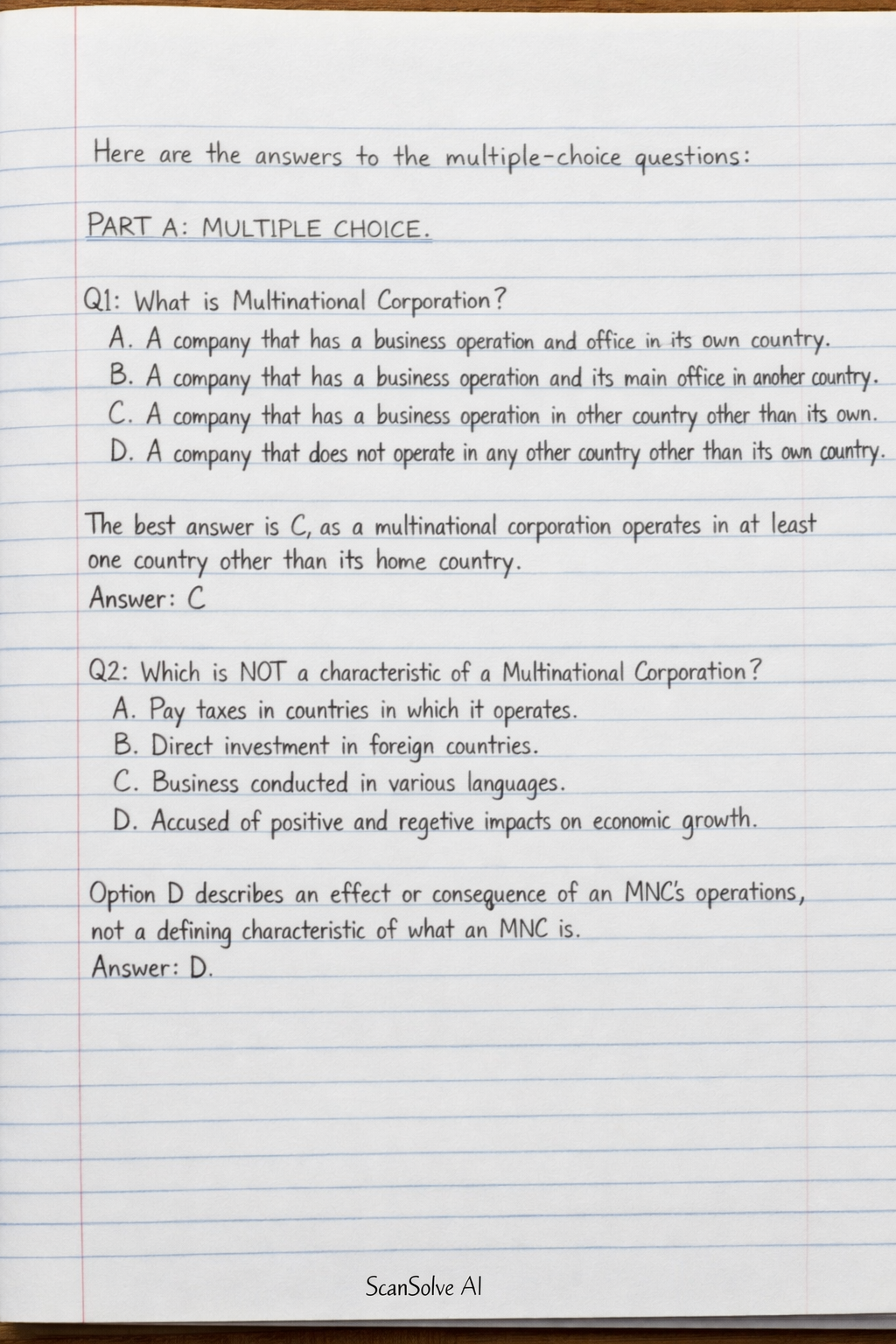
Here are the answers to the multiple-choice questions:
PART A: MULTIPLE CHOICE.
Q1: What is Multinational Corporation?
- A. A company that has a business operation and office in its own country.
- B. A company that has a business operation and its main office in another country.
- C. A company that has a business operation in other country other than its own.
- D. A company that does not operate in any other country other than its own country.
The best answer is C, as a multinational corporation operates in at least one country other than its home country.
- Answer: C
Q2: Which is NOT a characteristic of a Multinational Corporation?
- A. Pay taxes in countries in which it operates.
- B. Direct investment in foreign countries.
- C. Business conducted in various languages.
- D. Accused of positive and negative impacts on economic growth.
Option D describes an effect or consequence of an MNC's operations, not a defining characteristic of what an MNC is.
- Answer: D
Q3: Which of the following statement below represents Multinational Corporation 'Main Organisational Type'?
- A. A Transnational Corporation.
- B. A Centralise National Corporation.
- C. A National Division within a Corporation.
- D. All of the above.
A Transnational Corporation (TNC) is a specific and often considered advanced type of Multinational Corporation, characterized by decentralized decision-making and global integration.
- Answer: A
Q4: What is Transnational Corporation?
- A. A company that has a business operation and office in its own country.
- B. A company that has a business operation globally and have its own management.
- C. A company that has a business operation in other country other than its own country.
- D. A company that does not operate in any other country other than its own country.
A Transnational Corporation operates globally with decentralized management, meaning decision-making is distributed among its various international offices.
- Answer: B
Q5: Multinational Corporation generates how many percentages of its revenue overseas?
- A. 20%
- B. 30%
- C. 25%
- D. 35%
While the exact percentage varies greatly among MNCs, a significant portion of revenue often comes from overseas operations. 30% is a plausible figure representing a substantial international presence.
- Answer: B
Q6: The history of Multinational Company is linked with the history of ____.
- A. Imperialism
- B. Provincialism
- C. Communism
- D. Colonialism
Early forms of multinational corporations, such as trading companies, were closely tied to the expansion and economic exploitation characteristic of colonialism.
- Answer: D
Q7: The association of workers in a particular trade is known as;
- A. Tradesman
- B. Tribesman
- C. Labour Union.
- D. Trade association
A Labour Union (also known as a Trade Union) is an organization of workers formed to protect and advance their interests.
- Answer: C
Q8: What leads to 'Economic Diversification' for an increase income inflow for the government and reduce dependence?
- A. Industries
- B. Agriculture
- C. Mining
- D. Trade Union.
Economic diversification involves expanding into various sectors or industries to reduce reliance on a single one, thereby increasing income stability and reducing dependence.
- Answer: A
Q9: State one 'advantage of Online Social Networks'
- A. Promote trade and business.
- B. Spread bad influence.
- C. Makes people lazy.
- D. Cyber bullying.
Online social networks provide platforms for businesses to market products, engage with customers, and facilitate trade.
- Answer: A
Q10: State one 'disadvantage of 'Global Culture' in PNG.
- A. Cyber bullying.
- B. Bad influence.
- C. Make money.
- D. PNG culture dying.
A significant concern with the spread of global culture is the potential erosion or loss of unique local traditions, languages, and customs.
- Answer: D
Try one yourself
A new problem that tests the same skill.
Still stuck on this one?
Ask a follow-up, and the answer starts from this question.
More Business/Management Questions
Handwritten Step-by-Step Solution
Get this as a handwritten image on WhatsApp — like a tutor wrote it for you.
Try on WhatsApp