
We read your photo as:
A retailer buys an article from a wholesaler for 480 Taka and sells it to a customer for 576 Taka. The retailer makes a profit of 20%. The wholesaler also makes a profit of 20%. What was the cost pric
ScanSolve AI Answer
Step-by-step solution
12 stepsCalculate the retailer's cost price (RCP).
The retail selling price (RSP) is 576 Taka, and the retailer makes a 20% profit.
Let the retailer's cost price be .The retailer's cost price is the wholesaler's selling price (WSP). So, WSP = 480 Taka.
Calculate the wholesaler's cost price (WCP).
The wholesaler's selling price (WSP) is 480 Taka, and the wholesaler makes a 20% profit.
Let the wholesaler's cost price be .The cost price for the wholesaler is 400 Taka.
Calculate the cost price (CP) of the lentils.
The shopkeeper sold the lentils for 2075 Taka and incurred a 5% loss.
Let the cost price be .Calculate the selling price (SP) required to make a 5% profit.
To make a 5% profit, the selling price should be .
Rounding to two decimal places:
The shopkeeper should sell the lentils for 2293.42 Taka to make a 5% profit.
Determine the total cost price (CP) for an equal number of bananas from both rates.
Let's assume the shopkeeper bought 30 bananas at each rate (LCM of 10 and 15).
Cost of 30 bananas at 10 for 30 Taka:
Since 10 bananas cost 30 Taka, 30 bananas cost Taka.
Cost of 30 bananas at 15 for 30 Taka:
Since 15 bananas cost 30 Taka, 30 bananas cost Taka.
Total bananas bought = bananas.
Total cost price (CP) = Taka.Determine the total selling price (SP) for all bananas.
All 60 bananas are sold at a rate of 12 for 30 Taka.
Since 12 bananas sell for 30 Taka, 60 bananas (which is ) will sell for Taka.
Total selling price (SP) = 150 Taka.Calculate the percentage profit or loss.
Profit/Loss = SP - CP
Profit/Loss = Taka.
Since the profit/loss is 0, there is no profit or loss.There will be no profit or loss.
\boxed{\text{0% profit or loss}}Identify the given values.
Principal () = 2000 Taka
Time () = 5 years
Annual interest rate () = 10.50% (assuming percentage, as "10.50 Taka" for a rate is not standard)Apply the simple interest formula.
The formula for simple interest () is:
Substitute the given values:
The interest will be 1050 Taka.
Calculate the interest with the initial rate (10%).
Principal () = 3000 Taka
Time () = 3 years
Initial rate () = 10%Calculate the interest with the decreased rate (8%).
Principal () = 3000 Taka
Time () = 3 years
Decreased rate () = 8%Calculate the difference in interest.
Difference =
Difference =
Difference =The interest will be 180 Taka less.
Still stuck on this one?
Ask a follow-up, and the answer starts from this question.
More Business/Management Questions
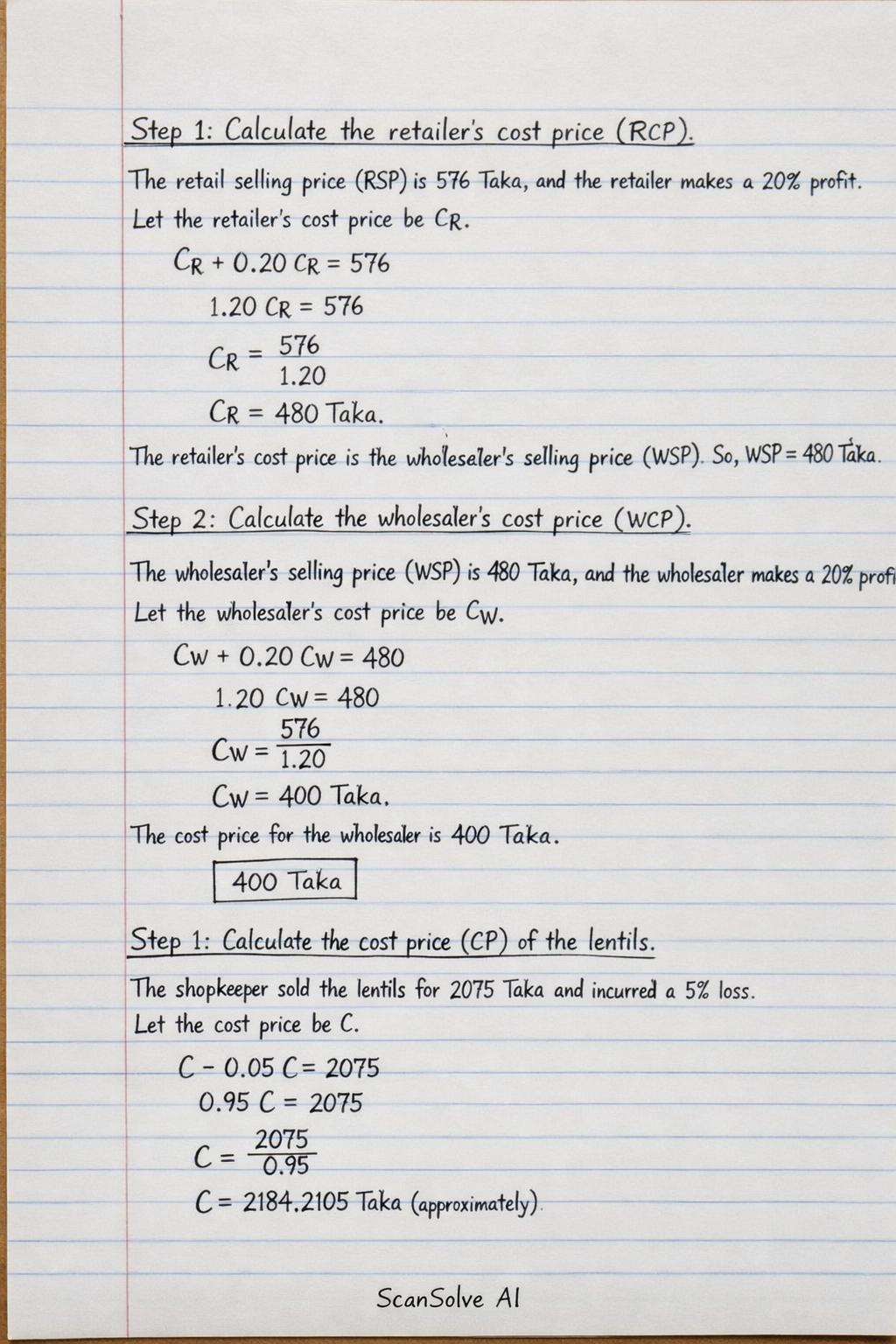
Handwritten Step-by-Step Solution
Get this as a handwritten image on WhatsApp — like a tutor wrote it for you.
Try on WhatsApp