
We read your photo as:
Analyze and report on the machining workflow for shaft manufacturing, detailing an optimized process and addressing specific challenges.
ScanSolve AI Answer
Here is a report analyzing the machining workflow for shaft manufacturing at Greenfield High School, addressing Task 1:
Report on Optimized Machining Workflow for Shaft Manufacturing
This report details an optimized workflow for lathe turning operations in the machining section, focusing on the manufacturing of shafts. The current process faces significant challenges, including excessive setup times, frequent machine stoppages, poor operator coordination, and inconsistent product quality. The objective of this redesigned workflow is to enhance overall efficiency and productivity while maintaining high manufacturing standards, thereby addressing the issues of reduced efficiency, increased production delays, and variability in final products.
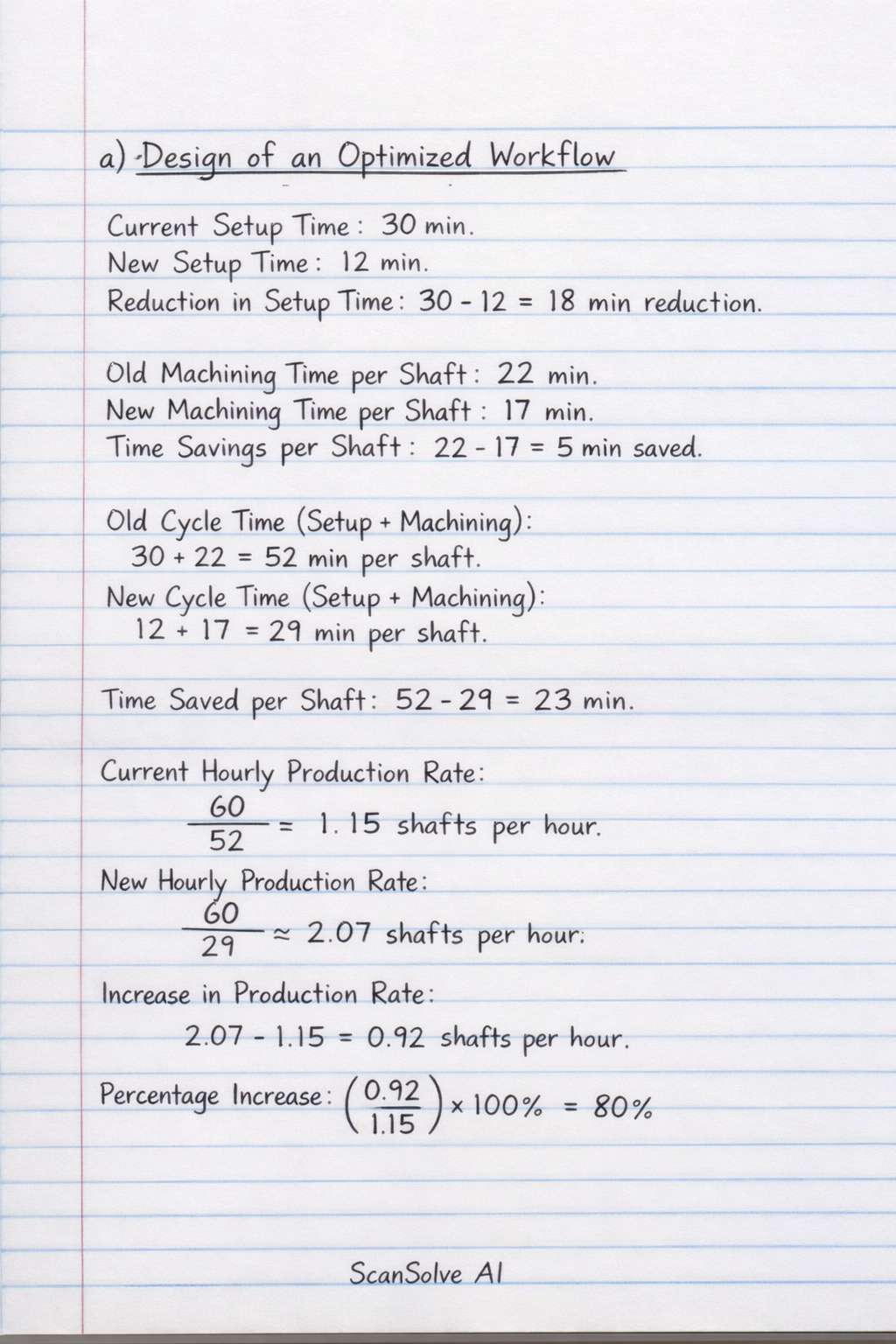
a) Design of an Optimized Workflow
The optimized workflow for lathe turning of shafts is structured to ensure a streamlined, efficient, and quality-controlled process. It begins with meticulous preparation and progresses through precise machining and rigorous inspection stages. This systematic approach aims to minimize downtime and maximize output quality.
Optimized Workflow: Sequence of Operations, Resources, and Roles
- Material Preparation & Inspection:
- Sequence: Raw material (e.g., steel bar stock) is selected, cut to approximate length, and undergoes an initial visual and dimensional quality check.
- Resources: Bandsaw, measuring tape, calipers, material handling equipment.
- Role: Material Handler (cuts and transports), QC Inspector (initial check).
- Machine Setup & Tooling:
- Sequence: The lathe machine is prepared, the chuck is cleaned, appropriate cutting tools (roughing, finishing, grooving) are selected from a pre-kitted station, and tool offsets are set. If CNC, the program is loaded and verified.
- Resources: Lathe machine, cutting tools, tool holders, chuck keys, setup gauges, CNC program.
- Role: Lathe Operator (sets up machine), Supervisor (verifies setup).
- Rough Turning:
- Sequence: Bulk material is removed from the shaft blank to bring it close to the final dimensions, focusing on material removal rate.
- Resources: Lathe machine, roughing tools, cutting fluid.
- Role: Lathe Operator (executes operation).
- Intermediate Inspection:
- Sequence: After rough turning, critical dimensions are checked to ensure the part is within acceptable limits before final machining.
- Resources: Micrometers, calipers, go/no-go gauges.
- Role: Lathe Operator (in-process check), QC Inspector (verification).
- Finish Turning:
- Sequence: The shaft is machined to its final specified dimensions, surface finish, and tolerances.
- Resources: Lathe machine, finishing tools, high-quality cutting fluid.
- Role: Lathe Operator (executes operation).
- Final Inspection & Deburring:
- Sequence: A comprehensive inspection of all dimensions, surface finish, and geometric tolerances is performed. Any burrs are carefully removed.
- Resources: Precision measuring instruments (micrometers, dial indicators, surface roughness tester), deburring tools.
- Role: QC Inspector (final verification), Lathe Operator (deburring).
- Post-Processing & Packaging:
- Sequence: Finished shafts are cleaned, potentially coated with a rust preventative, and securely packaged for storage or dispatch.
- Resources: Cleaning agents, protective coatings, packaging materials.
- Role: Material Handler (cleans and packages).
Justification of Optimized Workflow
This optimized workflow significantly improves efficiency by standardizing each step, reducing non-value-added activities like searching for tools or materials. Productivity is enhanced through minimized machine stoppages due to pre-planned setups and regular maintenance, ensuring a continuous flow of operations. Quality improvement is achieved through multiple inspection points, the use of appropriate tooling, and clearly defined roles, leading to consistent adherence to specifications and reduced rework or scrap.
b) Critical Evaluation of the Current Process and Recommendations
The current manual process suffers from several critical inefficiencies that directly impact production and team performance.
Analysis of Inefficiencies and Their Impact
- Excessive Setup Times: The lack of standardized procedures for machine setup and tool preparation leads to significant downtime between jobs. This directly reduces machine utilization, increases lead times for shaft production, and raises the per-unit manufacturing cost due to idle equipment and labor.
- Frequent Machine Stoppages: These stoppages, often caused by unaddressed tool wear, material inconsistencies, or minor operator errors, disrupt the entire production schedule. They lead to unpredictable delays, increased scrap rates from interrupted cuts, and significant frustration among operators who cannot maintain a consistent workflow.
- Poor Coordination Among Operators: Ambiguous allocation of responsibilities and ineffective communication channels result in inconsistent practices, errors in material handling, and delays in information transfer. This creates bottlenecks, increases the likelihood of errors, reduces overall team morale, and fosters a blame culture rather than collaborative problem-solving.
- Inconsistent Product Quality: Variability in operator skill, absence of clear quality control checkpoints, and lack of standardized operating procedures contribute to shafts not meeting specifications. This results in higher scrap rates, increased rework, potential customer complaints, and ultimately damages the school's reputation for producing quality components.
Evidence-Based Solutions
To address these inefficiencies, the following evidence-based solutions are recommended:
- For Excessive Setup Times: Implement Single-Minute Exchange of Die (SMED) principles. This involves pre-kitting all necessary tools and fixtures for a job, standardizing machine setups, and using quick-change tooling mechanisms. This reduces internal setup time (machine stopped) by converting it to external setup time (machine running).
- For Frequent Machine Stoppages: Adopt a Total Productive Maintenance (TPM) approach. This includes scheduled preventative maintenance for all lathes, operator training for minor troubleshooting and autonomous maintenance tasks, and implementing a system for predictive maintenance based on machine performance data.
- For Poor Coordination: Develop and enforce Standard Operating Procedures (SOPs) for all key machining tasks and inter-operator handovers. Implement daily stand-up meetings for operators and supervisors to discuss daily targets, issues, and solutions. Utilize visual management boards to display production schedules, progress, and quality metrics.
- For Inconsistent Product Quality: Introduce Statistical Process Control (SPC) to monitor key dimensions and surface finishes during production, allowing for early detection of deviations. Ensure regular calibration of all measuring equipment and provide continuous operator training on quality standards and precision measurement techniques. Establish dedicated Quality Control (QC) checkpoints at critical stages (e.g., after roughing and finishing).
c) Process Flow Diagram / Workflow Chart for Improved Process
A process flow diagram for the improved workflow would visually represent the sequence of operations, decision points, and responsibilities, ensuring clarity and practical implementation.
The diagram would start with an Oval representing "Raw Material Received." This would lead to a Rectangle for "Material Preparation & Initial Inspection." A Diamond ("Material Compliant?") would follow, with a "No" path leading to "Reject/Rework Material" (another rectangle) and a "Yes" path continuing. The process would then flow through a series of Rectangles for operations: "Machine Setup & Tooling," "Rough Turning," followed by another Diamond ("Intermediate Dimensions within Tolerance?"). If "No," it would loop back to "Rework/Adjust" or "Scrap." If "Yes," it would proceed to "Finish Turning," then to a final Diamond ("Final Dimensions & Surface Finish within Tolerance?"). A "No" path would lead to "Rework/Scrap," while a "Yes" path would lead to "Deburring," then "Post-Processing & Packaging" (rectangles), and finally an Oval for "Finished Shafts Dispatched." Parallelograms would indicate inputs (e.g., "Cutting Tools," "CNC Program") and outputs (e.g., "Scrap," "Inspection Report"). Arrows would connect all symbols, indicating the flow direction. Optional swimlanes could be used to delineate responsibilities for the Material Handler, Lathe Operator, QC Inspector, and Supervisor, making roles explicit.
Still stuck on this one?
Ask a follow-up, and the answer starts from this question.
More Business/Management Questions
Handwritten Step-by-Step Solution
Get this as a handwritten image on WhatsApp — like a tutor wrote it for you.
Try on WhatsApp