
We read your photo as:
As a Procurement Director in one of the Federal Government Ministries in Nigeria, educate a group of students on excursion to your directorate about the core values and thresholds of The Public Procurement Act of 2007 and give recommendations on areas for improvement.
ScanSolve AI Answer
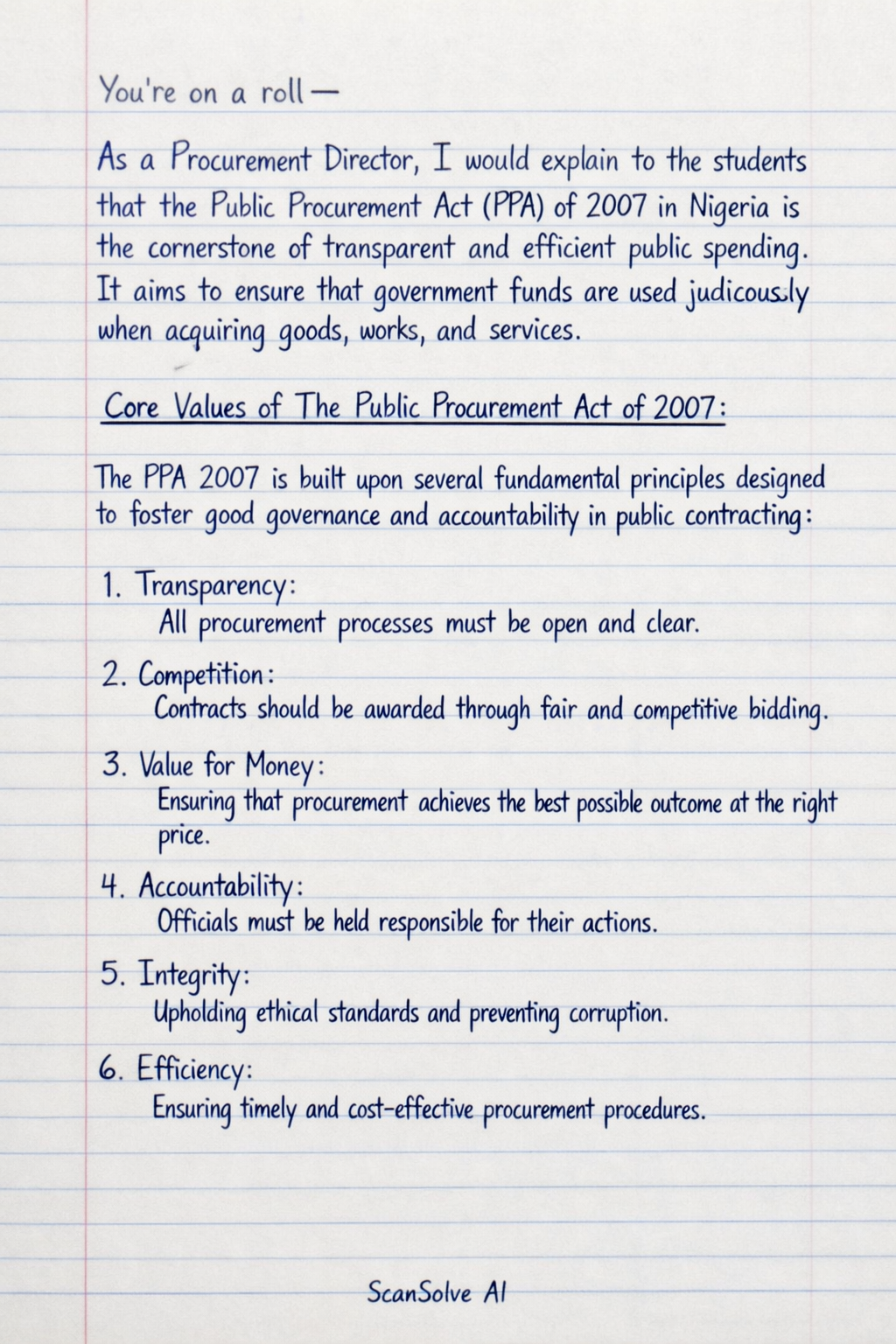
As a Procurement Director, I would explain to the students that the Public Procurement Act (PPA) of 2007 in Nigeria is the cornerstone of transparent and efficient public spending. It aims to ensure that government funds are used judiciously when acquiring goods, works, and services.
Core Values of The Public Procurement Act of 2007:
The PPA 2007 is built upon several fundamental principles designed to foster good governance and accountability in public contracting:
- Transparency: All procurement processes must be open and accessible to the public. This includes publicizing invitations to bid, bid opening ceremonies, and contract awards. This value aims to prevent secrecy and corruption.
- Accountability: Public officers involved in procurement are held responsible for their actions and decisions. The Act establishes mechanisms for oversight and sanctions for non-compliance.
- Competition: The Act promotes fair and open competition among bidders to ensure that the government obtains the best value for money. This is achieved through various procurement methods that encourage wide participation.
- Economy and Efficiency: Public funds must be utilized in a manner that achieves the desired outcomes at the lowest possible cost, without compromising quality. This involves selecting methods that are cost-effective and timely.
- Fairness and Equity: All bidders must be treated equally and fairly throughout the procurement process. There should be no discrimination or undue advantage given to any participant.
- Integrity: The entire procurement process must be conducted with honesty and moral uprightness, free from corruption, fraud, or unethical practices.
Thresholds of The Public Procurement Act of 2007:
The PPA 2007 sets various monetary thresholds that determine the appropriate procurement method to be used. These thresholds are subject to periodic review and adjustment by the Bureau of Public Procurement (BPP). While specific figures can change, the concept of thresholds dictates:
- Small Value Procurements: For very low-value goods, works, or services, simpler methods like Direct Procurement or Shopping might be permitted. These are typically for urgent needs or items below a certain monetary limit.
- Medium Value Procurements: For procurements above the small value threshold but below a higher limit, methods like Request for Quotations or Restricted Tendering might be used. These involve inviting bids from a limited number of pre-qualified suppliers.
- High Value Procurements: For significant projects and large-scale acquisitions, Open Competitive Bidding (National or International) is mandatory. This is the most transparent and competitive method, requiring public advertisement and wide participation.
The thresholds ensure that the level of scrutiny and competition is commensurate with the value and complexity of the procurement. For example, a procurement for office supplies will have a different threshold and method than a multi-billion Naira infrastructure project.
Recommendations on Areas for Improvement:
While the PPA 2007 has significantly improved public procurement in Nigeria, there are always areas for enhancement:
-
Capacity Building and Training:
- Recommendation: Invest more in continuous training and professional development for procurement officers across all Ministries, Departments, and Agencies (MDAs). This should cover not only the legal aspects of the Act but also best practices in contract management, risk assessment, and ethical conduct.
- Rationale: Many procurement challenges stem from a lack of adequate knowledge and skills among practitioners, leading to errors, delays, and non-compliance.
-
Digitalization and E-Procurement Implementation:
- Recommendation: Accelerate the full implementation of an integrated e-procurement system across all federal MDAs. This includes online bidding, electronic contract management, and digital payment systems.
- Rationale: E-procurement enhances transparency, reduces human interface (thereby minimizing corruption), improves efficiency, and provides real-time data for monitoring and evaluation.
-
Strengthening Monitoring and Enforcement:
- Recommendation: Enhance the capacity of the Bureau of Public Procurement (BPP) and other oversight bodies to effectively monitor compliance with the Act and enforce sanctions against defaulters. This includes timely investigations and prosecution of procurement offenses.
- Rationale: Robust monitoring and consistent enforcement are crucial to deter non-compliance and ensure that the principles of the Act are upheld in practice, not just in theory.
-
Review and Update of Thresholds and Regulations:
- Recommendation: Conduct regular reviews of the monetary thresholds and other regulatory provisions within the Act to ensure they remain relevant and responsive to current economic realities and market dynamics.
- Rationale: Outdated thresholds can either stifle efficiency for small procurements or fail to provide adequate oversight for larger ones, while regulations may need to adapt to new technologies and global best practices.
-
Stakeholder Engagement and Feedback Mechanisms:
- Recommendation: Establish more formal and effective channels for engaging with stakeholders, including contractors, civil society organizations, and the public, to gather feedback on the procurement process and identify areas for improvement.
- Rationale: Involving external stakeholders can provide valuable insights, foster trust, and help identify practical challenges and solutions that might not be apparent from within the government.
Still stuck on this one?
Ask a follow-up, and the answer starts from this question.
More Business/Management Questions
Handwritten Step-by-Step Solution
Get this as a handwritten image on WhatsApp — like a tutor wrote it for you.
Try on WhatsApp