
We read your photo as:
Explain collective bargaining, its advantages and disadvantages, and the difference between strikes and lockouts. What is the main legal framework for these in South Africa?
ScanSolve AI Answer
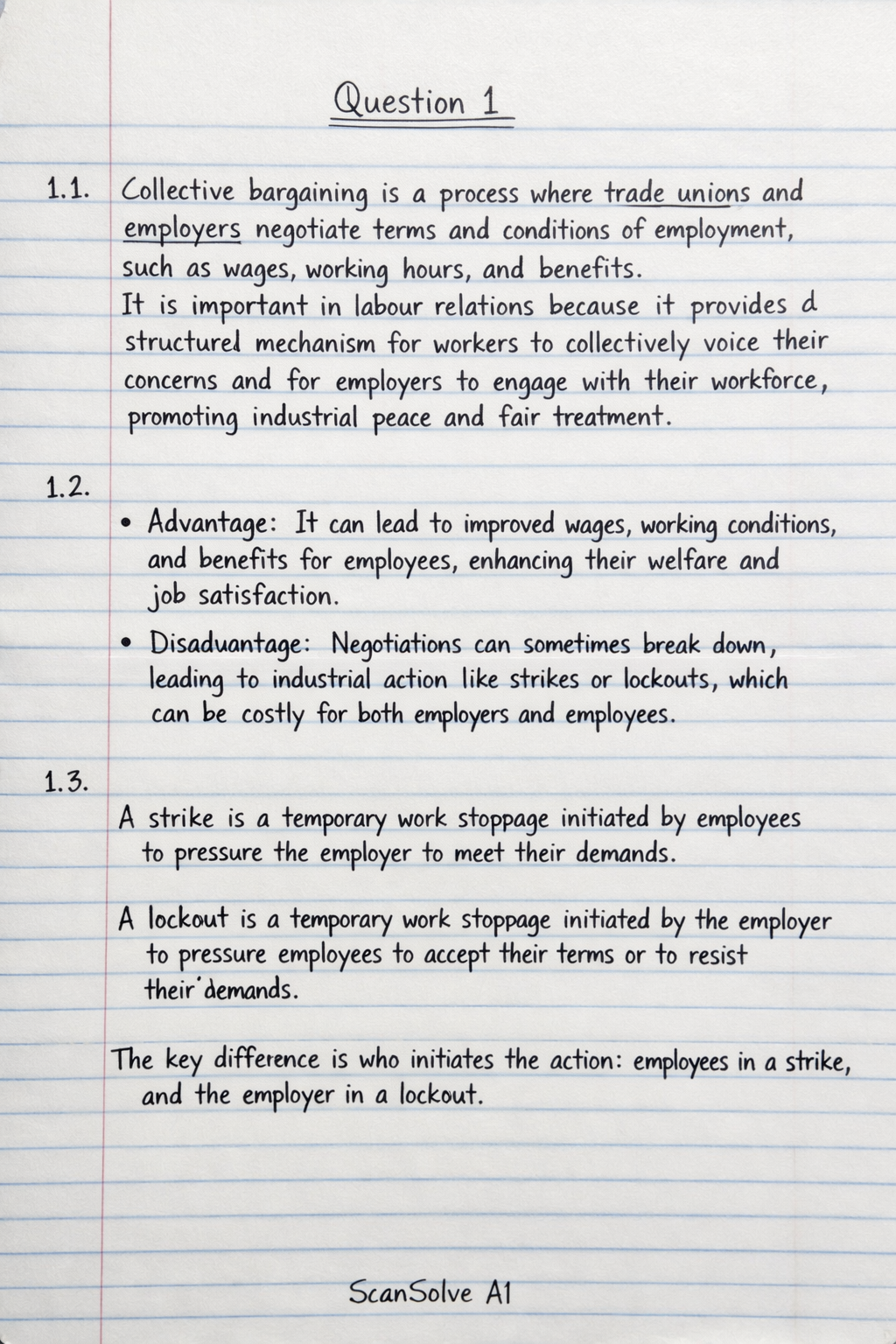
Question 1
1.1. Collective bargaining is a process where trade unions and employers negotiate terms and conditions of employment, such as wages, working hours, and benefits. It is important in labour relations because it provides a structured mechanism for workers to collectively voice their concerns and for employers to engage with their workforce, promoting industrial peace and fair treatment.
1.2.
- Advantage: It can lead to improved wages, working conditions, and benefits for employees, enhancing their welfare and job satisfaction.
- Disadvantage: Negotiations can sometimes break down, leading to industrial action like strikes or lockouts, which can be costly for both employers and employees.
1.3. A strike is a temporary work stoppage initiated by employees to pressure the employer to meet their demands. A lockout is a temporary work stoppage initiated by the employer to pressure employees to accept their terms or to resist their demands. The key difference is who initiates the action: employees in a strike, and the employer in a lockout.
1.4. The primary legal framework governing strikes and lockouts in South Africa is the Labour Relations Act 66 of 1995.
Question 2
2.1. Industrialisation led to the rise of trade unions by creating large factories and workplaces where workers faced similar harsh conditions, long hours, and low wages. This concentration of workers fostered a sense of collective identity and the need for a unified voice to demand better treatment and protect their interests against powerful employers.
2.2.
- Positive impact: Industrialisation led to the creation of numerous jobs, contributing to economic growth and providing employment opportunities for a larger population.
- Negative impact: It often resulted in poor working conditions, child labour, and exploitation of workers due to the pursuit of profit and lack of protective labour laws.
2.3. Industrialisation created the conditions (poor working conditions, low wages) that necessitated the formation of trade unions. These unions then engaged in collective bargaining with employers to improve terms of employment. When collective bargaining fails to resolve disputes, workers may resort to strikes as a means of last resort to pressure employers to concede to their demands. Thus, industrialisation spurred the need for collective bargaining, and strikes became a tool within that bargaining process.
Question 3
Case Study 1: Collective Bargaining in the Mining Sector
Q3.1. Collective bargaining played a crucial role as the mechanism through which trade unions and the mining company negotiated to address the workers' demands for higher wages and improved safety conditions. It was the formal process used to reach an agreement.
Q3.2. The outcome of the negotiations was a collective agreement that included wage increases and stricter safety protocols for the workers.
Still stuck on this one?
Ask a follow-up, and the answer starts from this question.
More Business/Management Questions
Handwritten Step-by-Step Solution
Get this as a handwritten image on WhatsApp — like a tutor wrote it for you.
Try on WhatsApp