
We read your photo as:
Explain the concepts of entrepreneurship and remuneration, and discuss fair employment practices and their importance, including examples of own capital and semi-skilled labour.
ScanSolve AI Answer
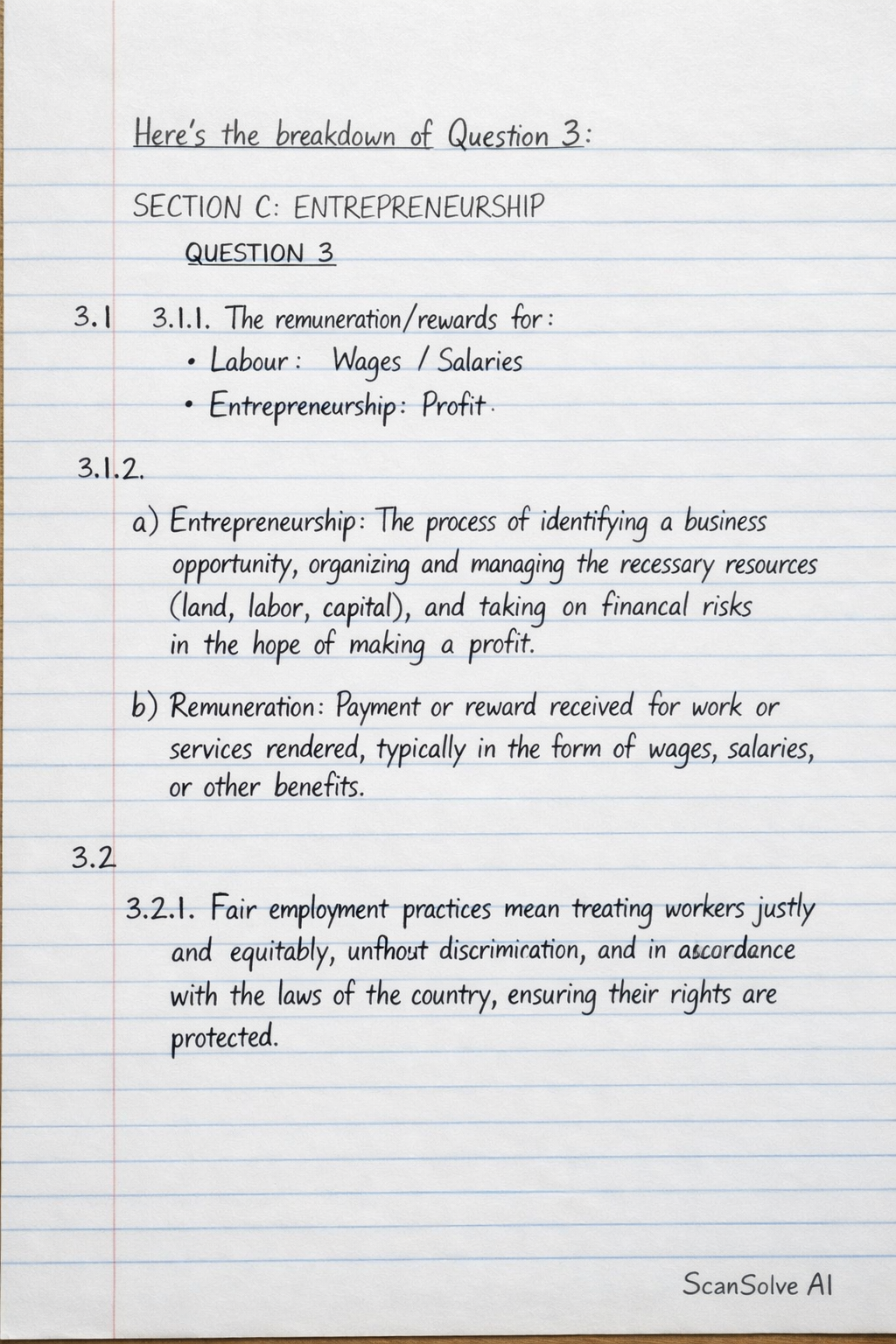
Here's the breakdown of Question 3:
SECTION C: ENTREPRENEURSHIP
QUESTION 3
3.1
3.1.1. The remuneration/rewards for:
* Labour: Wages/Salaries
* Entrepreneurship: Profit
3.1.2.
a) Entrepreneurship: The process of identifying a business opportunity, organizing and managing the necessary resources (land, labor, capital), and taking on financial risks in the hope of making a profit.
b) Remuneration: Payment or reward received for work or services rendered, typically in the form of wages, salaries, or other benefits.
3.2
3.2.1. Fair employment practices mean treating workers justly and equitably, without discrimination, and in accordance with the laws of the country, ensuring their rights are protected.
3.2.2.
a) Own capital: This refers to the funds contributed by the owner(s) of a business from their personal savings or assets.
* Example: An owner investing R50,000 of their personal savings to start a new business.
b) Semi-skilled labour: This describes workers who possess some level of training or experience, allowing them to perform tasks that require more than basic physical effort but less specialized knowledge than skilled labour.
* Example: A machine operator in a factory.
3.2.3. Two reasons why fair employment practices are important: * Fairly treated employees are more likely to be loyal and productive, becoming better assets to the business. * Unfair treatment can lead to a loss of customers and financial losses for the business, as well as being illegal in South Africa.
3.2.4. The importance of the following factors of production:
a) Labour: Labour is crucial because it provides the human effort, skills, and knowledge necessary to transform raw materials into finished goods and services. Without labour, other factors of production cannot be effectively utilized, and businesses cannot operate.
b) Land: Land is important as it provides the physical space for business operations, such as factories, offices, or farms. It also encompasses all natural resources (e.g., minerals, water, fertile soil) that are essential raw materials for production.
Still stuck on this one?
Ask a follow-up, and the answer starts from this question.
More Business/Management Questions
Handwritten Step-by-Step Solution
Get this as a handwritten image on WhatsApp — like a tutor wrote it for you.
Try on WhatsApp