
We read your photo as:
Explain entrepreneurship, its types, and its importance, using Mr. Joseph's situation as an example.
ScanSolve AI Answer
-
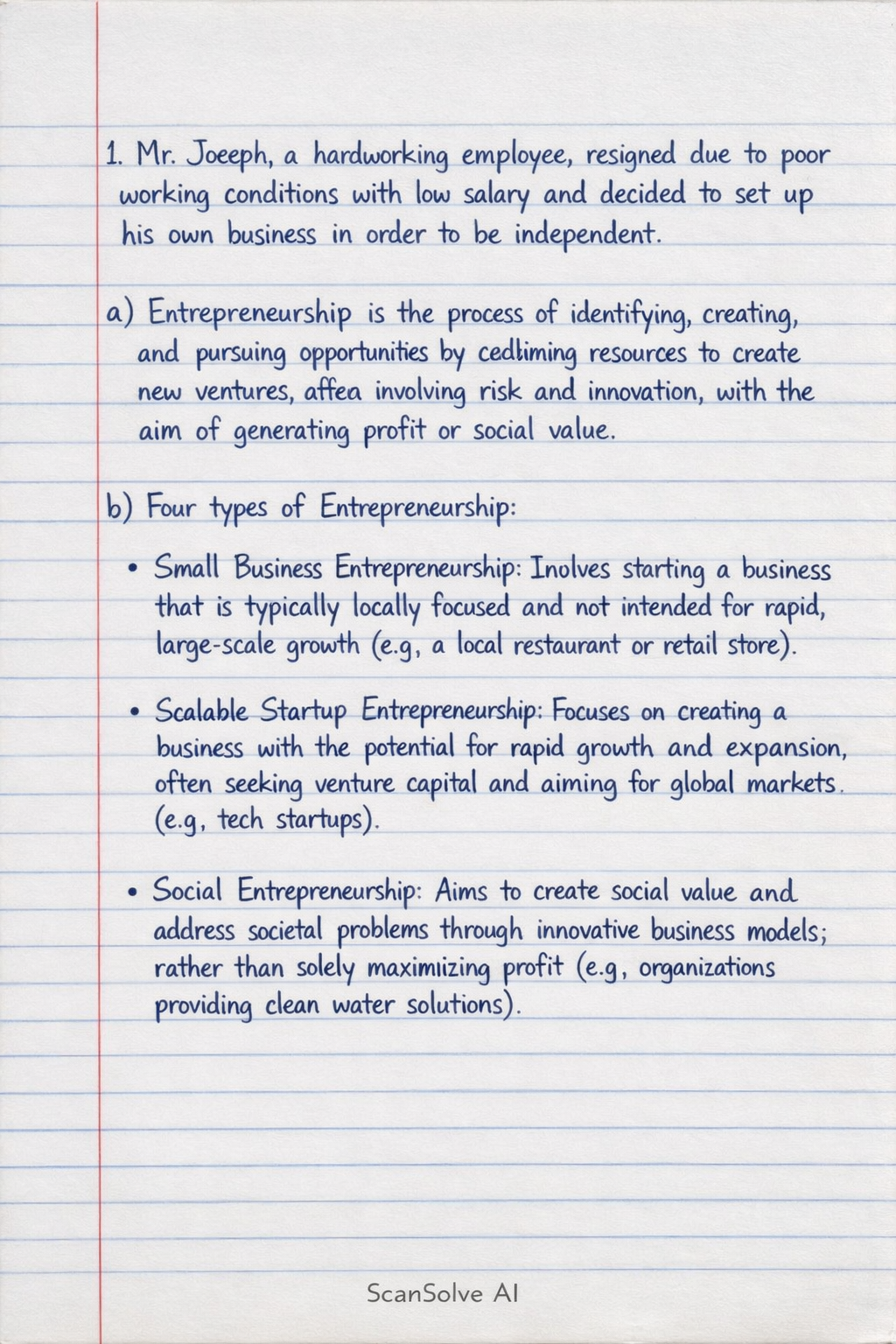
Mr. Joseph, a hardworking employee resigned due to poor working conditions with low salary and decided to set up his own business in order to be independent.
-
a) Entrepreneurship is the process of identifying, creating, and pursuing opportunities by combining resources to create new ventures, often involving risk and innovation, with the aim of generating profit or social value.
-
b) Four types of Entrepreneurship:
- Small Business Entrepreneurship: Involves starting a business that is typically locally focused and not intended for rapid, large-scale growth (e.g., a local restaurant or retail store).
- Scalable Startup Entrepreneurship: Focuses on creating a business with the potential for rapid growth and expansion, often seeking venture capital and aiming for global markets (e.g., tech startups).
- Social Entrepreneurship: Aims to create social value and address societal problems through innovative business models, rather than solely maximizing profit (e.g., organizations providing clean water solutions).
- Intrapreneurship: Refers to entrepreneurial activities undertaken by employees within an existing large organization, leading to new products, services, or processes for the company.
-
c) Four importance of Entrepreneurship to Mr. Joseph:
- Independence/Autonomy: He gains control over his work and decisions.
- Higher income potential: Opportunity to earn more than his previous low salary.
- Job satisfaction: He can pursue his passion and work in better conditions.
- Personal growth: Develops new skills and experiences as a business owner.
-
d)
-
i) Four entrepreneurial challenges Mr. Joseph might face:
- Lack of capital/funding: Securing sufficient funds to start and sustain the business.
- Intense competition: Facing established businesses or new entrants in the market.
- Market uncertainty: Difficulty in predicting customer demand and market trends.
- Regulatory hurdles: Navigating complex legal and administrative requirements for business registration and operation.
-
ii) Three ways some of these challenges can be overcome:
- For lack of capital: Develop a detailed business plan to attract investors or secure loans, and explore bootstrapping or crowdfunding options.
- For intense competition: Differentiate the business by offering unique products/services, superior customer service, or targeting a niche market.
- For market uncertainty: Conduct thorough market research to understand customer needs and preferences, and start with a minimum viable product to test the market.
-
-
-
Enterprises are created by entrepreneurs in order to achieve their vision.
-
a) An enterprise is an organization, typically a business, that is formed for a specific purpose, often to produce goods or services for profit or to achieve a particular social objective.
-
b) Three characteristics of an enterprise:
- Risk-bearing: Enterprises operate in an environment of uncertainty and must be prepared to take financial and operational risks.
- Innovation: Enterprises often introduce new products, services, or processes to gain a competitive advantage and meet evolving market demands.
- Resource mobilization: Enterprises combine various factors of production, such as human, financial, and physical resources, to achieve their objectives.
-
c) The five phases of an entrepreneurial project:
- Idea Generation: The initial stage where potential business opportunities are identified and new concepts are conceived.
- Feasibility Study: An in-depth evaluation of the business idea to determine its viability from technical, market, financial, and organizational perspectives.
- Business Plan Development: The creation of a comprehensive document outlining the business's objectives, strategies, operations, and financial projections.
- Resource Mobilization/Startup: The process of acquiring necessary capital, human resources, and physical assets, and formally establishing the business entity.
- Launch and Growth: The stage where the product or service is introduced to the market, operations begin, and the business focuses on scaling and expansion.
-
d)
-
i) Three major resources of an enterprise in Cameroon:
- Human Resources: The skilled and unskilled labor force available for employment.
- Natural Resources: Raw materials such as agricultural products (e.g., cocoa, coffee), timber, and minerals.
- Capital Resources: Financial capital, machinery, equipment, and infrastructure.
-
ii) Four social roles of an enterprise:
- Job creation: Providing employment opportunities for individuals.
- Poverty reduction: Contributing to economic growth and improving living standards.
- Provision of goods and services: Meeting consumer needs and wants.
- Community development: Engaging in corporate social responsibility (CSR) initiatives and contributing to local infrastructure.
-
-
-
Entrepreneurs can generate business ideas from every opportunity.
-
I- Five characteristics of a good business opportunity:
- Timely: Addresses a current or emerging market need or trend.
- Attractive: Has a large enough market and potential for significant profitability.
- Durable: Sustainable over the long term, not just a fleeting trend.
- Achievable: Within the capabilities and resources of the entrepreneur to execute.
- Value-creating: Offers unique benefits or solutions that customers are willing to pay for.
-
II- Seven components of a good business plan:
- Executive Summary: A concise overview of the entire plan, highlighting the business concept, objectives, and key financial projections.
- Company Description: Provides details about the business, its mission, vision, legal structure, and the problems it aims to solve.
- Market Analysis: In-depth research on the target market, industry trends, customer demographics, and competitive landscape.
- Organization and Management: Outlines the organizational structure, management team, key personnel, and their roles and responsibilities.
- Service or Product Line: Describes the products or services offered, including their features, benefits, and any intellectual property.
- Marketing and Sales Strategy: Details how the business will attract, retain, and grow its customer base, including pricing, promotion, distribution, and sales tactics.
- Financial Projections: Presents detailed financial forecasts, including income statements, balance sheets, cash flow statements, and break-even analysis.
-
III- Differentiate between limited and unlimited liability company:
- A limited liability company (LLC) is a business structure where the personal assets of the owners (shareholders) are protected from the company's debts and legal liabilities. The owners' financial risk is limited to the amount of capital they have invested in the company.
- An unlimited liability company is a business structure (common in sole proprietorships and general partnerships) where the owners are personally responsible for all the company's debts and legal obligations. Their personal assets can be used to cover business liabilities if the business cannot pay them.
-
Still stuck on this one?
Ask a follow-up, and the answer starts from this question.
More Business/Management Questions
Handwritten Step-by-Step Solution
Get this as a handwritten image on WhatsApp — like a tutor wrote it for you.
Try on WhatsApp