
We read your photo as:
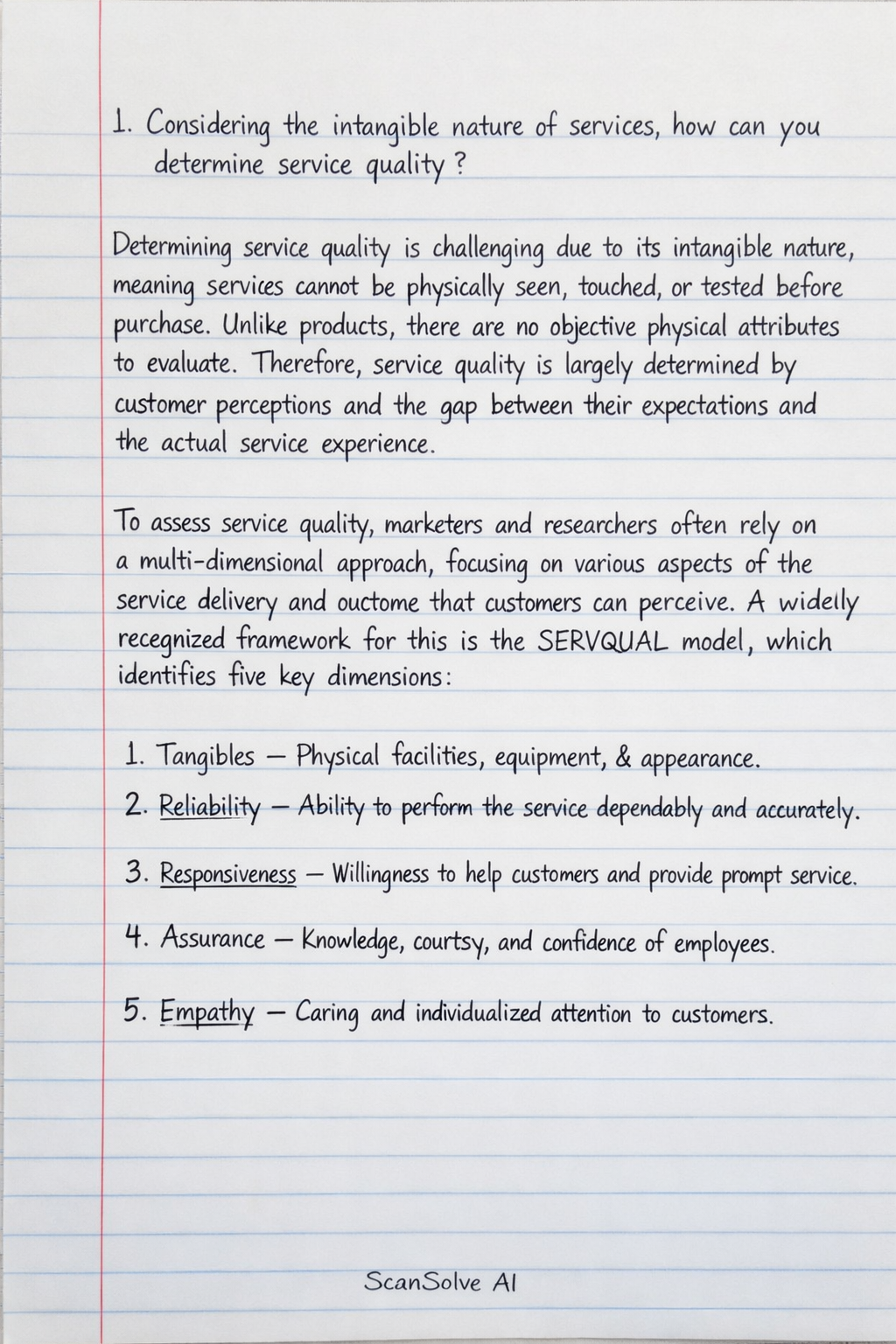
Considering the intangible nature of services, how can you determine service quality?
ScanSolve AI Answer
1. Considering the intangible nature of services, how can you determine service quality?
Determining service quality is challenging due to its intangible nature, meaning services cannot be physically seen, touched, or tested before purchase. Unlike products, there are no objective physical attributes to evaluate. Therefore, service quality is largely determined by customer perceptions and the gap between their expectations and the actual service experience.
To assess service quality, marketers and researchers often rely on a multi-dimensional approach, focusing on various aspects of the service delivery and outcome that customers can perceive. A widely recognized framework for this is the SERVQUAL model, which identifies five key dimensions:
- Reliability: This refers to the ability to perform the promised service dependably and accurately. Customers assess if the service is delivered correctly the first time, every time, and if promises are kept. For example, a bank processing a transaction accurately or a bus arriving on schedule.
- Responsiveness: This is the willingness to help customers and provide prompt service. It involves how quickly and efficiently service providers respond to customer requests, inquiries, or problems. For example, a customer service representative answering calls without long waits or a restaurant serving food in a timely manner.
- Assurance: This relates to the knowledge and courtesy of employees and their ability to inspire trust and confidence. Customers evaluate the competence, credibility, and security provided by the service staff. For example, a doctor's expertise or a mechanic's honest advice.
- Empathy: This involves the caring, individualized attention provided to customers. It focuses on understanding the customer's needs and providing personalized service. For example, a hotel staff member remembering a guest's preferences or a teacher providing individual support to a student.
- Tangibles: Although services are intangible, there are often physical cues associated with their delivery. This dimension refers to the appearance of physical facilities, equipment, personnel, and communication materials. These tangible elements provide concrete evidence of the service quality. For example, a clean and modern clinic, well-dressed staff, or clear and professional brochures.
In essence, service quality is determined by measuring the difference between what customers expect from a service and their perceptions of the service they actually receive across these dimensions. A positive gap (perceptions exceed expectations) indicates high quality, while a negative gap (expectations exceed perceptions) indicates poor quality. Companies gather this information through surveys, feedback forms, direct observation, and complaint analysis to continuously monitor and improve their service offerings.
Still stuck on this one?
Ask a follow-up, and the answer starts from this question.
More Business/Management Questions
Handwritten Step-by-Step Solution
Get this as a handwritten image on WhatsApp — like a tutor wrote it for you.
Try on WhatsApp