
We read your photo as:
Construct a Pareto chart to represent the expenditure of a household with the following details: Food Rs. 800, Clothing Rs. 500, Education Rs. 400, Fuel Rs. 200, Misc. Rs. 100.
Business/Management
ScanSolve AI Answer
Answer
To represent the data by a Pareto chart, we first need to calculate the percentage of expenditure for each item and then sort them in descending order. After that, we calculate the cumulative percentage.
Step-by-step solution
4 stepsCalculate the total expenditure.
Total expenditure Rs.
Calculate the percentage of expenditure for each item.
- Food:
- Clothing:
- Education:
- Fuel:
- Misc.:
Sort the items in descending order of expenditure and calculate the cumulative percentage.
Construct the Pareto chart.
A Pareto chart is a bar chart where the bars are arranged in descending order of frequency or cost, combined with a line graph that shows the cumulative percentage.
- The x-axis would list the items in the order: Food, Clothing, Education, Fuel, Misc.
- The left y-axis would represent the expenditure in Rupees, ranging from 0 to 800. Bars would be drawn for each item corresponding to its expenditure.
- The right y-axis would represent the cumulative percentage, ranging from 0% to 100%. A line graph would be plotted using the cumulative percentages for each item.
The table above provides all the necessary data to construct the Pareto chart.
Was this helpful?
Still stuck on this one?
Ask a follow-up, and the answer starts from this question.
Got a different question?Ask your own question
More Business/Management Questions
QCreate a Pareto chart for the given expenditure data, showing the percentage of total expenditure…QA pie chart shows the expenditure of a household. Food expenditure is represented by angle x…QCalculate the item with the highest expenditure and the fraction spent on clothing, given the income…QCalculate the angles for each expenditure category for Family A to create a pie diagram.QThe Smith family has an annual income of Gh¢15,000.00. They planned to budget it in the following…
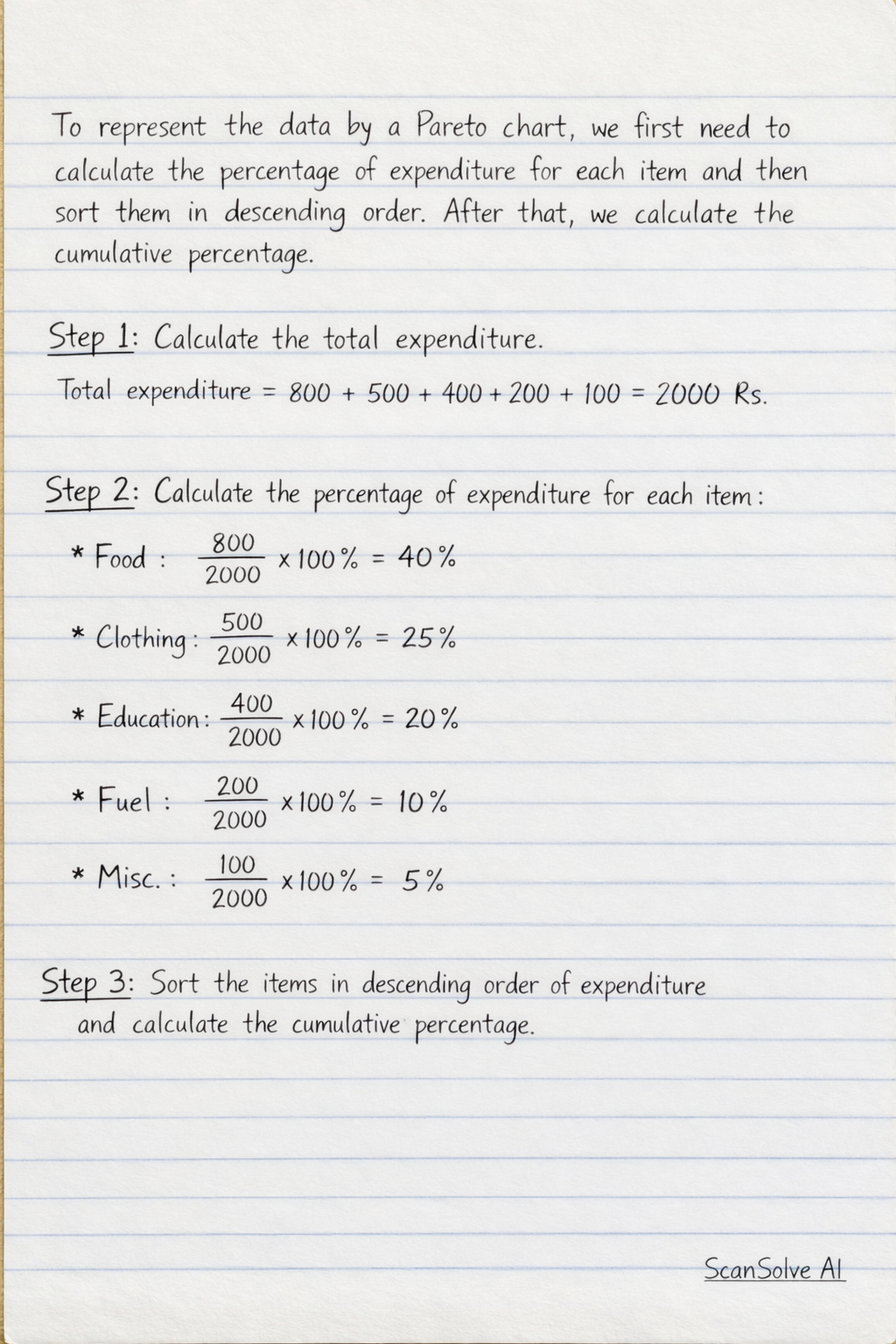
Handwritten Step-by-Step Solution
Get this as a handwritten image on WhatsApp — like a tutor wrote it for you.
Try on WhatsApp