
We read your photo as:
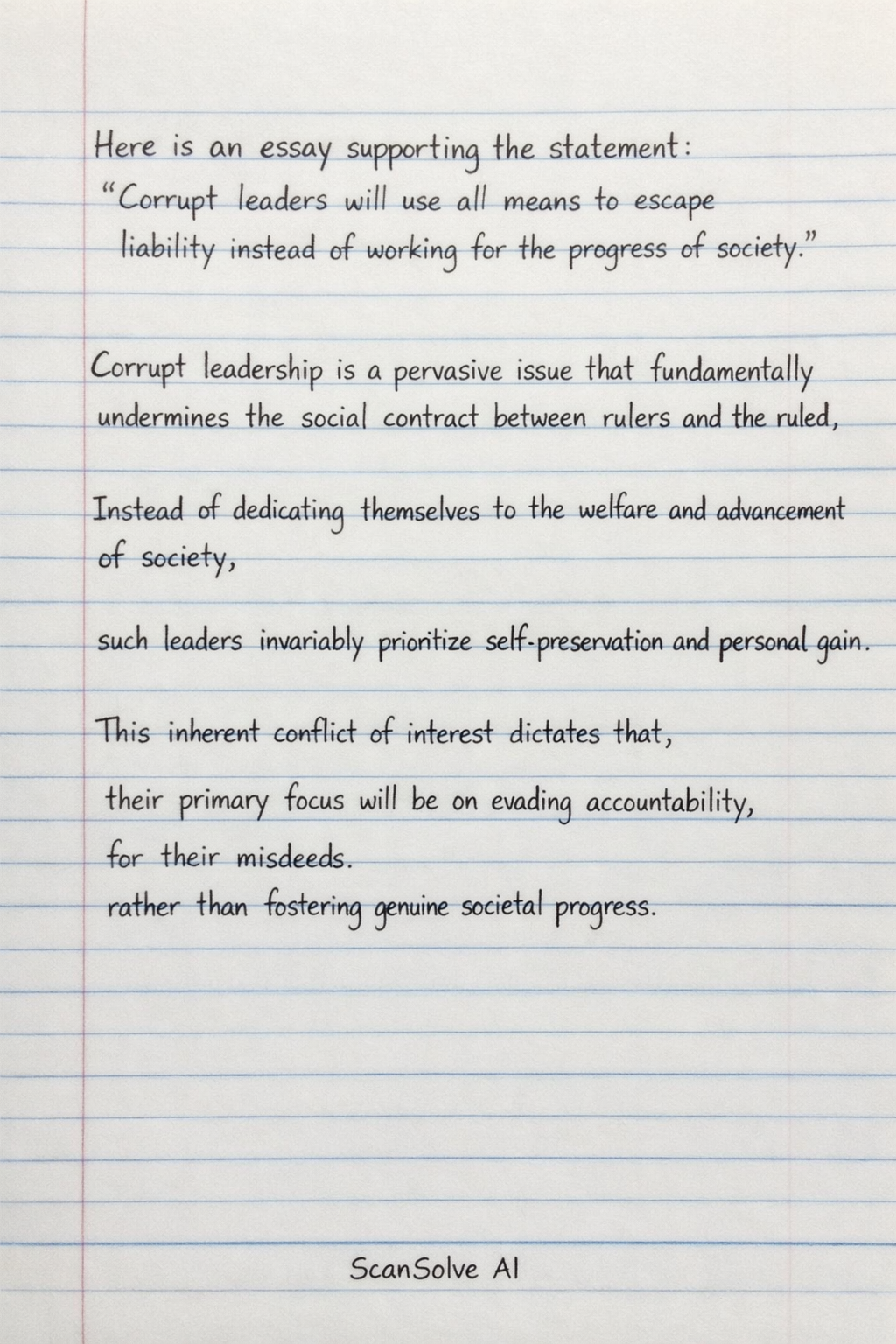
Corrupt leadership is a pervasive issue that fundamentally undermines the social contract between rulers and the ruled. Instead of dedicating themselves to the welfare and advancement of society, such
ScanSolve AI Answer
Here is an essay supporting the statement: "Corrupt leaders will use all means to escape liability instead of working for the progress of society."
Corrupt leadership is a pervasive issue that fundamentally undermines the social contract between rulers and the ruled. Instead of dedicating themselves to the welfare and advancement of society, such leaders invariably prioritize self-preservation and personal gain. This inherent conflict of interest dictates that their primary focus will be on evading accountability for their misdeeds, rather than fostering genuine societal progress.
One of the most common tactics employed by corrupt leaders to escape liability is the manipulation of legal and political systems. They may exert undue influence over the judiciary, ensuring that investigations into their actions are stifled or that favorable verdicts are rendered. Control over legislative bodies allows them to enact laws that protect their interests or grant them immunity. Furthermore, they often suppress independent media and dissent, preventing public scrutiny and the exposure of their illicit activities. Resources that should be allocated to strengthening democratic institutions are instead diverted to fortify their personal power base, creating a shield against any form of accountability.
This relentless pursuit of self-preservation inevitably leads to the neglect of societal progress. Funds earmarked for critical public services such as education, healthcare, and infrastructure development are often embezzled or misdirected into private accounts. The energy and focus of the government become centered on maintaining the corrupt leader's grip on power, rather than on implementing policies that would genuinely benefit the populace. This results in economic stagnation, a decline in living standards, and a widening gap between the rich and the poor, as the nation's potential is squandered for the benefit of a select few.
The long-term impact of such leadership is devastating for citizens and institutions alike. Public trust in government erodes, leading to cynicism and disengagement. The rule of law is weakened, fostering a culture of impunity where corruption becomes normalized. Talented individuals may leave the country, and foreign investment can be deterred, further hindering development. Ultimately, corrupt leaders, by prioritizing their escape from liability, create a cycle of underdevelopment and injustice that traps their societies in a state of perpetual struggle, far removed from any meaningful progress.
In conclusion, the actions of corrupt leaders consistently demonstrate a clear preference for personal gain and the evasion of responsibility over the genuine advancement of their society. Their strategies for escaping liability, from manipulating legal systems to suppressing dissent, directly divert resources and attention away from national development. This behavior is a fundamental barrier to progress, ensuring that the well-being of the nation remains secondary to the self-serving interests of its leadership.
Still stuck on this one?
Ask a follow-up, and the answer starts from this question.
More Business/Management Questions
Handwritten Step-by-Step Solution
Get this as a handwritten image on WhatsApp — like a tutor wrote it for you.
Try on WhatsApp