
We read your photo as:
Discuss five ethical practices businesses should observe, and explain five stages involved in starting a small business.
Business/Management
ScanSolve AI Answer
Here are the answers to your questions:
b) Discuss five ethical practices that businesses should observe.
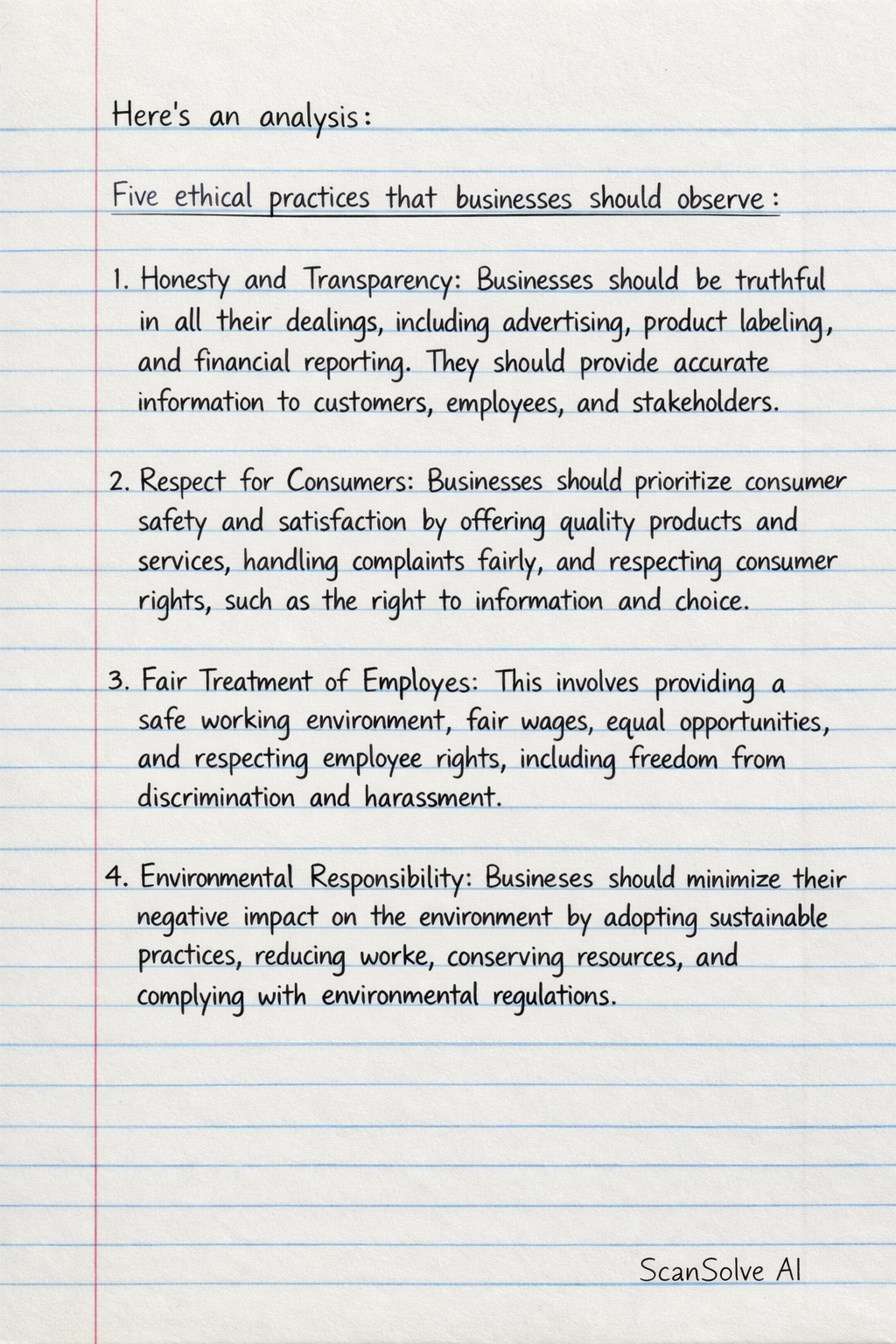
- Honesty and Transparency: Businesses should be truthful in all their dealings, including advertising, product labeling, and financial reporting. They should provide accurate information to customers, employees, and stakeholders.
- Respect for Consumers: Businesses should prioritize consumer safety and satisfaction by offering quality products and services, handling complaints fairly, and respecting consumer rights, such as the right to information and choice.
- Fair Treatment of Employees: This involves providing a safe working environment, fair wages, equal opportunities, and respecting employee rights, including freedom from discrimination and harassment.
- Environmental Responsibility: Businesses should minimize their negative impact on the environment by adopting sustainable practices, reducing waste, conserving resources, and complying with environmental regulations.
- Community Engagement and Social Responsibility: Businesses should contribute positively to the communities in which they operate through initiatives like philanthropy, local employment, and supporting community development projects.
5.a) Explain five stages involved in starting a small business.
- Idea Generation and Feasibility Study: This initial stage involves identifying a business idea, researching its potential, and conducting a feasibility study to assess market demand, competition, financial viability, and operational requirements.
- Business Planning: Once the idea is deemed feasible, a comprehensive business plan is developed. This document outlines the business goals, strategies, market analysis, financial projections, and operational details.
- Sourcing Capital: This stage involves identifying and securing the necessary funds to start and operate the business. Sources can include personal savings, bank loans, grants, venture capital, or crowdfunding.
- Legal Registration and Compliance: The entrepreneur must register the business with relevant authorities (e.g., Registrar of Companies), obtain necessary licenses and permits, and comply with all legal and regulatory requirements.
- Setting up Operations and Launch: This final stage involves acquiring premises, purchasing equipment, hiring staff, setting up supply chains, marketing the business, and officially launching operations to serve customers.
b) Discuss five ways in which consumers are protected in Kenya.
- Consumer Protection Act: Kenya has a Consumer Protection Act that provides a legal framework for safeguarding consumer rights, including the right to safety, information, choice, and redress. It prohibits unfair trade practices.
- Regulatory Bodies: Various government agencies, such as the Kenya Bureau of Standards (KEBS) and the Communications Authority of Kenya (CAK), set and enforce standards for product quality, safety, and service delivery.
- Consumer Organizations: Non-governmental organizations (NGOs) and consumer associations advocate for consumer rights, educate the public, and provide platforms for consumers to voice complaints and seek assistance.
- Legal Recourse and Courts: Consumers have the right to seek legal redress through courts or tribunals for damages or losses incurred due to faulty products, misleading advertising, or unfair business practices.
- Product Labeling and Information Requirements: Laws mandate that products must have clear and accurate labels, including ingredients, expiry dates, usage instructions, and warnings, enabling consumers to make informed choices.
Was this helpful?
Still stuck on this one?
Ask a follow-up, and the answer starts from this question.
Got a different question?Ask your own question
More Business/Management Questions
QHere is the outline of Section B: Practical Tasks Task 1: You are required to formulate a business…QWhat does time management mean? State TWO characteristics of an entrepreneur that could contribute…QHow to set up a business(the entrepreneurship processQDiscuss five ways a business interacts with its external environment to improve operations. Identify…QWhat is a business plan and describe briefly TEN (10) primary purposes of a business plan? List FIVE…
Browse by topic:Business
Handwritten Step-by-Step Solution
Get this as a handwritten image on WhatsApp — like a tutor wrote it for you.
Try on WhatsApp