
We read your photo as:
Discuss the different channels that can be used to pass on information in organizations. Explain the factors that impede the exchange of information in any organization. State the importance of Clarity Business Writing; in business. Define memo. Explain its importance. Explain Agenda in detail.
ScanSolve AI Answer
I will provide the answers for Section D - Communication, as requested from the picture.
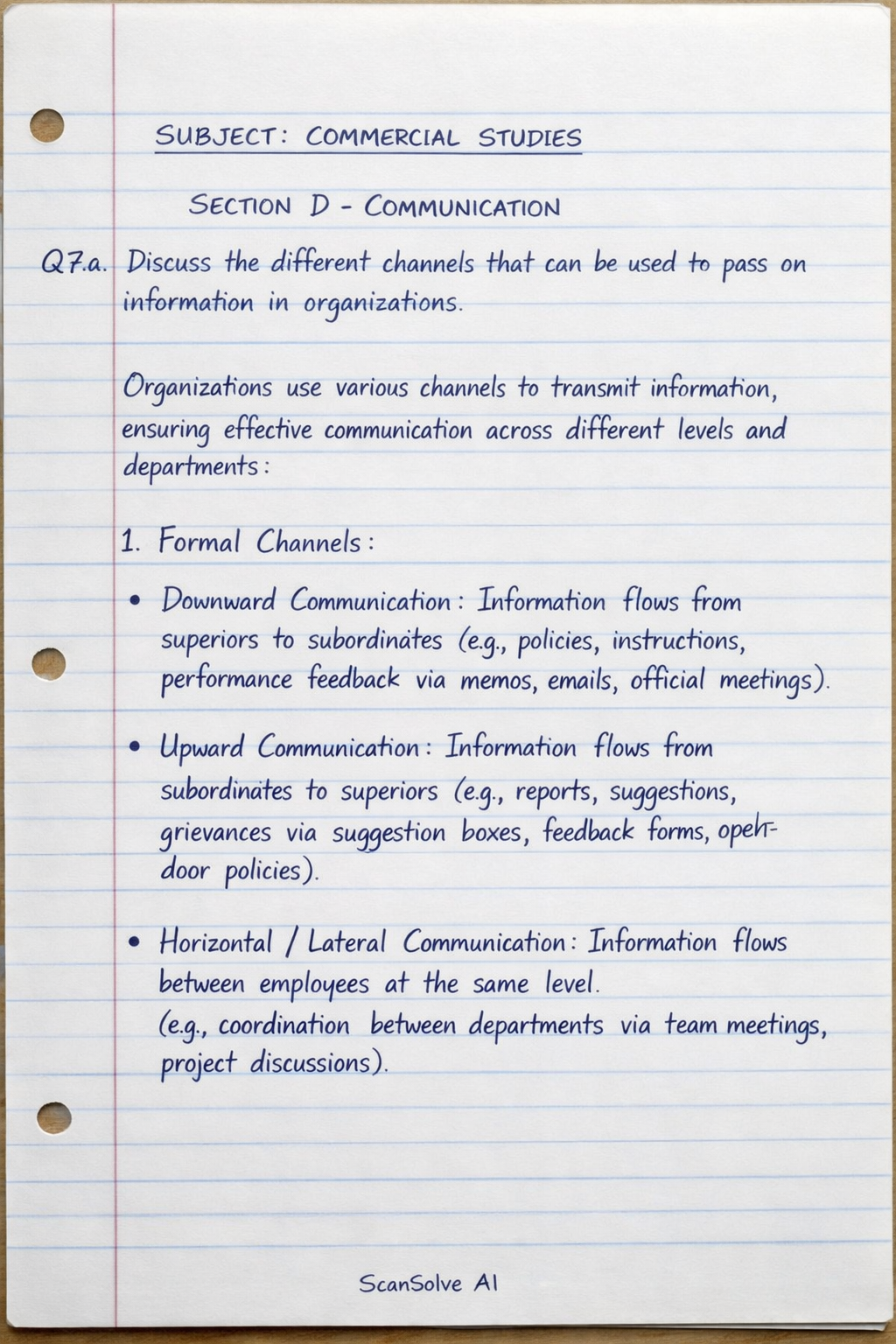
SUBJECT: COMMERCIAL STUDIES
SECTION D - COMMUNICATION
Q7.a. Discuss the different channels that can be used to pass on information in organizations.
Organizations use various channels to transmit information, ensuring effective communication across different levels and departments:
- Formal Channels: These follow the official hierarchy and structure of the organization.
- Downward Communication: Information flows from superiors to subordinates (e.g., policies, instructions, performance feedback via memos, emails, official meetings).
- Upward Communication: Information flows from subordinates to superiors (e.g., reports, suggestions, grievances via suggestion boxes, feedback forms, open-door policies).
- Horizontal/Lateral Communication: Information flows between employees at the same hierarchical level (e.g., coordination between departments via team meetings, project discussions).
- Diagonal Communication: Information flows between employees at different levels but in different departments (e.g., a marketing manager communicating with a production supervisor).
- Informal Channels (Grapevine): This is an unofficial network of communication that arises from social interactions among employees. While often fast, it can be prone to inaccuracies. It includes casual conversations, rumours, and social gatherings.
Q7.b. Explain the factors that impede the exchange of information in any organization.
Several factors can hinder the effective exchange of information within an organization, leading to miscommunication and inefficiency:
- Semantic Barriers: Differences in language, jargon, or interpretation of words can lead to misunderstandings. Technical terms might not be understood by non-specialists.
- Psychological Barriers: Emotional states, prejudices, selective perception, or lack of attention can distort messages. A sender's attitude or a receiver's defensiveness can block effective listening.
- Organizational Barriers: Poor organizational structure, unclear roles, excessive layers of hierarchy, or lack of proper communication policies can impede information flow. Information can get lost or distorted as it passes through many levels.
- Physical Barriers: Noise, distance between communicators, faulty equipment, or poor timing can disrupt communication. For example, a noisy environment makes verbal communication difficult.
- Information Overload: When employees receive too much information, they may struggle to process it all, leading to important messages being overlooked or ignored.
- Lack of Trust: If there is a lack of trust between sender and receiver, messages may be viewed with suspicion, leading to misinterpretation or reluctance to share information.
Q8.a. State the importance of Clarity in Business Writing in business.
Clarity in business writing is paramount because it ensures that messages are easily understood, preventing misinterpretations and fostering efficient operations. Its importance includes:
- Prevents Misunderstanding: Clear writing leaves no room for ambiguity, ensuring the reader grasps the intended message precisely.
- Saves Time and Resources: When instructions or information are clear, less time is spent on clarifications, rework, or correcting errors caused by confusion.
- Enhances Professionalism: Well-written, clear communication reflects positively on the individual and the organization, building credibility and trust.
- Facilitates Decision-Making: Clear reports, proposals, and analyses provide decision-makers with accurate and digestible information, leading to better strategic choices.
- Improves Productivity: Employees can perform tasks more effectively and efficiently when they receive clear instructions and understand their roles and responsibilities.
Q8.b. Define memo. Explain its importance.
- Definition of Memo: A memo (short for memorandum) is a concise, informal, and internal written communication used within an organization to convey information, instructions, or announcements to a specific group of employees. It typically has a standard format including "To," "From," "Date," and "Subject" lines.
- Importance of Memo: Memos are crucial for internal communication due to several reasons:
- Official Record: They provide a written record of decisions, policies, or instructions, which can be referenced later.
- Efficiency: Memos are quick to write and distribute, making them ideal for conveying urgent or routine information to multiple recipients simultaneously.
- Clarity and Conciseness: Their structured format encourages clear, direct, and brief communication, reducing ambiguity.
- Cost-Effective: Compared to formal letters or meetings, memos are a cost-effective way to disseminate information internally.
- Reinforces Policies: They are effective for announcing new policies, procedures, or changes, ensuring all relevant staff are informed.
Q8.c. Explain Agenda in detail.
- Explanation of Agenda: An agenda is a list of items or topics to be discussed or acted upon at a formal meeting. It serves as a roadmap for the meeting, outlining the sequence of discussions and the objectives to be achieved. A well-prepared agenda is typically circulated to participants in advance of the meeting.
- Components of a Detailed Agenda:
- Meeting Title: Clearly states the purpose or name of the meeting (e.g., "Quarterly Sales Review Meeting").
- Date, Time, and Location: Specifies when and where the meeting will take place.
- Attendees: Lists the expected participants or indicates the target audience.
- Call to Order: The formal start of the meeting.
- Approval of Previous Minutes: A standard item to review and approve the record of the last meeting.
- Matters Arising: Discussion of any action points or unfinished business from previous meetings.
- Main Discussion Items: A numbered list of topics to be covered, often with a brief description, the name of the person responsible for leading the discussion, and an allocated time slot for each.
- Any Other Business (AOB): A slot for minor issues or new topics that arise during the meeting, usually introduced at the end.
- Date of Next Meeting: Sets the schedule for future gatherings.
- Adjournment: The formal end of the meeting.
- Importance of an Agenda:
- Focus and Direction: Keeps the meeting on track and ensures all critical topics are addressed.
- Preparation: Allows participants to prepare adequately for discussions, bringing relevant information or data.
- Time Management: Helps in allocating time efficiently to each item, preventing meetings from running over schedule.
- Efficiency: Ensures productive discussions and clear outcomes, as everyone knows what needs to be achieved.
- Record Keeping: Forms part of the official documentation of the meeting, alongside the minutes.
Still stuck on this one?
Ask a follow-up, and the answer starts from this question.
More Business/Management Questions
Handwritten Step-by-Step Solution
Get this as a handwritten image on WhatsApp — like a tutor wrote it for you.
Try on WhatsApp