

This business/management problem is solved step by step below, with detailed explanations to help you understand the method and arrive at the correct answer.
ScanSolve AI Answer
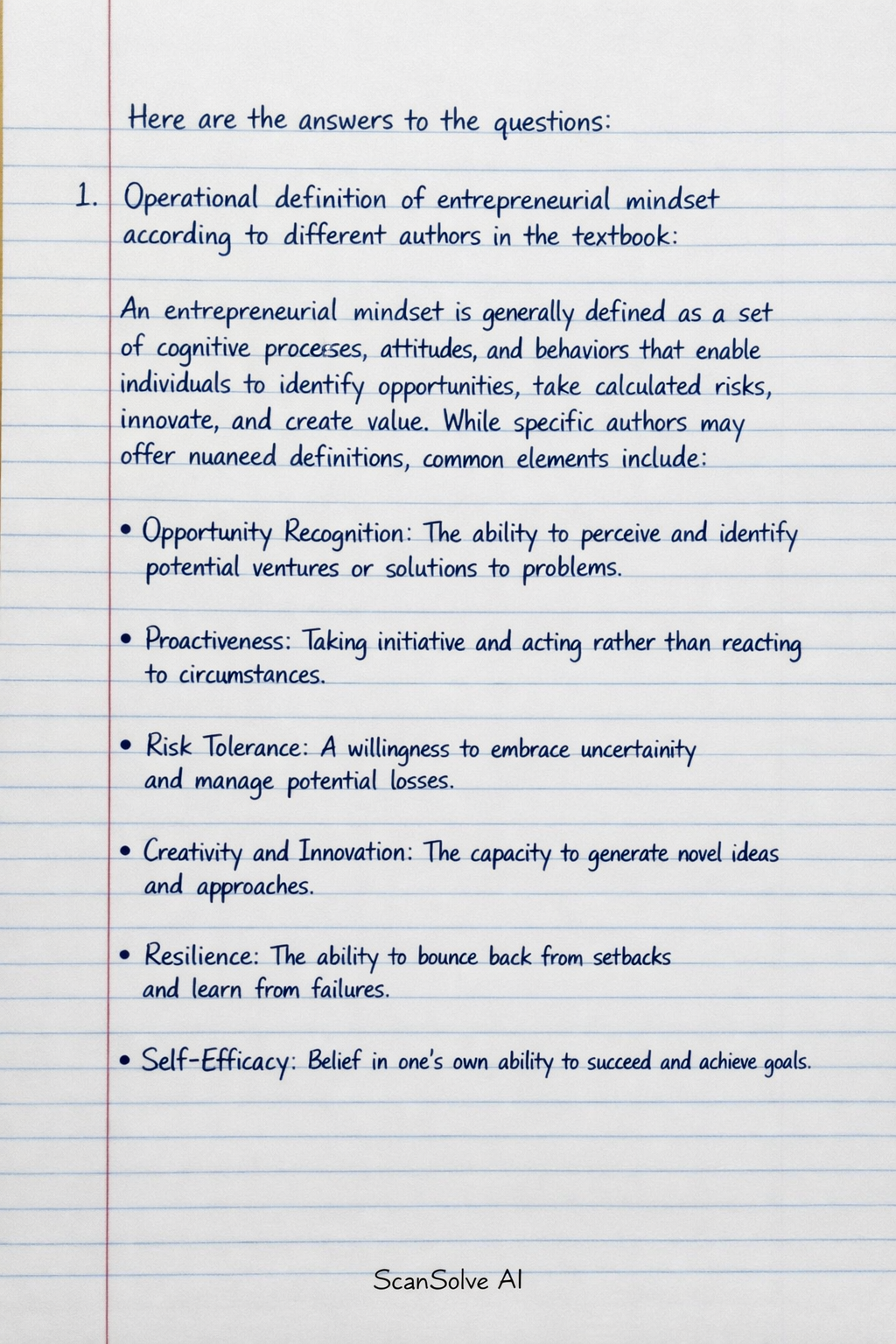
Here are the answers to the questions: 1. Operational definition of entrepreneurial mindset according to different authors in the textbook: An entrepreneurial mindset is generally defined as a set of cognitive processes, attitudes, and behaviors that enable individuals to identify opportunities, take calculated risks, innovate, and create value. While specific authors may offer nuanced definitions, common elements include: Opportunity Recognition: The ability to perceive and identify potential ventures or solutions to problems. Proactiveness: Taking initiative and acting rather than reacting to circumstances. Risk Tolerance: A willingness to embrace uncertainty and manage potential losses. Creativity and Innovation: The capacity to generate novel ideas and approaches. Resilience: The ability to bounce back from setbacks and learn from failures. Self-Efficacy: Belief in one's own ability to succeed and achieve goals. 2. The three dimensions of entrepreneurship and their major contents: The three commonly recognized dimensions of entrepreneurship are: Innovation: Major Contents: Developing new products, services, processes, technologies, or business models. This includes improving existing offerings, finding new markets, or creating novel ways to deliver value. It emphasizes creativity, problem-solving, and the introduction of something new or significantly improved. Risk-Taking: Major Contents: The willingness to commit resources (time, money, effort) to ventures with uncertain outcomes. This involves assessing and managing financial, personal, and market risks. It's about making decisions in the face of incomplete information and accepting the possibility of failure for the potential of significant gain. Proactiveness: Major Contents: Taking initiative, anticipating future needs, and acting ahead of competitors or market trends. This involves being forward-looking, seizing opportunities, and shaping the environment rather than merely responding to it. It reflects an aggressive posture towards market entry and competitive positioning. 3. Delimitations of entrepreneurial mindset: The delimitations of an entrepreneurial mindset define its scope and boundaries, distinguishing it from other mindsets. These include: Focus on Opportunity Creation: It primarily concerns the identification and exploitation of new opportunities, rather than solely managing existing operations. Tolerance for Ambiguity and Uncertainty: It operates effectively in environments characterized by high levels of unknown factors and incomplete information, unlike mindsets that prefer stability and predictability. Resource Scarcity: It often involves creating value with limited resources, requiring resourcefulness and bootstrapping, rather than relying on abundant established resources. Action-Oriented: It emphasizes taking action and experimenting, rather than extensive planning without execution. Not Solely Business Creation: While often associated with starting new businesses, an entrepreneurial mindset can also apply to innovation within existing organizations (intrapreneurship) or social ventures. Last free one today — make it count tomorrow, or type /upgrade for unlimited.