
We read your photo as:
What are five factors that influence the choice of a distribution channel?
Business/Management
ScanSolve AI Answer
a) Five factors that may influence the choice of a distribution channel are:
- Nature of the Product: The characteristics of the product significantly impact the channel choice. Perishable goods (e.g., fresh produce) require short, direct channels to minimize spoilage. Complex or custom-made products (e.g., industrial machinery) often need direct selling with technical support, while standardized consumer goods can use longer, indirect channels.
- Nature of the Market: The target market's size, geographic spread, and buying habits are crucial. A widely dispersed market with many small buyers might necessitate extensive indirect channels (wholesalers, retailers), whereas a concentrated market with few large buyers might favor direct sales.
- Company Objectives and Resources: A company's marketing objectives (e.g., market penetration, brand image) and available resources (financial, human, technological) influence its ability to manage different channels. A company with limited resources might rely on intermediaries, while a large company might prefer direct distribution for greater control.
- Competitors' Distribution Channels: Businesses often consider the channels used by their competitors. A company might choose to use similar channels to compete directly or opt for different channels to gain a competitive advantage or reach underserved segments.
- Cost of Distribution: The financial implications of different channels are a key consideration. Direct channels might involve higher initial investment in sales force and logistics but offer greater control and potentially higher margins. Indirect channels might have lower upfront costs but involve sharing margins with intermediaries.
b) Five features of a monopolistic market structure are:
- Many Buyers and Sellers: There are a large number of firms and consumers in the market, none of whom have a dominant share, but each firm has a small degree of market power over its specific product.
- Product Differentiation: Firms sell products that are similar but not identical. They differentiate their products through branding, quality, features, design, packaging, or associated services, making them unique in the eyes of consumers.
- Easy Entry and Exit: There are relatively low barriers to entry and exit for firms in the long run. New firms can enter the market if they see profit opportunities, and existing firms can leave if they are making losses.
- Non-Price Competition: Firms compete using methods other than price. This includes extensive advertising, sales promotions, branding, and product development to attract customers and build brand loyalty.
- Some Control Over Price: Due to product differentiation, each firm faces a downward-sloping demand curve for its specific product. This gives firms some degree of market power, allowing them to set prices slightly above marginal cost, unlike in perfect competition.
Was this helpful?
Still stuck on this one?
Ask a follow-up, and the answer starts from this question.
Got a different question?Ask your own question
More Business/Management Questions
QWhat are 5 channels through which goods can be imported?QList five factors to consider when choosing a lubricant.QClassify the items below under department stores, sales promotion, transport and warehousing, and…QState and explain five factors that determine freight rate in sea transport.QWhat is the purpose of the distribution channels mentioned in the text?
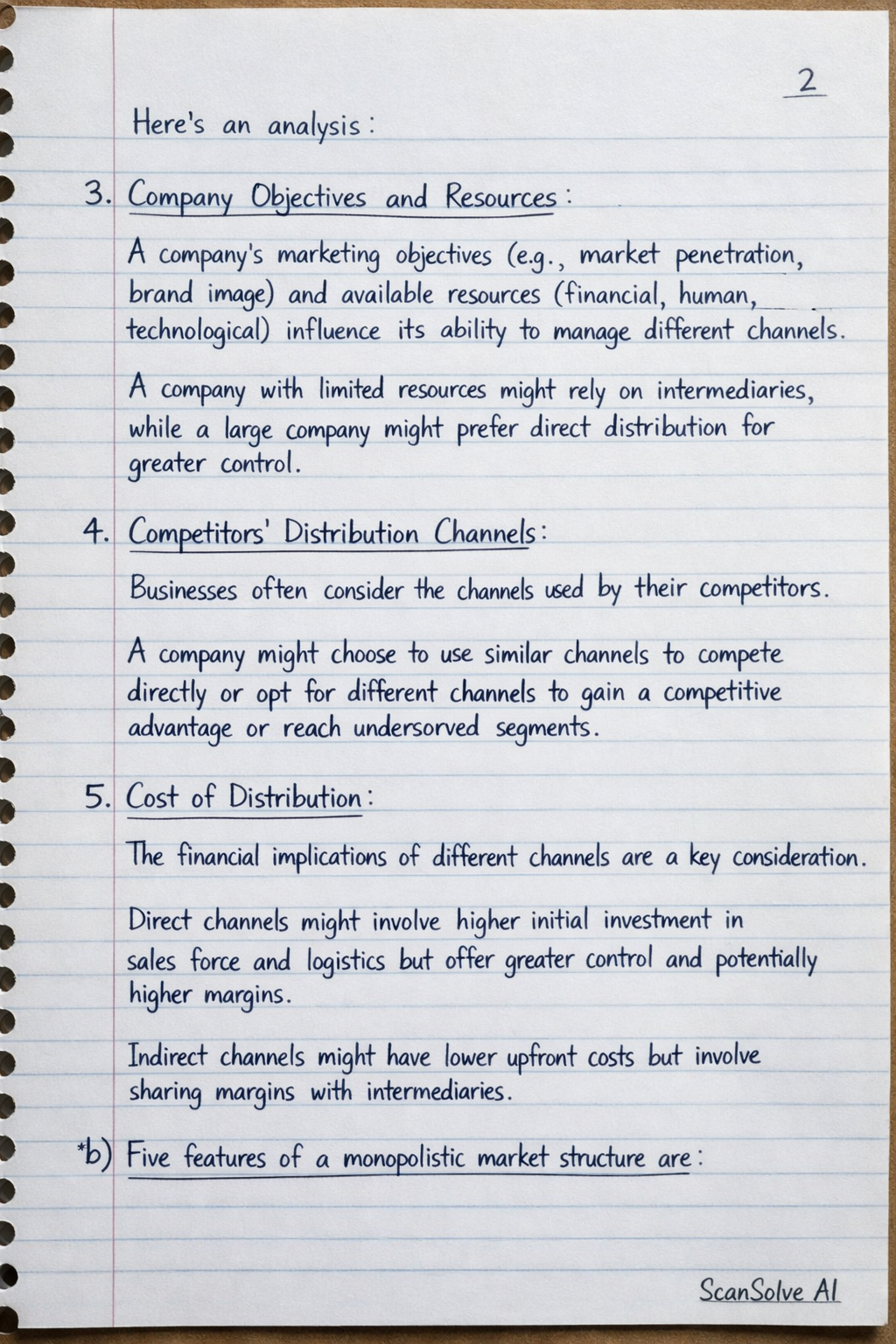
Handwritten Step-by-Step Solution
Get this as a handwritten image on WhatsApp — like a tutor wrote it for you.
Try on WhatsApp