
We read your photo as:
Describe four characteristics of Verbal Communication in a classroom and five forms of Non-Verbal signals a teacher can use.
Business/Management
ScanSolve AI Answer
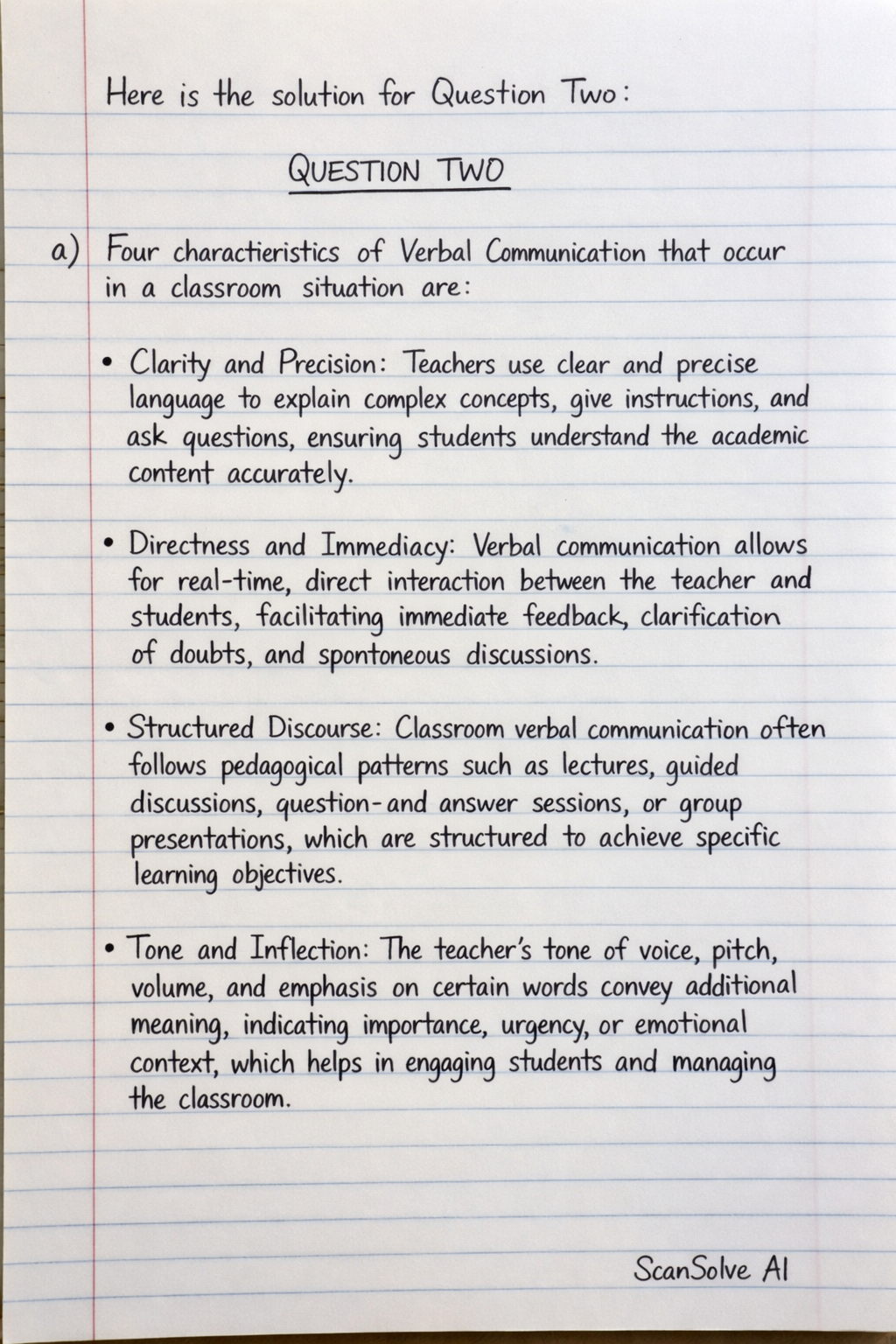
Here is the solution for Question Two:
QUESTION TWO
a) Four characteristics of Verbal Communication that occur in a classroom situation are:
- Clarity and Precision: Teachers use clear and precise language to explain complex concepts, give instructions, and ask questions, ensuring students understand the academic content accurately.
- Directness and Immediacy: Verbal communication allows for real-time, direct interaction between the teacher and students, facilitating immediate feedback, clarification of doubts, and spontaneous discussions.
- Structured Discourse: Classroom verbal communication often follows pedagogical patterns such as lectures, guided discussions, question-and-answer sessions, or group presentations, which are structured to achieve specific learning objectives.
- Tone and Inflection: The teacher's tone of voice, pitch, volume, and emphasis on certain words convey additional meaning, indicating importance, urgency, or emotional context, which helps in engaging students and managing the classroom.
b) Five forms of Non-Verbal signals that can be used by a classroom teacher to effectively deliver subject content to learners are:
- Eye Contact: A teacher can use eye contact to engage students, monitor their understanding, encourage participation, or subtly manage classroom behavior without interrupting the flow of the lesson.
- Facial Expressions: Expressions like a smile, a nod, a frown, or raised eyebrows can convey approval, confusion, encouragement, or disapproval, providing immediate feedback to students about their responses or behavior.
- Gestures: Hand movements, pointing, or shrugging can be used to emphasize key points, illustrate concepts (e.g., showing size or direction), direct attention to specific objects or areas, or encourage students to respond.
- Body Posture: A teacher's posture can project confidence, approachability, or authority. Standing tall and open can indicate readiness to teach, while leaning in can show attentiveness to a student's question.
- Proxemics (Use of Space): Moving around the classroom, standing near a particular student, or approaching a group can be used to manage attention, create a sense of presence, encourage participation from quieter students, or address disruptive behavior.
Was this helpful?
Still stuck on this one?
Ask a follow-up, and the answer starts from this question.
Got a different question?Ask your own question
More Business/Management Questions
Q4 How can you receive simple non-verbal instructions? 1.3 How can you use non-verbal means to convey…QList four functions of feedback and four types of formal communication.QExplain three reasons why listening is an important aspect of communication. State any three forms…QAs a first-grade teacher, you can use a variety of methods to teach vocabulary. Explain what skill…QWhich of the following are effective communication techniques?
Handwritten Step-by-Step Solution
Get this as a handwritten image on WhatsApp — like a tutor wrote it for you.
Try on WhatsApp