
We read your photo as:
Describe four features of mail order business. State five conditions that could lead to the dissolution of a cooperative society. List the following Acts: Sale of Goods Act; Foods and Drugs Act; Price control Act.
Business/Management
ScanSolve AI Answer
Step-by-step solution
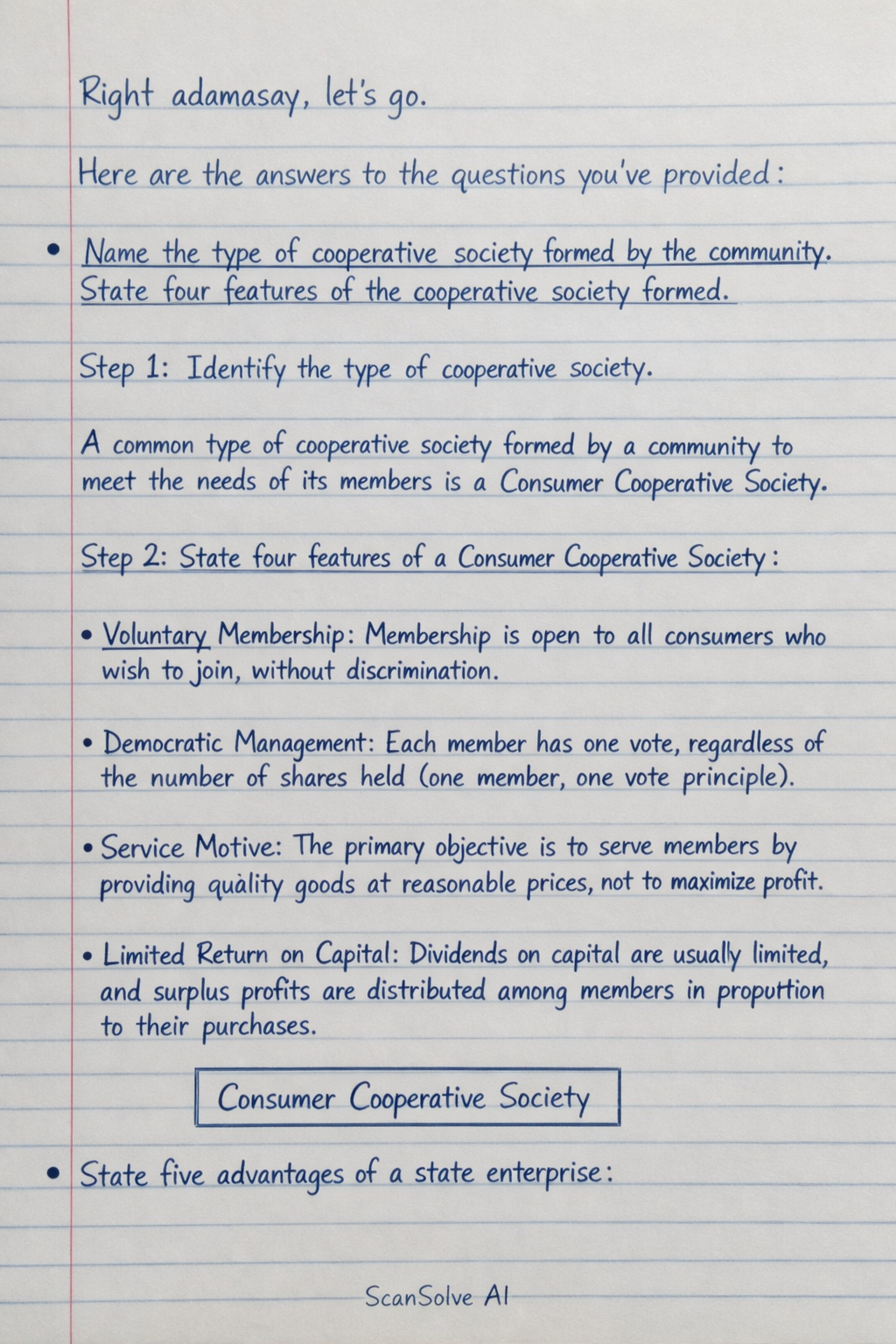
7 stepsHere are the answers to the questions you've provided:
- Name the type of cooperative society formed by the community. State four features of the cooperative society formed.
Identify the type of cooperative society.
A common type of cooperative society formed by a community to meet the needs of its members is a Consumer Cooperative Society.
State four features of a Consumer Cooperative Society.
- Voluntary Membership: Membership is open to all consumers who wish to join, without discrimination.
- Democratic Management: Each member has one vote, regardless of the number of shares held (one member, one vote principle).
- Service Motive: The primary objective is to serve members by providing quality goods at reasonable prices, not to maximize profit.
- Limited Return on Capital: Dividends on capital are usually limited, and surplus profits are distributed among members in proportion to their purchases.
- State five advantages of a state enterprise.
State five advantages of a state enterprise.
- Public Welfare: State enterprises prioritize public welfare and social objectives over profit maximization.
- Large-scale Operations: They can undertake large-scale projects requiring huge capital investments that private sectors might be unwilling or unable to fund.
- Strategic Importance: They operate in strategic sectors like defense, energy, and infrastructure, which are vital for national security and economic development.
- Employment Generation: State enterprises often create significant employment opportunities.
- Price Stability: They can help stabilize prices of essential goods and services, making them accessible to all segments of society.
- State five reasons small stores continue to exist despite markets. (Assuming "despite large markets" or "supermarkets")
State five reasons small stores continue to exist despite large markets/supermarkets.
- Personalized Service: Small stores often offer personalized attention and build strong relationships with customers.
- Convenience: They are typically located within residential areas, offering easy access for daily needs without long travel.
- Credit Facilities: Many small stores offer credit facilities to regular customers, which large stores rarely do.
- Specialized Products: They may stock niche or specialized products that large supermarkets do not carry.
- Community Hub: Small stores often serve as community gathering points, fostering a sense of local connection.
- State five features of mail order business.
State five features of mail order business.
- No Personal Contact: There is no direct personal interaction between the buyer and the seller.
- Reliance on Advertising: Sales are primarily generated through advertisements in newspapers, magazines, catalogs, or online platforms.
- Payment in Advance or COD: Customers typically pay in advance (e.g., online payment, money order) or through Cash on Delivery (COD).
- Delivery by Post/Courier: Goods are delivered directly to the customer's doorstep via postal services or courier companies.
- Wide Reach: It can cater to customers in geographically dispersed areas, including remote locations.
- State five conditions that could lead to the dissolution... (Assuming "dissolution of a partnership")
State five conditions that could lead to the dissolution of a partnership.
- Mutual Agreement: All partners agree to dissolve the partnership.
- Expiration of Term: The partnership was formed for a fixed period, and that period has expired.
- Completion of Venture: The partnership was formed for a specific venture or project, and that venture has been completed.
- Death of a Partner: The death of any partner can lead to the dissolution of the partnership, unless otherwise specified in the partnership agreement.
- Insolvency of a Partner: If a partner becomes insolvent, the partnership may be dissolved.
- the following Acts: Sale of Goods Act; Goods and Drugs Act; ... control Act;
Briefly explain the Sale of Goods Act and the Goods and Drugs Act.
- Sale of Goods Act: This act governs contracts for the sale of goods. It defines the rights and duties of buyers and sellers, and sets out implied conditions and warranties in a contract of sale, such as goods being of merchantable quality and fit for purpose.
- Goods and Drugs Act: This act (often referred to as Food and Drugs Act in many jurisdictions) regulates the manufacture, sale, and distribution of food, drugs, cosmetics, and medical devices to ensure their safety, quality, and proper labeling, protecting public health.
Was this helpful?
Still stuck on this one?
Ask a follow-up, and the answer starts from this question.
Got a different question?Ask your own question
More Business/Management Questions
QExplain 5 principles that distinguish cooperative societies from other forms of business…QUsing a well labeled diagram, explain how excess supply and excess demand is created in the market…QNataka maswali yajibiwe na kingeleza tafadhaliExplain 5 principles that distinguish cooperative…QWhat are four advantages of E-Commerce, four unethical issues in product promotion, and four…QJohn has been operating an electronic business, which has collapsed after 5 years of its operation…
Handwritten Step-by-Step Solution
Get this as a handwritten image on WhatsApp — like a tutor wrote it for you.
Try on WhatsApp