
We read your photo as:
Describe four ways young people can manage their social media footprint and analyse two negative implications of social media use during work.
ScanSolve AI Answer
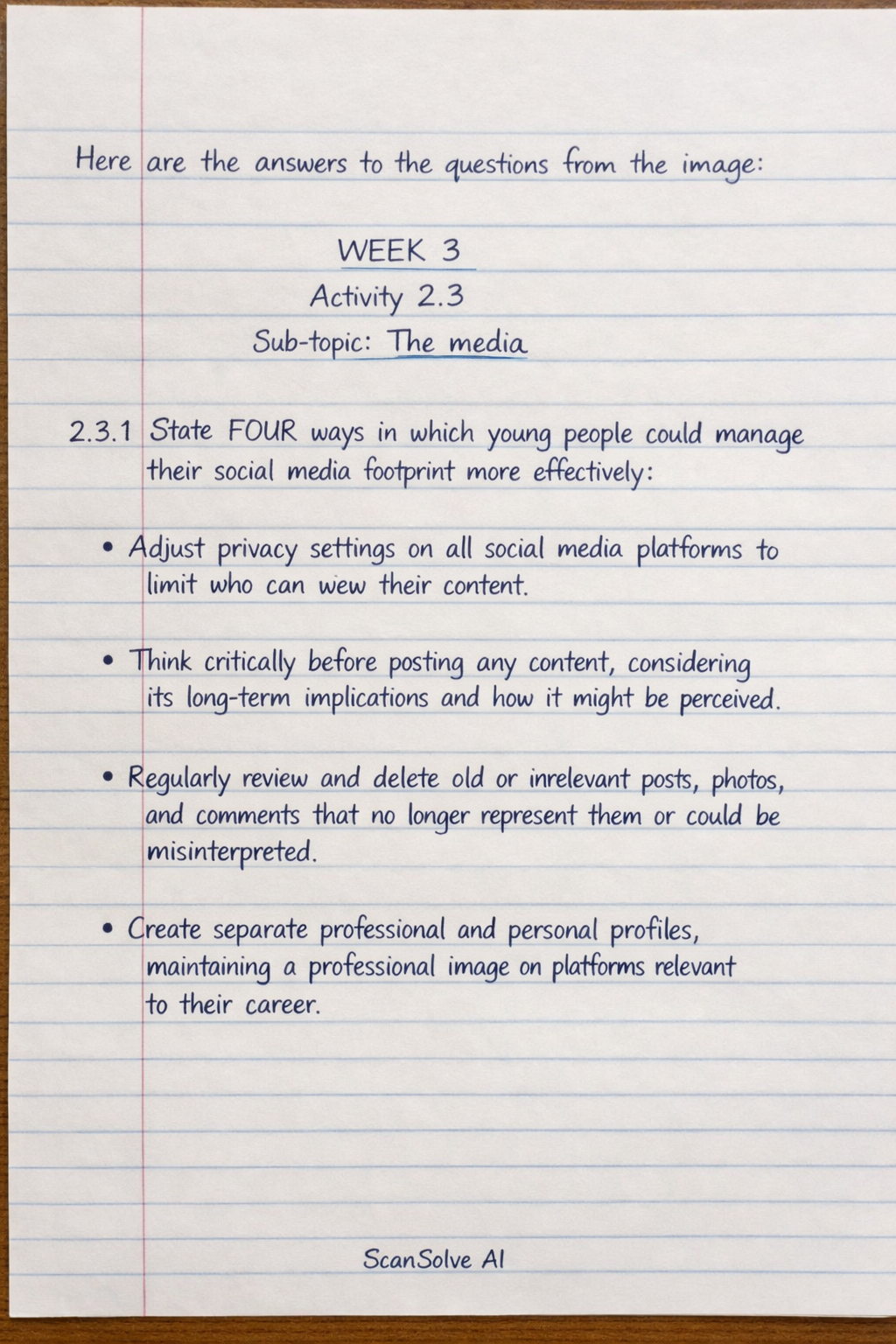
Here are the answers to the questions from the image:
WEEK 3
Activity 2.3
Sub-topic: The media
-
2.3.1 State FOUR ways in which young people could manage their social media footprint more effectively.
- Adjust privacy settings on all social media platforms to limit who can view their content.
- Think critically before posting any content, considering its long-term implications and how it might be perceived.
- Regularly review and delete old or irrelevant posts, photos, and comments that no longer represent them or could be misinterpreted.
- Create separate professional and personal profiles, maintaining a professional image on platforms relevant to their career.
-
2.3.2 Analyse TWO possible negative implications that spending time on social media during working hours may have for a workplace.
- Decreased productivity: Employees spending excessive time on social media during working hours are distracted from their tasks, leading to reduced output, missed deadlines, and a decline in overall work quality. This directly impacts the company's efficiency and profitability.
- Security risks and data breaches: Accessing social media on company devices can expose the workplace network to malware, phishing scams, or viruses. Employees might also inadvertently share confidential company information through unsecured platforms, compromising data security and intellectual property.
-
2.3.3 Discuss critically why it is important for an employer to enforce limitations on the use of personal electronic devices in order to protect a company.
- Protection of confidential information and data security: Personal devices can be vulnerable to malware or unsecured networks, posing a risk of data breaches if employees access company data on them. Limitations prevent the unauthorized sharing or leakage of sensitive company information, protecting intellectual property and client data.
- Maintaining productivity and professional conduct: Excessive use of personal devices for non-work-related activities during working hours leads to significant distractions and reduced employee productivity. Enforcing limitations ensures employees remain focused on their tasks, maintain a professional image, and contribute effectively to the company's goals, preventing a decline in overall performance.
WEEK 4
Activity 2.4
Sub-topic: The media
-
2.4.1 State FOUR ways in which media could ensure access of information to all communities.
- Utilize diverse media platforms such as community radio, local newspapers, and public access television, especially in areas with limited internet connectivity.
- Provide information in multiple languages to cater to the linguistic diversity within communities.
- Simplify complex information into easy-to-understand language and use visual aids to make it accessible to people with varying literacy levels.
- Establish community outreach programs and partnerships with local organizations to disseminate information directly to underserved populations.
-
2.4.2 Analyse how limitations to the right to freedom of expression of the media may assist in promoting public safety.
- Preventing incitement to violence and hatred: Limitations can prohibit media from publishing content that directly incites violence, hatred, or public disorder. This prevents the escalation of conflicts, protects vulnerable groups, and maintains social cohesion, thereby promoting public safety.
- Combating misinformation during crises: In times of public health emergencies or natural disasters, restrictions can prevent the spread of false or misleading information that could cause widespread panic, endanger lives, or hinder effective emergency responses. This ensures that the public receives accurate and reliable information crucial for their safety.
-
2.4.3 Critically discuss the impact of the increasing digital divide on different groups in society, specifically the poorer communities.
- Exacerbated educational inequality: Poorer communities often lack access to reliable internet and digital devices, which severely limits their ability to participate in online learning, access educational resources, and develop essential digital literacy skills. This widens the educational gap, hindering academic achievement and future opportunities for children and young adults.
- Limited economic and employment opportunities: In an increasingly digital economy, many job applications, training programs, and remote work opportunities require internet access and digital skills. The digital divide excludes individuals from poorer communities from these vital pathways to employment and economic advancement, perpetuating cycles of poverty and unemployment.
BIWEEKLY TEST 2.2
- 2.2.1 Social media: Online platforms and tools that allow individuals to create, share, and exchange content, ideas, and information within virtual communities and networks.
- 2.2.2 Social media footprint: The unique data trail left by an individual's online activities, including posts, comments, likes, shares, and personal information, which can be permanent and publicly accessible.
- 2.2.3 Cyber wellness: The positive well-being of individuals in the digital world, encompassing safe, responsible, and ethical use of technology, and managing online risks to maintain mental and physical health.
- 2.2.4 Cyber safety: The practice of protecting oneself and one's data while using the internet, including preventing cyberbullying, online scams, identity theft, and exposure to inappropriate content.
- 2.2.5 Cyberbullying: The use of electronic communication to bully a person, typically by sending messages of an intimidating, threatening, or harassing nature.
- 2.2.6 Cyber-savvy: Having a good understanding of how the internet and digital technologies work, and being skilled at using them safely, effectively, and responsibly.
Still stuck on this one?
Ask a follow-up, and the answer starts from this question.
More Business/Management Questions
Handwritten Step-by-Step Solution
Get this as a handwritten image on WhatsApp — like a tutor wrote it for you.
Try on WhatsApp