
We read your photo as:
Define horizontal integration, internal economies of scale, and mobility of labour with examples. Explain four factors influencing labour supply.
ScanSolve AI Answer
Question 2
a) Define the following terms, giving an example in each case:
-
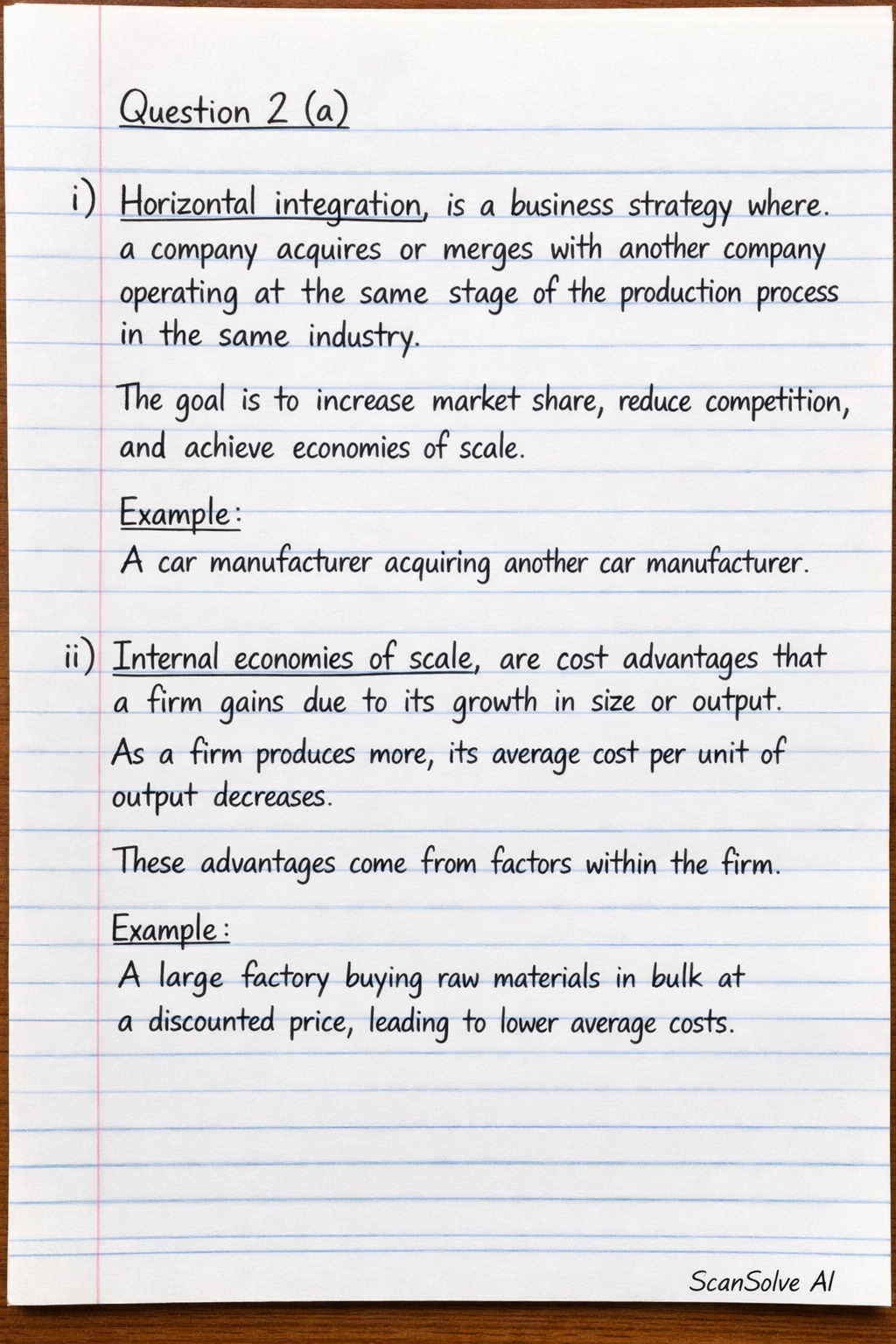
i) Horizontal integration is a business strategy where a company acquires or merges with another company operating at the same stage of the production process in the same industry. The goal is often to increase market share, reduce competition, and achieve economies of scale. Example: A car manufacturer acquiring another car manufacturer.
-
ii) Internal economies of scale are cost advantages that a firm gains due to its growth in size or output. As a firm produces more, its average cost per unit of output decreases. These advantages arise from factors within the firm itself. Example: A large factory buying raw materials in bulk at a discounted price, leading to lower average costs.
-
iii) Mobility of labour refers to the ease with which workers can move between different jobs, occupations, or geographical locations. It can be occupational (changing jobs/professions) or geographical (moving to a different area for work). Example: A construction worker moving from one city to another to find work on a new building project.
b) State and explain four (4) factors which influence the supply of labour:
- Wage Rate: The primary factor influencing labour supply is the wage rate offered. A higher wage rate for a particular job or industry generally attracts more workers, increasing the supply of labour, assuming other factors remain constant.
- Non-Monetary Benefits: These include factors like working conditions, job security, opportunities for promotion, fringe benefits (e.g., health insurance, pension plans), and the prestige of the job. Better non-monetary benefits can increase the attractiveness of a job, leading to a higher supply of labour even if wages are not exceptionally high.
- Population Size and Structure: A larger working-age population naturally leads to a greater potential supply of labour. The demographic structure, including age distribution and gender participation rates, also affects the total number of people available for work.
- Education and Training: The level and type of education and training available in an economy determine the supply of skilled labour for various occupations. An increase in access to relevant education and vocational training can increase the supply of qualified workers for specific industries.
- Trade Union Strength: Strong trade unions can influence working conditions, wages, and job security, which can affect the attractiveness of certain jobs and thus the supply of labour to those sectors. They might restrict entry into certain professions, thereby limiting supply.
- Government Policies: Policies related to taxation, unemployment benefits, immigration, and retirement age can significantly impact the labour supply. For instance, lower income taxes might encourage more people to work, while generous unemployment benefits might reduce the incentive to seek employment.
c) Explain three (3) reasons for the slow growth rate of industrialization in Cameroon:
- Inadequate Infrastructure: Cameroon faces challenges with insufficient and poorly maintained infrastructure, including unreliable electricity supply, poor road networks, and limited access to clean water. These deficiencies increase production costs for industries, hinder the transportation of raw materials and finished goods, and deter both domestic and foreign investment in the industrial sector.
- Limited Access to Finance: Small and medium-sized enterprises (SMEs), which are crucial for industrial growth, often struggle to access affordable credit from commercial banks. High interest rates, stringent collateral requirements, and a lack of specialized financial institutions for industrial development limit their ability to invest in new technologies, expand operations, and compete effectively.
- Weak Institutional and Regulatory Framework: Issues such as corruption, bureaucratic red tape, and an inconsistent legal and regulatory environment create uncertainty and increase the cost of doing business. This discourages both local and foreign investors from committing to long-term industrial projects, thereby stifling industrial expansion and diversification.
- Dependence on Primary Commodities: Cameroon's economy remains heavily reliant on the export of raw materials and agricultural products (e.g., oil, timber, cocoa). This over-reliance means there is less focus and investment in developing value-added processing and manufacturing industries, leading to a lack of industrial diversification and vulnerability to global commodity price fluctuations.
Still stuck on this one?
Ask a follow-up, and the answer starts from this question.
More Business/Management Questions
Handwritten Step-by-Step Solution
Get this as a handwritten image on WhatsApp — like a tutor wrote it for you.
Try on WhatsApp