We read your photo as:

I. Calculate the weighted average cost of capital (WACC) for M Co as at 31 December 2018. ii. Briefly advise the directors of M Co on the suitability of using the WACC calculated in (a) above to discount the expected cash flows of the project.

Business/Management

ScanSolve AI Answer

Answer

i

14.63%\text{14.63\%}

Step-by-step solution

5 steps

Part i· 5 steps

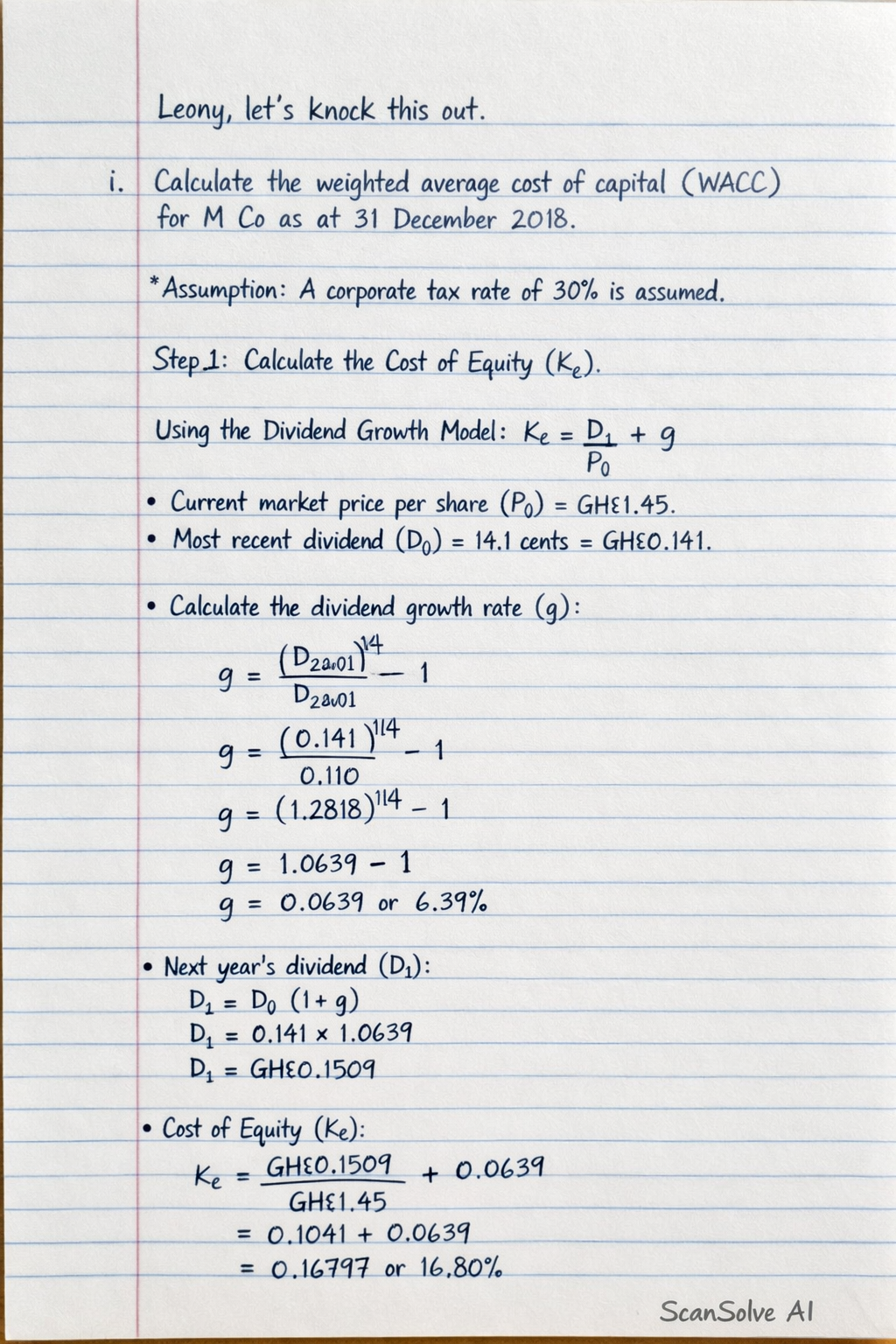
Calculate the weighted average cost of capital (WACC) for M Co as at 31 December 2018.

Assumption: A corporate tax rate of 30%30\% is assumed as it is not provided in the question.

  1. Calculate the Cost of Equity (KeK_e)

    The cost of equity is calculated using the Dividend Growth Model (Ke=D1P0+gK_e = \frac{D_1}{P_0} + g).

    • Current market price per share (P0P_0) = GH¢1.45.
    • Most recent dividend (D0D_0) = 14.1 cents = GH¢0.141.
    • Calculate the dividend growth rate (gg) using the geometric mean from 2014 to 2018: g=(D2018D2014)1n−1=(0.1410.110)14−1g = \left(\frac{D_{2018}}{D_{2014}}\right)^{\frac{1}{n}} - 1 = \left(\frac{0.141}{0.110}\right)^{\frac{1}{4}} - 1 g=(1.281818)14−1=1.0639−1=0.0639 or 6.39%g = (1.281818)^{\frac{1}{4}} - 1 = 1.0639 - 1 = 0.0639 \text{ or } 6.39\%
    • Next year's dividend (D1D_1) = D0(1+g)=GH¢0.141×(1+0.0639)=GH¢0.141×1.0639=GH¢0.1509D_0 (1+g) = GH¢0.141 \times (1 + 0.0639) = GH¢0.141 \times 1.0639 = GH¢0.1509.
    • Cost of Equity (KeK_e): Ke=GH¢0.1509GH¢1.45+0.0639=0.104069+0.0639=0.167969 or 16.80%K_e = \frac{GH¢0.1509}{GH¢1.45} + 0.0639 = 0.104069 + 0.0639 = 0.167969 \text{ or } 16.80\%
  2. Calculate the Market Value of Equity (VeV_e)

    • Number of shares = 3 million.
    • Market price per share = GH¢1.45. Ve=3,000,000×GH¢1.45=GH¢4,350,000V_e = 3,000,000 \times GH¢1.45 = GH¢4,350,000
  3. Calculate the Cost of Debt (KdK_d) and Market Value of Debt (VdV_d)

    • Debentures:
      • Nominal value = GH¢1,000,000.
      • Coupon rate = 7%.
      • Redemption value = GH¢100 per GH¢100 nominal.
      • Current market price = GH¢83.60 per GH¢100 nominal.
      • Years to maturity (NN) = 2022−2018=42022 - 2018 = 4 years.
      • Annual interest payment (II) = 7% of GH¢100 = GH¢7.
      • Pre-tax cost of debentures (Kd,debK_{d,deb}) is calculated using interpolation for Yield to Maturity (YTM):
        • At 12%: 7×PVAF(12%,4)+100×PVF(12%,4)=7×3.0373+100×0.6355=21.2611+63.55=84.81117 \times PVAF(12\%, 4) + 100 \times PVF(12\%, 4) = 7 \times 3.0373 + 100 \times 0.6355 = 21.2611 + 63.55 = 84.8111
        • At 13%: 7×PVAF(13%,4)+100×PVF(13%,4)=7×2.9745+100×0.6133=20.8215+61.33=82.15157 \times PVAF(13\%, 4) + 100 \times PVF(13\%, 4) = 7 \times 2.9745 + 100 \times 0.6133 = 20.8215 + 61.33 = 82.1515
        • Kd,deb=12%+(13%−12%)×84.8111−83.6084.8111−82.1515=12%+1%×1.21112.6596=12%+0.4553%=12.46%K_{d,deb} = 12\% + (13\% - 12\%) \times \frac{84.8111 - 83.60}{84.8111 - 82.1515} = 12\% + 1\% \times \frac{1.2111}{2.6596} = 12\% + 0.4553\% = 12.46\%
      • Market value of debentures (Vd,debV_{d,deb}) = GH¢1,000,000GH¢100×GH¢83.60=GH¢836,000\frac{GH¢1,000,000}{GH¢100} \times GH¢83.60 = GH¢836,000.
    • Bank Loan:
      • Amount = GH¢500,000.
      • Interest rate = 8%.
      • Pre-tax cost of bank loan (Kd,loanK_{d,loan}) = 8%8\%.
      • Market value of bank loan (Vd,loanV_{d,loan}) = GH¢500,000.
    • Total Market Value of Debt (VdV_d): Vd=Vd,deb+Vd,loan=GH¢836,000+GH¢500,000=GH¢1,336,000V_d = V_{d,deb} + V_{d,loan} = GH¢836,000 + GH¢500,000 = GH¢1,336,000
  4. Calculate the After-Tax Cost of Debt

    • After-tax cost of debentures = Kd,deb(1−T)=0.1246×(1−0.30)=0.1246×0.70=0.08722 or 8.72%K_{d,deb}(1-T) = 0.1246 \times (1 - 0.30) = 0.1246 \times 0.70 = 0.08722 \text{ or } 8.72\%.
    • After-tax cost of bank loan = Kd,loan(1−T)=0.08×(1−0.30)=0.08×0.70=0.056 or 5.60%K_{d,loan}(1-T) = 0.08 \times (1 - 0.30) = 0.08 \times 0.70 = 0.056 \text{ or } 5.60\%.
  5. Calculate the Weighted Average Cost of Capital (WACC)

    • Total market value of capital (VV) = Ve+Vd=GH¢4,350,000+GH¢1,336,000=GH¢5,686,000V_e + V_d = GH¢4,350,000 + GH¢1,336,000 = GH¢5,686,000.
    • WACC formula: WACC=Ke(VeV)+Kd,deb(1−T)(Vd,debV)+Kd,loan(1−T)(Vd,loanV)WACC = K_e \left(\frac{V_e}{V}\right) + K_{d,deb}(1-T) \left(\frac{V_{d,deb}}{V}\right) + K_{d,loan}(1-T) \left(\frac{V_{d,loan}}{V}\right) WACC=0.1680(4,350,0005,686,000)+0.08722(836,0005,686,000)+0.056(500,0005,686,000)WACC = 0.1680 \left(\frac{4,350,000}{5,686,000}\right) + 0.08722 \left(\frac{836,000}{5,686,000}\right) + 0.056 \left(\frac{500,000}{5,686,000}\right) WACC=0.1680×0.76504+0.08722×0.14703+0.056×0.08793WACC = 0.1680 \times 0.76504 + 0.08722 \times 0.14703 + 0.056 \times 0.08793 WACC=0.12852672+0.0128289+0.00492408WACC = 0.12852672 + 0.0128289 + 0.00492408 WACC = 0.1462797 \text{ or } \boxed{\text{14.63%}}

Part ii

Briefly advise the directors of M Co on the suitability of using the WACC calculated in (a) above to discount the expected cash flows of the project.

The calculated WACC represents the average cost of capital for M Co's existing business risk profile. It is suitable for discounting the expected cash flows of the new project only if the new product has a similar business risk profile to the company's current operations. If the new product introduces a significantly different level of risk, using the company's overall WACC would be inappropriate and could lead to incorrect investment decisions. In such cases, a project-specific discount rate, reflecting the unique risk of the new venture, should be estimated.

Was this helpful?

Try one yourself

A new problem that tests the same skill.

Still stuck on this one?

Ask a follow-up, and the answer starts from this question.

Got a different question?Ask your own question
Handwritten step-by-step solution preview

Handwritten Step-by-Step Solution

Get this as a handwritten image on WhatsApp — like a tutor wrote it for you.

Try on WhatsApp