
We read your photo as:
Identify and categorize the causes of grievances for staff and students, and explain the failure of the grievance handling procedure described in the case study.
ScanSolve AI Answer
Step-by-step solution
10 stepsPart a· 2 steps
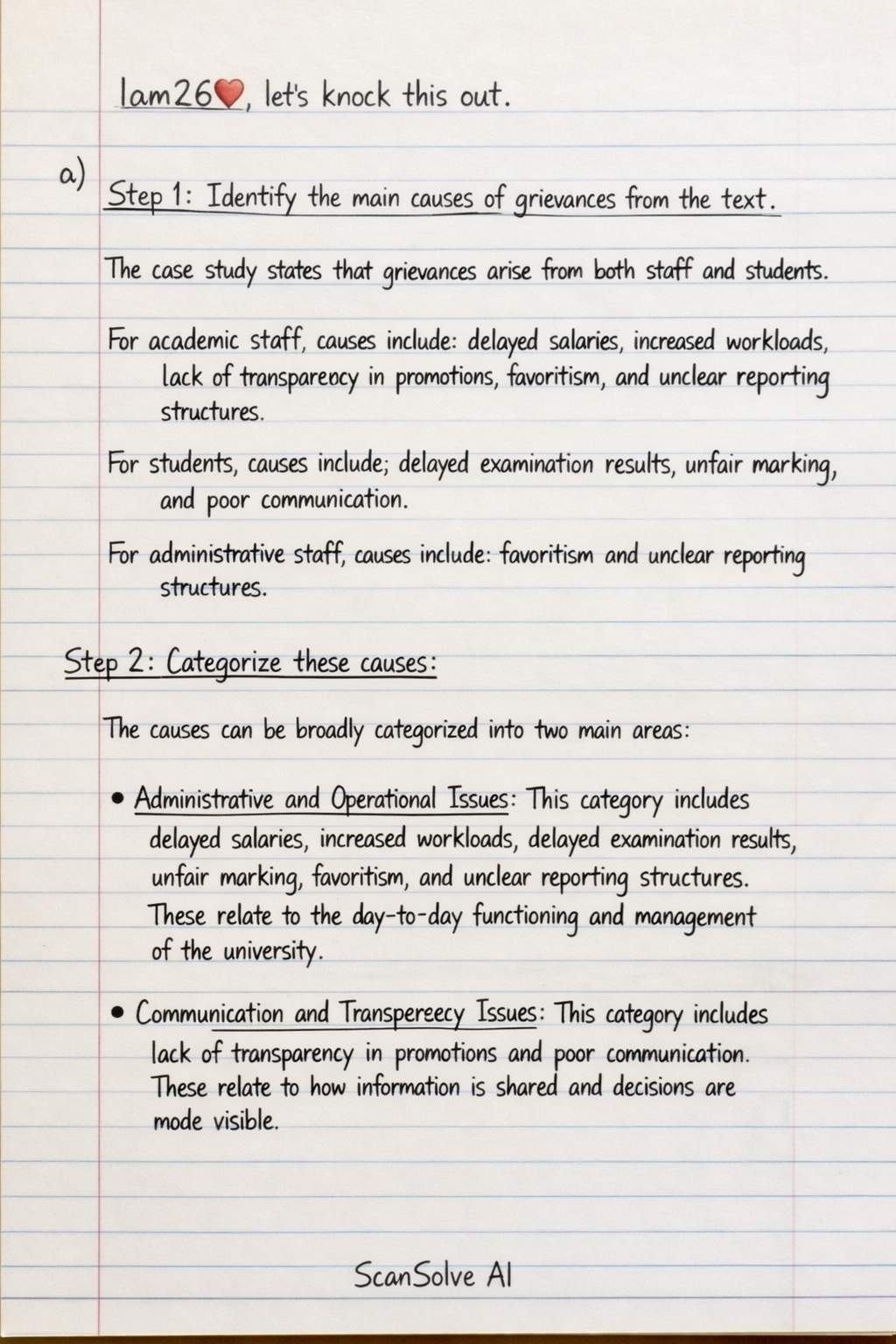
Identify the main causes of grievances from the text.
The case study states that grievances arise from both staff and students.
For academic staff, causes include: delayed salaries, increased workloads, lack of transparency in promotions, favoritism, and unclear reporting structures.
For students, causes include: delayed examination results, unfair marking, and poor communication.
For administrative staff, causes include: favoritism and unclear reporting structures.Categorize these causes.
The causes can be broadly categorized into two main areas:
- Administrative and Operational Issues: This category includes delayed salaries, increased workloads, delayed examination results, unfair marking, favoritism, and unclear reporting structures. These relate to the day-to-day functioning and management of the university.
- Communication and Transparency Issues: This category includes lack of transparency in promotions and poor communication. These relate to how information is shared and decisions are made visible.
Part b· 2 steps
Identify the stages of the grievance handling procedure and where it fails.
The procedure involves complaints being reported to supervisors, escalated to heads of departments, and then to top management. The system is ineffective throughout this process.
Explain why the procedure fails.
The system fails due to:
- Absence of clear timelines for resolution.
- Lack of effective feedback mechanisms to complainants.
- Improper documentation of grievances and their resolutions.
- Absence of a dedicated grievance committee to impartially handle and oversee the process.
Part c· 2 steps
Propose methods to improve grievance collection.
To improve collection, KIUT should introduce:
- Multiple Reporting Channels: Establish clear, accessible channels such as a dedicated online portal, suggestion boxes, or a specific office for grievance submission, ensuring anonymity where appropriate.
- Awareness Campaigns: Regularly inform staff and students about the available grievance channels and the process.
Propose methods to improve grievance management.
To improve management, KIUT should introduce:
- Clear Timelines: Implement specific timeframes for acknowledging, investigating, and resolving grievances at each stage.
- Feedback Mechanisms: Ensure regular updates and final outcomes are communicated to complainants.
- Standardized Documentation: Develop a robust system for recording all grievances, investigations, and resolutions.
- Dedicated Grievance Committee: Establish an impartial committee with diverse representation to review and resolve complex cases.
Part d· 2 steps
Outline redesign elements for fairness.
To ensure fairness, the university should redesign its system to include:
- Transparent Procedures: Clearly publish the grievance policy, process, and expected timelines for all stakeholders.
- Impartial Adjudication: Establish an independent and unbiased grievance committee or ombudsman with clear terms of reference and authority.
- Right to Appeal: Provide a clear mechanism for complainants to appeal decisions they deem unsatisfactory.
- Confidentiality and Non-Retaliation: Guarantee confidentiality for complainants and protect them from any form of retaliation.
Outline redesign elements for efficiency.
To ensure efficiency, the university should redesign its system to include:
- Streamlined Process: Simplify the steps involved in filing and resolving grievances, reducing bureaucratic hurdles.
- Automated Tracking System: Implement a digital system to log, track, and monitor the progress of each grievance, ensuring accountability.
- Regular Training: Provide ongoing training for supervisors and committee members on grievance handling best practices.
- Performance Metrics: Set key performance indicators (KPIs) for grievance resolution times and satisfaction rates to continuously monitor and improve the system.
Part e· 2 steps
Identify the immediate consequences mentioned in the text.
The text states that unresolved complaints lead to low staff morale, student dissatisfaction, and potential reputational damage.
Elaborate on these as long-term consequences.
If grievances are not properly addressed, the likely long-term consequences for KIUT include:
- Sustained Low Staff Morale: This can lead to decreased productivity, high staff turnover, difficulty in attracting qualified personnel, and a generally negative work environment.
- Increased Student Dissatisfaction: This can result in a decline in student enrollment, poor academic performance, protests, and a negative perception of the university's educational quality and student support.
- Severe Reputational Damage: A university known for unresolved grievances will suffer a loss of trust from students, staff, parents, and the wider community, impacting its ability to secure funding, partnerships, and its overall standing in the academic world.
- Legal and Financial Risks: Unresolved grievances could escalate into legal disputes, leading to costly lawsuits and financial penalties for the university.
Still stuck on this one?
Ask a follow-up, and the answer starts from this question.
More Business/Management Questions
Handwritten Step-by-Step Solution
Get this as a handwritten image on WhatsApp — like a tutor wrote it for you.
Try on WhatsApp