
We read your photo as:
Identify whether the following statements about information systems and knowledge management are true or false.
ScanSolve AI Answer
Answer
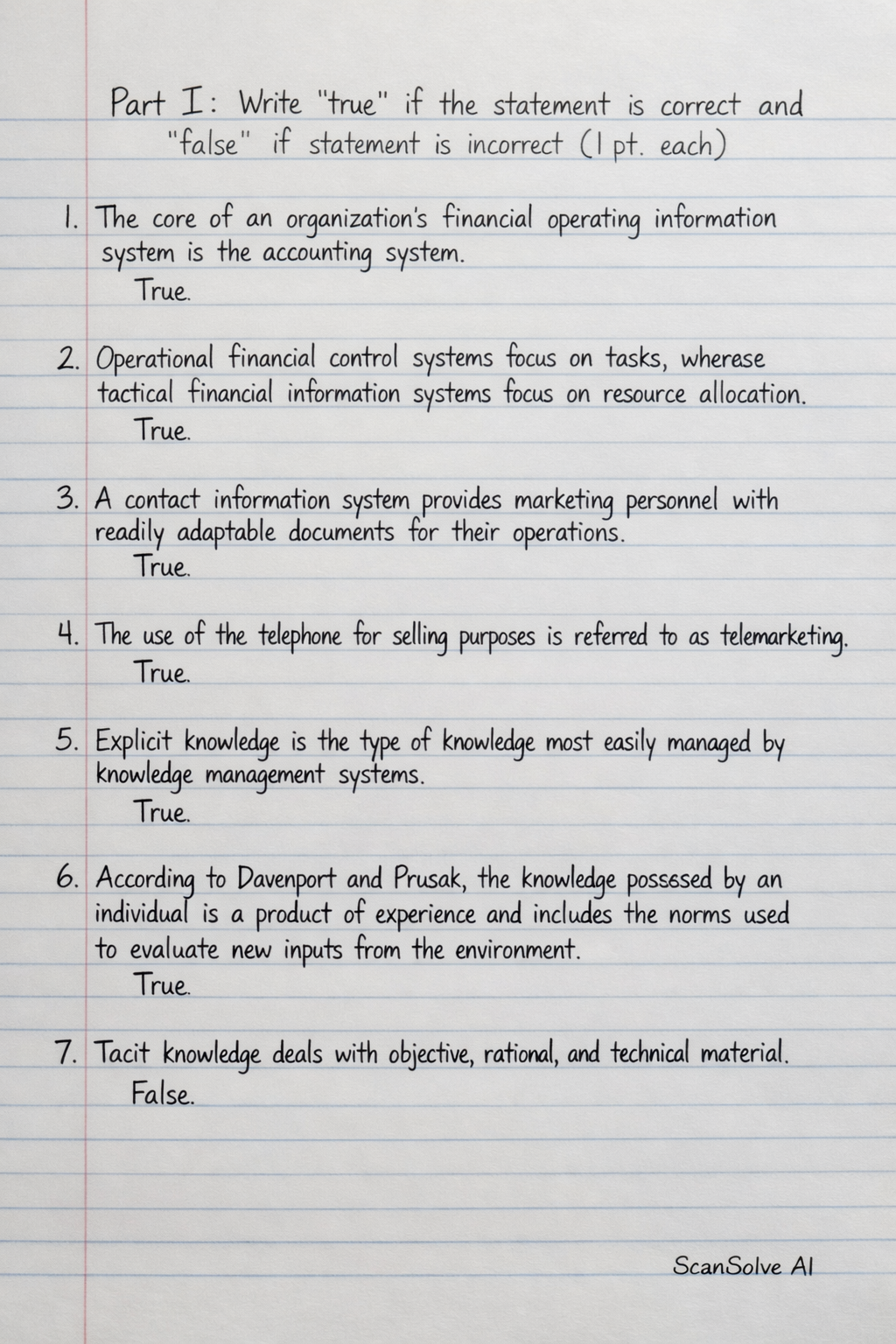
Part I: Write "true" if the statement is correct and "false" if statement is incorrect (1 pt. each)
- The core of an organization's financial operating information system is the accounting system.
- True
- Operational financial control systems focus on tasks, whereas tactical financial information systems focus on resource allocation.
- True
- A contact information system provides marketing personnel with readily adaptable documents for their operations.
- True
- The use of the telephone for selling purposes is referred to as telemarketing.
- True
- Explicit knowledge is the type of knowledge most easily managed by knowledge management systems.
- True
- According to Davenport and Prusak, the knowledge possessed by an individual is a product of experience and includes the norms used to evaluate new inputs from the environment.
- True
- Tacit knowledge deals with objective, rational, and technical material.
- False (Tacit knowledge is subjective, experiential, and difficult to articulate, unlike explicit knowledge which deals with objective and technical material.)
- Knowledge management involves managing knowledge that is useful for specific purposes and that creates value for the organization.
- True
- When information is further processed, it has the potential to become knowledge.
- True
- An employee information system within a personnel file contains information about each employee's work experience, preferences, test scores, interests, and special skills or proficiency.
- True
Part II: Choose the correct answers from the given alternative (1.5 pts. each)
1. Which of the following statement is/are correct?
- A. Explicit knowledge is hidden and refers to intuitions experiences and insights. (Incorrect, this describes tacit knowledge.)
- B. Tacit knowledge is impersonal, so it can be stacked through the organizational memories. (Incorrect, tacit knowledge is personal and difficult to codify.)
- C. Tacit knowledge is hidden and refers to intuitions experiences and insights. (Correct, this accurately defines tacit knowledge.)
- D. Explicit is personal, and can be easily lost if the key people of organizations leave them. (Incorrect, this describes tacit knowledge.)
- E. None
The correct statement is C.
The final answer is
2. Strategic information systems typically include several types of information flows:
- A. An analysis of internally generated information describing the status of the organization. (Correct, strategic systems use internal data.)
- B. An analysis of externally generated data describing the present and future environment for the organization. (Correct, strategic systems use external data for environmental scanning.)
- C. Forecasts of the future of that organization in those environments. (Correct, strategic systems support forecasting and long-term planning.)
- D. All
- E. None
Since A, B, and C are all true components of information flows in strategic information systems, the answer is D.
The final answer is
3. Which of the followings are not true about position information systems?
- A. It also allow the personnel manager to identify human resource problems.
- B. It allow identify the details about unfilled positions.
- C. To identify each position in the organization.
A position information system primarily defines and tracks job positions.
- B. Identifying details about unfilled positions is a direct function. (True)
- C. Identifying each position in the organization is the fundamental purpose. (True)
- A. While a position information system provides data that helps a personnel manager identify human resource problems (e.g., by showing vacant positions or redundant roles), the system itself does not identify the problems in an analytical sense; the manager performs the analysis. Therefore, this statement is the least directly true or "not true" in the context of the system's direct function.
The final answer is
Try one yourself
A new problem that tests the same skill.
Still stuck on this one?
Ask a follow-up, and the answer starts from this question.
More Business/Management Questions
Handwritten Step-by-Step Solution
Get this as a handwritten image on WhatsApp — like a tutor wrote it for you.
Try on WhatsApp