
We read your photo as:
INSTRUCTION: ANSWER ANY FOUR(4) QUESTIONS ONLY
ScanSolve AI Answer
here are the answers to four questions from the paper:
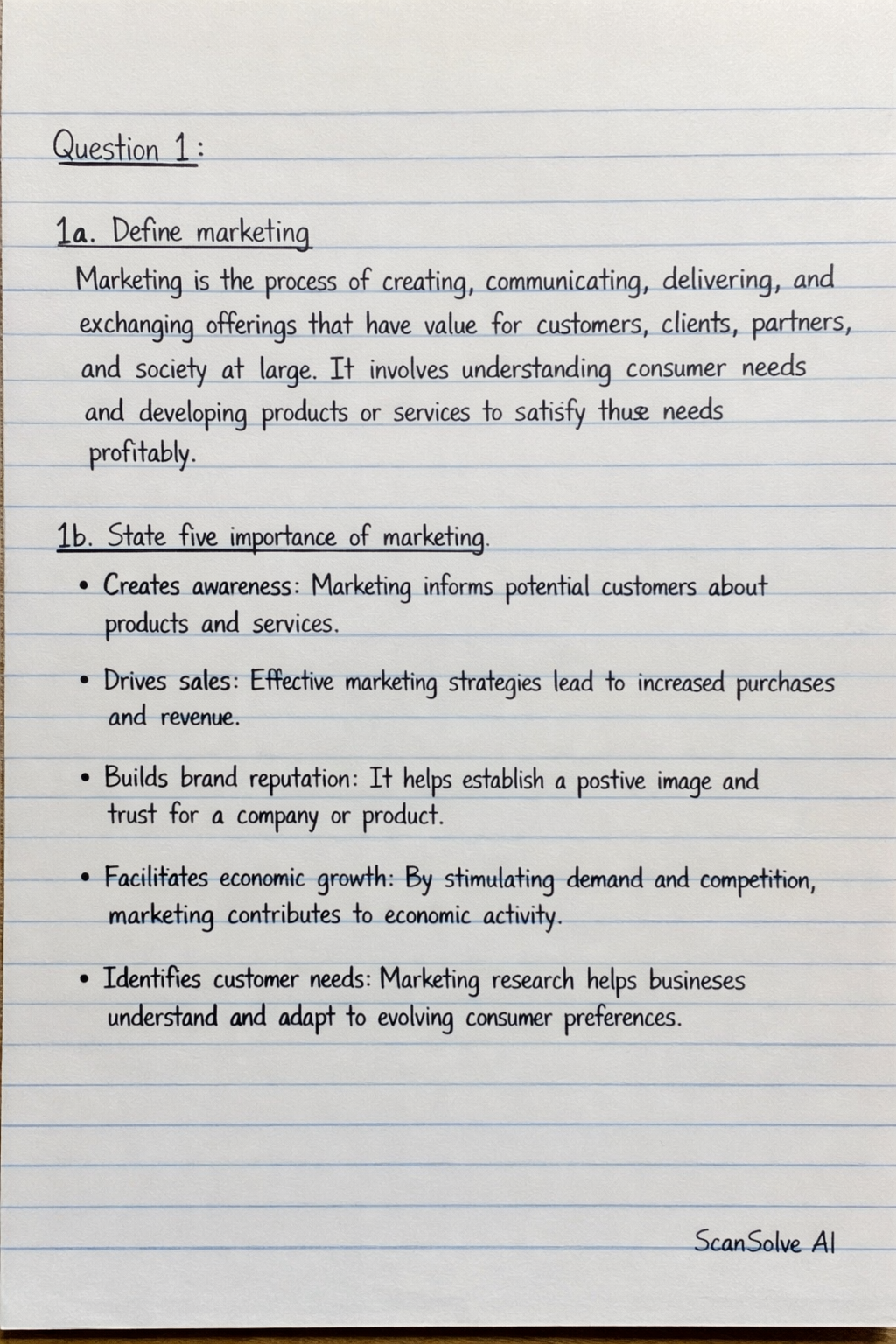
Question 1:
-
1a. Define marketing Marketing is the process of creating, communicating, delivering, and exchanging offerings that have value for customers, clients, partners, and society at large. It involves understanding consumer needs and developing products or services to satisfy those needs profitably.
-
1b. State five importance of marketing
- Creates awareness: Marketing informs potential customers about products and services.
- Drives sales: Effective marketing strategies lead to increased purchases and revenue.
- Builds brand reputation: It helps establish a positive image and trust for a company or product.
- Facilitates economic growth: By stimulating demand and competition, marketing contributes to economic activity.
- Identifies customer needs: Marketing research helps businesses understand and adapt to evolving consumer preferences.
-
1c. Mention five (5) qualities of a good marketer
- Customer-focused: Understands and prioritizes customer needs and desires.
- Creative: Develops innovative campaigns and solutions to attract attention.
- Analytical: Uses data and insights to make informed decisions and measure effectiveness.
- Adaptable: Responds quickly to market changes and new trends.
- Communicative: Clearly conveys messages to target audiences and stakeholders.
Question 2:
-
Write short notes on the following:
-
(i) Services Services are intangible activities or benefits that one party can offer to another, which do not result in the ownership of anything. Examples include haircuts, legal advice, or transportation. They are characterized by intangibility, inseparability, variability, and perishability.
-
(ii) Consumer products Consumer products are goods and services purchased by the final consumer for personal consumption. These are bought to satisfy individual or household needs and wants, rather than for resale or further processing. Examples include groceries, clothing, and electronics.
-
(iii) Shopping products Shopping products are consumer goods that customers typically compare on attributes such as suitability, quality, price, and style in the process of selecting and purchasing. Consumers spend more time and effort gathering information and making comparisons before buying. Examples include furniture, major appliances, and airline tickets.
-
(iv) Industrial products Industrial products are goods purchased by individuals and organizations for further processing or for use in conducting a business. Unlike consumer products, their purpose is not for personal consumption but for production or operational use. Examples include raw materials, machinery, and office supplies.
-
(v) Unsought products Unsought products are consumer products that the consumer either does not know about or knows about but does not normally think of buying. These products require a lot of advertising, personal selling, and other marketing efforts. Examples include life insurance, funeral services, or new inventions.
-
Question 3:
-
3a. What is marketing mix? The marketing mix is a set of controllable tactical marketing tools that a company uses to produce the response it wants in the target market. It consists of everything the firm can do to influence the demand for its product.
-
3b. State the four P's of marketing mix and explain each of them The four P's of the marketing mix are:
- Product: This refers to the goods or services a company offers to its target market. It includes aspects like quality, design, features, branding, packaging, and warranties. The product must meet the needs and wants of the target customers.
- Price: This is the amount of money customers must pay to obtain the product. Pricing strategies involve setting competitive prices, considering costs, perceived value, discounts, payment terms, and credit options.
- Place (Distribution): This involves the company's activities that make the product available to target consumers. It includes channels of distribution (e.g., retailers, wholesalers, online), logistics, inventory management, transportation, and coverage.
- Promotion: This refers to activities that communicate the merits of the product and persuade target customers to buy it. It includes advertising, personal selling, sales promotion, public relations, and direct marketing.
Question 5:
-
5a. Define Entrepreneurship Entrepreneurship is the process of designing, launching, and running a new business, which is often initially a small business. It involves identifying opportunities, taking on financial risks in the hope of profit, and innovating to create value.
-
5b. Highlight five (5) functions of an entrepreneur
- Opportunity identification: Recognizing and evaluating new business ideas and market gaps.
- Risk-taking: Assuming financial and personal risks associated with starting and operating a business.
- Innovation: Developing new products, services, processes, or business models.
- Resource mobilization: Gathering and organizing necessary resources like capital, labor, and technology.
- Decision-making and management: Making strategic and operational decisions and overseeing business operations.
-
5c. State five importance of entrepreneurship
- Job creation: Entrepreneurs create new businesses, leading to employment opportunities for others.
- Economic growth: New businesses contribute to the Gross Domestic Product (GDP) and overall economic development.
- Innovation and technological advancement: Entrepreneurs often introduce new products, services, and technologies that improve quality of life.
- Wealth creation: Successful entrepreneurial ventures generate wealth for the entrepreneurs, investors, and employees.
- Social change: Entrepreneurs can address societal problems by developing innovative solutions and creating social enterprises.
Still stuck on this one?
Ask a follow-up, and the answer starts from this question.
More Business/Management Questions
Handwritten Step-by-Step Solution
Get this as a handwritten image on WhatsApp — like a tutor wrote it for you.
Try on WhatsApp