
We read your photo as:
List and briefly describe types of workplace hazards and discuss relevant safety rules and regulations.
ScanSolve AI Answer
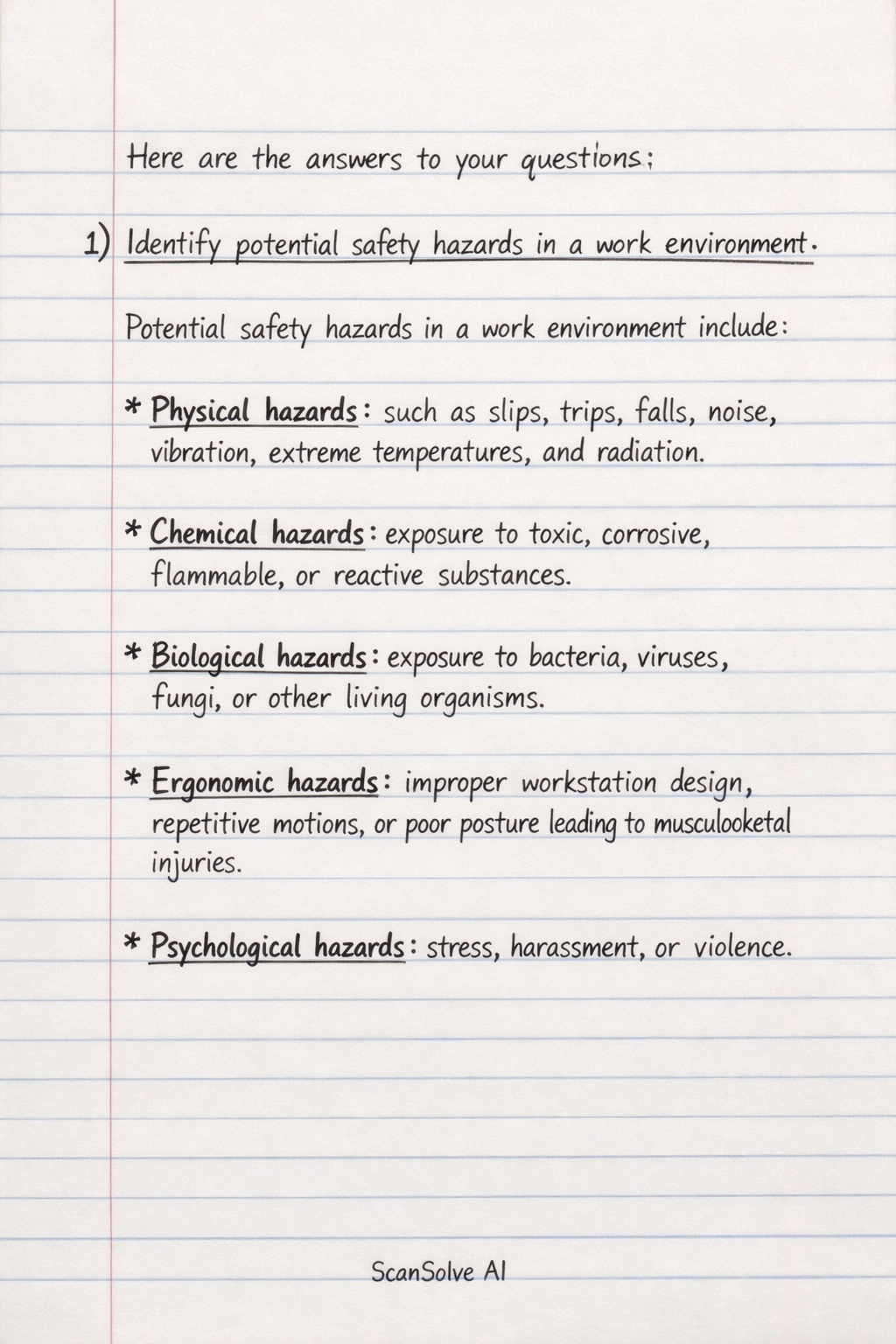
Here are the answers to your questions:
1) Identify potential safety hazards in a work environment.
Potential safety hazards in a work environment include:
- Physical hazards: such as slips, trips, falls, noise, vibration, extreme temperatures, and radiation.
- Chemical hazards: exposure to toxic, corrosive, flammable, or reactive substances.
- Biological hazards: exposure to bacteria, viruses, fungi, or other living organisms.
- Ergonomic hazards: improper workstation design, repetitive motions, or poor posture leading to musculoskeletal injuries.
- Psychological hazards: stress, harassment, or violence.
2) Discuss safety rules and regulations in a work environment.
Safety rules and regulations in a work environment are established guidelines and legal requirements designed to protect employees from harm and ensure a safe workplace. These typically include:
- Personal Protective Equipment (PPE): Mandating the use of safety helmets, goggles, gloves, and other gear.
- Emergency Procedures: Clear protocols for evacuations, first aid, and fire safety.
- Hazard Communication: Proper labeling of chemicals and training on their safe handling.
- Machine Guarding: Ensuring machinery has safety guards to prevent contact with moving parts.
- Training: Providing regular safety training to all employees on specific hazards and safe work practices.
3) Discuss classification of computers.
Computers can be classified in several ways, primarily by their size, functionality, and data handling capabilities.
- By Size/Power:
- Supercomputers: The fastest and most powerful, used for complex scientific calculations and simulations.
- Mainframes: Large, powerful systems used by big organizations for critical applications and data processing.
- Minicomputers (Midrange Computers): Smaller than mainframes but more powerful than personal computers, used by medium-sized businesses.
- Workstations: High-performance single-user computers for specialized tasks like graphic design or engineering.
- Microcomputers (Personal Computers): Common desktop, laptop, and tablet computers for individual use.
- By Functionality:
- Servers: Provide services to other computers (clients) over a network.
- Embedded Computers: Specialized computers integrated into other devices, like in cars or appliances.
- By Data Handling:
- Analog Computers: Process continuous data, often used for scientific and industrial control.
- Digital Computers: Process discrete data (binary digits), used for most modern computing tasks.
- Hybrid Computers: Combine features of both analog and digital computers.
4) Explain the importance of communication in a work environment.
Communication is crucial in a work environment because it facilitates coordination, problem-solving, and productivity. Effective communication ensures that tasks are understood, expectations are clear, and information flows smoothly between colleagues and departments. It helps prevent misunderstandings, builds strong team relationships, and allows for timely feedback and decision-making, ultimately contributing to a more efficient and harmonious workplace.
5) Explain the importance of drawing as a means of communication.
Drawing is a powerful means of communication because it allows for the visual representation of ideas, concepts, and designs that might be difficult or impossible to convey through words alone. It provides a universal language, transcending linguistic barriers, and enables precise and detailed instructions for manufacturing, construction, or artistic expression. Drawings can clarify complex information, illustrate relationships between components, and serve as a permanent record of design intent.
6) Distinguish between artistic and technical drawing used in the technical field.
- Artistic drawing focuses on expression, aesthetics, and conveying emotion or abstract ideas. It often involves subjective interpretation, uses various styles, and aims to create visually appealing or thought-provoking images. While it can depict real objects, its primary goal is not precise instruction or measurement.
- Technical drawing, on the other hand, is a precise and standardized form of communication used to convey factual information about how an object is to be constructed or functions. It adheres to strict rules, conventions, and scales, using specific lines, symbols, and dimensions to provide unambiguous instructions for engineers, manufacturers, and builders. Its purpose is clarity, accuracy, and functionality, not artistic expression.
Still stuck on this one?
Ask a follow-up, and the answer starts from this question.
More Business/Management Questions
Handwritten Step-by-Step Solution
Get this as a handwritten image on WhatsApp — like a tutor wrote it for you.
Try on WhatsApp