
We read your photo as:
Define a master budget and prepare a cash budget for the three months ending 30 November 2026.
Business/Management
ScanSolve AI Answer
Answer
Step-by-step solution
4 stepsPart a
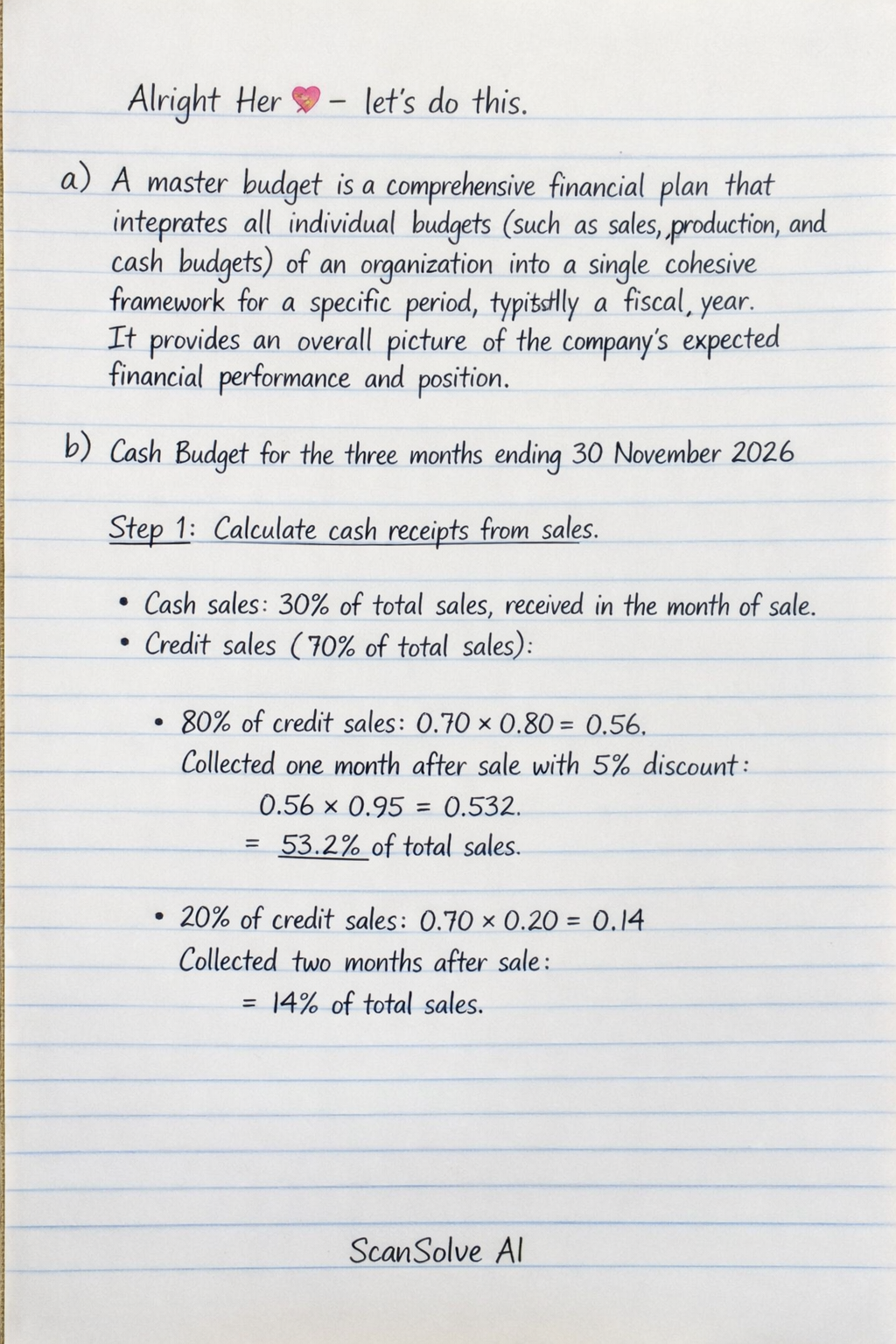
A master budget is a comprehensive financial plan that integrates all individual budgets (such as sales, production, and cash budgets) of an organization into a single, cohesive framework for a specific period, typically a fiscal year. It provides an overall picture of the company's expected financial performance and position.
Part b
Cash Budget for the three months ending 30 November 2026
Calculate cash receipts from sales.
- Cash sales: 30% of total sales, received in the month of sale.
- Credit sales (70% of total sales):
- 80% of credit sales (i.e., of total sales) collected one month after sale, with a 5% discount ( of total sales).
- 20% of credit sales (i.e., of total sales) collected two months after sale.
Month Total Sales ($) Cash Sales (30%) ($) 1-Month Credit (53.2%) ($) 2-Month Credit (14%) ($) July 120,000 - - - August 160,000 - 85,120 (from Aug) 16,800 (from Jul) September 180,000 54,000 95,760 (from Sep) 22,400 (from Aug) October 260,000 78,000 138,320 (from Oct) 25,200 (from Sep) November 200,000 60,000 - - Receipts September 54,000 85,120 16,800 October 78,000 95,760 22,400 November 60,000 138,320 25,200 - September Receipts from Sales: 85,120 + 155,920
- October Receipts from Sales: 95,760 + 196,160
- November Receipts from Sales: 138,320 + 223,520
Calculate payments for production cost.
- Production cost: 50% of next month's sales.
- Payments: 60% in the month of production, 40% one month later.
Month Next Month's Sales ($) Production Cost (50%) ($) 60% Paid in Month ($) 40% Paid Next Month ($) August 180,000 (Sep sales) 90,000 - 36,000 (from Aug) September 260,000 (Oct sales) 130,000 78,000 52,000 (from Sep) October 200,000 (Nov sales) 100,000 60,000 40,000 (from Oct) November 240,000 (Dec sales) 120,000 72,000 - Payments September 78,000 36,000 October 60,000 52,000 November 72,000 40,000 - September Payments for Production: 36,000 = $114,000
- October Payments for Production: 52,000 = $112,000
- November Payments for Production: 40,000 = $112,000
Incorporate other receipts and payments.
- Opening Balance (1 Sep):
(\6,000)$ overdraft. - Issue of Ordinary Shares:
20,000 \times \1.20 = $24,000$ (October). - Sale of Motor Vehicle: $18,000 (received in November).
- Sundry Expenses: $45,000 per month (September, October, November).
- Loan from FM Bank: $15,000 (September).
- Redemption of Preference Shares: $55,000 (October).
- Purchase of Equipment: $100,000 (November).
- Opening Balance (1 Sep):
Construct the cash budget.
Was this helpful?
Try one yourself
A new problem that tests the same skill.
Still stuck on this one?
Ask a follow-up, and the answer starts from this question.
Got a different question?Ask your own question
More Business/Management Questions
QExtract from the Cash Budget. Comparison of budgeted figures to actual figures for December 2026.QPrepare a cash budget for the three months ending 31 October, showing cash receipts and cash…QCompile a cash budget for Blankets Limited for July to December 2026 and clearly indicate any…QPrepare a bank reconciliation statement for the month ending November 30, 2023, using the provided…QPrepare the sales budget for the quarter ending 30 June 2026, showing adjusted quantities and total…
Handwritten Step-by-Step Solution
Get this as a handwritten image on WhatsApp — like a tutor wrote it for you.
Try on WhatsApp