
We read your photo as:
State and explain five factors that determine freight rate in sea transport.
Business/Management
ScanSolve AI Answer
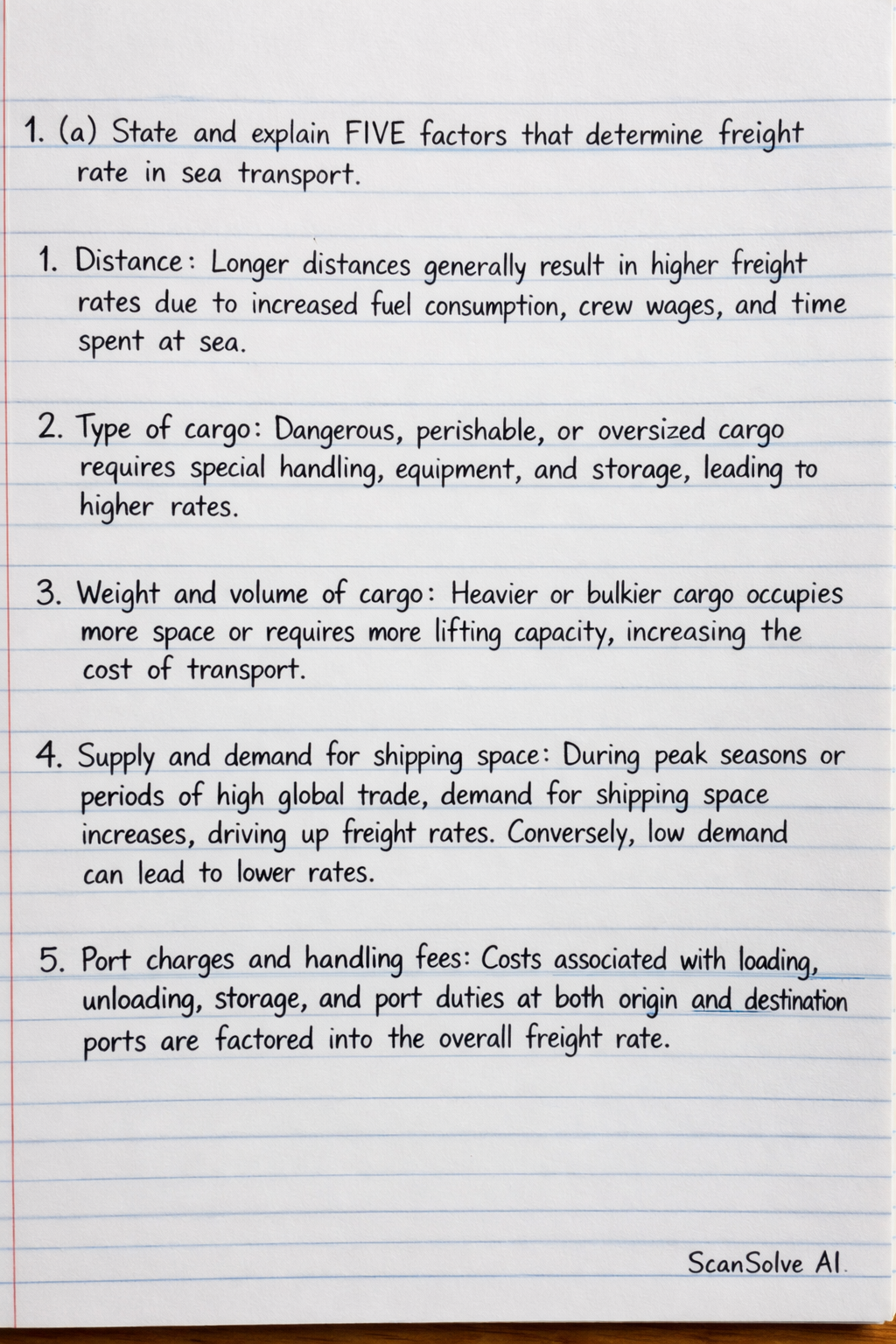
1. (a) State and explain FIVE factors that determine freight rate in sea transport.
- Distance: Longer distances generally result in higher freight rates due to increased fuel consumption, crew wages, and time spent at sea.
- Type of cargo: Dangerous, perishable, or oversized cargo requires special handling, equipment, and storage, leading to higher rates.
- Weight and volume of cargo: Heavier or bulkier cargo occupies more space or requires more lifting capacity, increasing the cost of transport.
- Supply and demand for shipping space: During peak seasons or periods of high global trade, demand for shipping space increases, driving up freight rates. Conversely, low demand can lead to lower rates.
- Port charges and handling fees: Costs associated with loading, unloading, storage, and port duties at both origin and destination ports are factored into the overall freight rate.
- Fuel prices (Bunker Adjustment Factor - BAF): Fluctuations in global oil prices directly impact the cost of fuel for vessels, which is often passed on to shippers through a BAF surcharge.
- Currency fluctuations (Currency Adjustment Factor - CAF): Changes in exchange rates between the currency of the freight rate and the operational costs can lead to adjustments in the rate.
- Seasonality and weather conditions: Certain seasons or routes prone to adverse weather may incur higher rates due to increased risk or potential delays.
Was this helpful?
Still stuck on this one?
Ask a follow-up, and the answer starts from this question.
Got a different question?Ask your own question
More Business/Management Questions
QWhat are five factors that influence the choice of a distribution channel?QRegulation and Control case movement protect operators carriers and customers, Describe the…QIn relation to moving General goods, the icc has a set of trading rules known as encoterms 2010…QExplain the factors determining the type and amount of trade in E.A. 1. Natural resources…QDescribe the features and applications of five different types of ships.
Handwritten Step-by-Step Solution
Get this as a handwritten image on WhatsApp — like a tutor wrote it for you.
Try on WhatsApp