

This business/management problem is solved step by step below, with detailed explanations to help you understand the method and arrive at the correct answer.
ScanSolve AI Answer
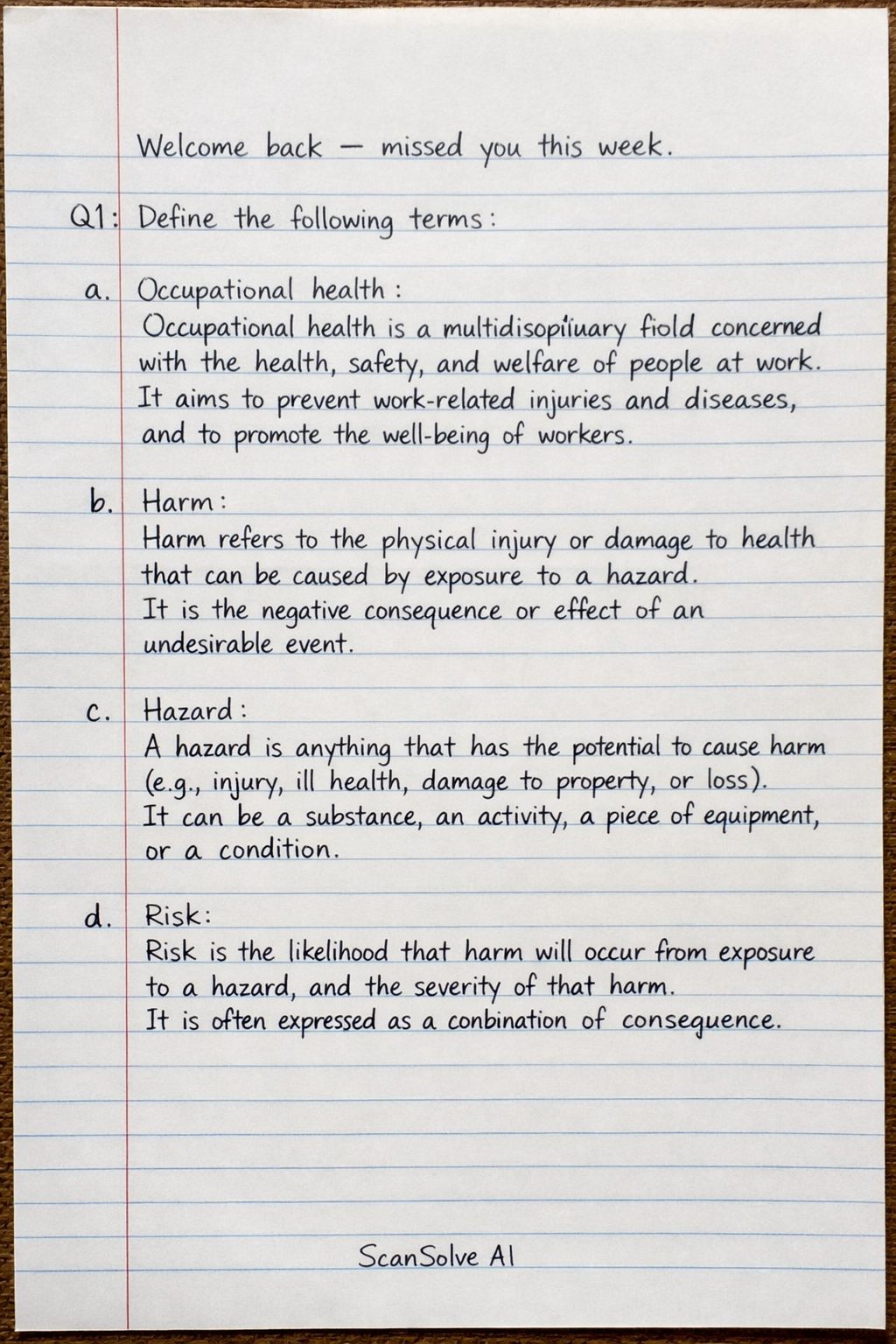
Welcome back — missed you this week. Q1: Define the following terms: a. Occupational health:* Occupational health is a multidisciplinary field concerned with the health, safety, and welfare of people at work*. It aims to prevent work-related injuries and diseases, and to promote the well-being of workers. b. Harm:* Harm refers to the physical injury or damage to health* that can be caused by exposure to a hazard. It is the negative consequence or effect of an undesirable event. c. Hazard:* A hazard is anything that has the potential to cause harm* (e.g., injury, ill health, damage to property, or loss). It can be a substance, an activity, a piece of equipment, or a condition. d. Risk:* Risk is the likelihood that harm will occur from exposure to a hazard, and the severity of that harm*. It is often expressed as a combination of probability and consequence. Q2: Explain the objectives of occupational health services. The objectives of occupational health services include: • Protecting workers from health risks arising from their work or working environment. • Promoting and maintaining the highest degree of physical, mental, and social well-being of workers in all occupations. • Adapting work to the worker and each worker to their job. • Preventing occupational accidents and diseases. • Providing health surveillance and promoting health in the workplace. Q3: Outline any five ergonomic hazards. Five ergonomic hazards include: • Repetitive movements: Performing the same motion repeatedly, leading to musculoskeletal disorders. • Awkward postures: Working in positions that strain the body, such as excessive bending, twisting, or reaching. • Forceful exertions: Applying significant physical force, like lifting heavy objects or gripping tools tightly. • Vibration: Exposure to whole-body or hand-arm vibration from tools or machinery. • Poor workstation design: Inadequate setup of desks, chairs, or equipment that forces unnatural body positions. Q4: Explain any three methods of occupational hazard identification. Three methods of occupational hazard identification are: • Workplace inspections: Regularly walking through the workplace to visually identify potential hazards, unsafe conditions, and practices. This can involve checklists and observations. • Incident and accident investigations: Analyzing past incidents, near misses, and accidents to understand their root causes and identify underlying hazards that contributed to them. • Worker consultations and feedback: Engaging employees through surveys, safety meetings, or suggestion boxes to gather their insights on hazards they encounter, as they often have direct knowledge of risks in their work areas. Q5: Explain the four stages in occupational risk management. The four stages in occupational risk management are: • Hazard Identification: This first stage involves systematically identifying all potential sources of harm in the workplace. It includes looking for anything that could cause injury or ill health, such as substances, equipment, work methods, or environmental conditions. • Risk Assessment: Once hazards are identified, this stage involves evaluating the likelihood of harm occurring from each hazard and the potential severity of that harm. It helps prioritize risks by determining who might be harmed, how, and how seriously. • Risk Control: This stage focuses on implementing measures to eliminate or reduce the identified risks to an acceptable level. It follows a hierarchy of controls, starting with elimination, substitution, engineering controls, administrative controls, and finally, personal protective equipment (PPE). • Review and Monitoring: The final stage involves regularly reviewing the effectiveness of the implemented control measures and monitoring the workplace for new or changing hazards. This ensures that the risk management process remains effective and responsive to changes in the work environment. Q6: Outline five principles of occupational health. Five principles of occupational health include: • Prevention: Prioritizing the prevention of work-related injuries and diseases over treatment. • Adaptation of work to workers: Designing jobs, equipment, and workplaces to suit the physical and mental capabilities of workers. • Multidisciplinary approach: Involving various professionals (e.g., doctors, hygienists, ergonomists) to address occupational health comprehensively. • Worker participation: Encouraging workers to be actively involved in identifying hazards and developing safety solutions. • Confidentiality: Ensuring the privacy of workers' health information and medical records. Q7: Outline any three occupational diseases. Three occupational diseases are: • Asbestosis: A chronic lung disease caused by inhaling asbestos fibers, leading to scarring of lung tissue. • Noise-induced hearing loss: Permanent hearing impairment resulting from prolonged exposure to excessive noise levels in the workplace. • Carpal tunnel syndrome: A condition causing pain, numbness, and tingling in the hand and arm, often linked to repetitive hand and wrist movements. Send me the next one 📸