
We read your photo as:
Which of the following best describes the mindset and inner drive that motivates individuals to innovate, take risks, and create something new?
Business/Management
ScanSolve AI Answer
-
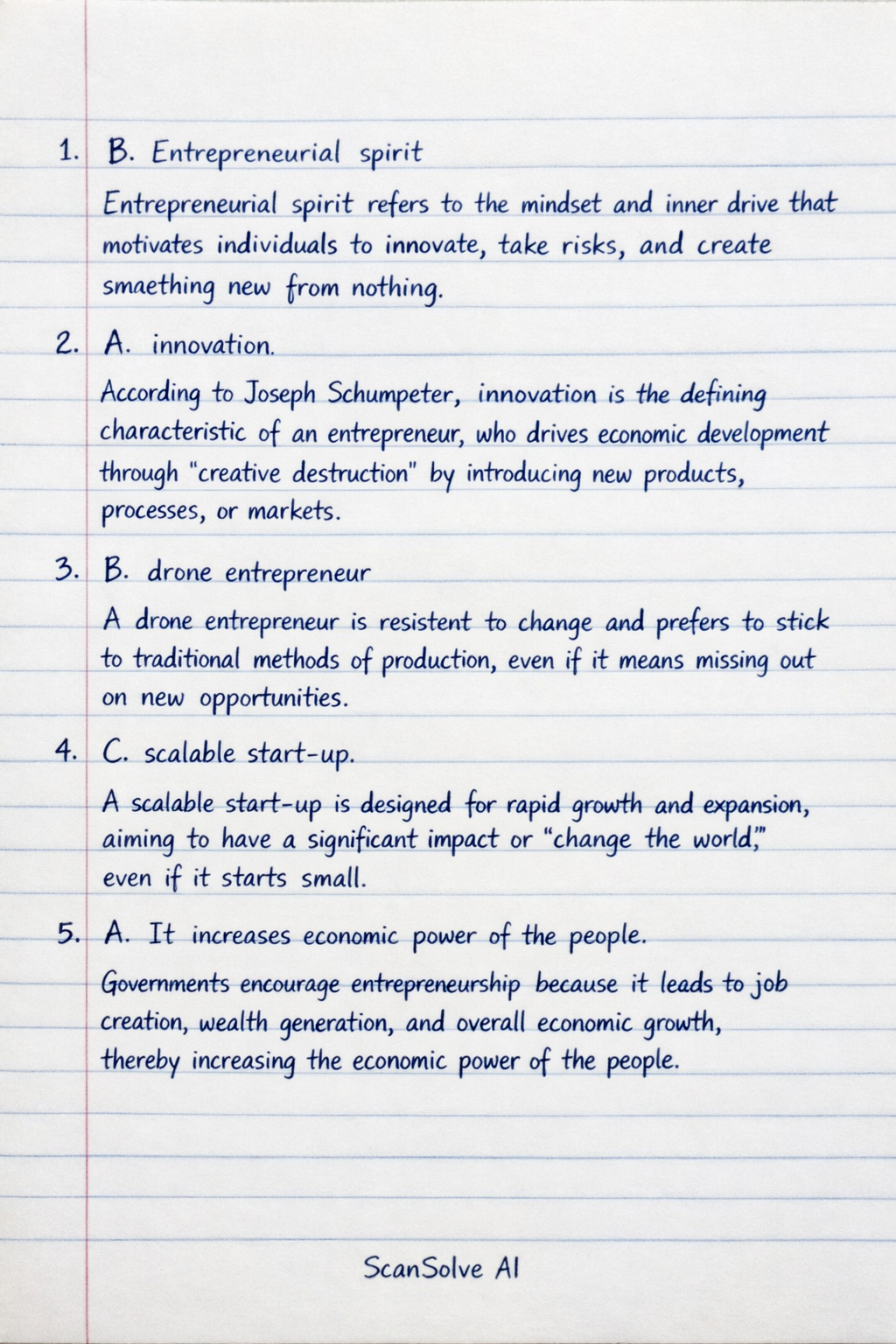
B. Entrepreneurial spirit
- Entrepreneurial spirit refers to the mindset and inner drive that motivates individuals to innovate, take risks, and create something new from nothing.
-
A. innovation
- According to Joseph Schumpeter, innovation is the defining characteristic of an entrepreneur, who drives economic development through "creative destruction" by introducing new products, processes, or markets.
-
B. drone entrepreneur
- A drone entrepreneur is resistant to change and prefers to stick to traditional methods of production, even if it means missing out on new opportunities.
-
C. scalable start-up
- A scalable start-up is designed for rapid growth and expansion, aiming to have a significant impact or "change the world," even if it starts small.
-
A. It increases economic power of the people
- Governments encourage entrepreneurship because it leads to job creation, wealth generation, and overall economic growth, thereby increasing the economic power of the people.
-
C. It is a source of income
- For the entrepreneur, the most direct advantage of starting a business is that it serves as a source of income and potential wealth.
-
C. Inadequate access to finance
- Inadequate access to finance (capital) is a common and significant challenge for start-up entrepreneurs, particularly in developing economies like Cameroon.
-
C. Lack of infrastructure
- Lack of infrastructure (e.g., reliable electricity, roads, internet) is a major systemic barrier that hinders business expansion and efficiency in many developing countries, including Cameroon.
-
C. Innovation
- To create an enterprise, innovation is a crucial characteristic, as it involves developing new products, services, or processes that differentiate the business.
-
D. Manufacturing enterprises
- Enterprises that produce tangible goods (physical products) are classified as manufacturing enterprises.
-
B. Social enterprises
- Social enterprises are businesses that prioritize addressing social or environmental problems and improving community welfare, alongside achieving financial sustainability.
-
C. To understand entrepreneurs strengths and weaknesses
- Entrepreneurial profiling helps in assessing an individual's traits, skills, and motivations, primarily to understand their strengths and weaknesses for better decision-making and development.
-
A. Helps the entrepreneur identify his area of interest
- Self-discovery in the entrepreneurship process is vital for an entrepreneur to understand their passions, values, and skills, which helps them identify their area of interest for a business venture.
-
D. Business planning
- After self-discovery and opportunity recognition, the next logical stage in the entrepreneurship process is business planning, where the idea is formalized and strategies are developed.
-
A. Tenacity
- Tenacity (persistence and determination) is a key characteristic of successful entrepreneurs, enabling them to overcome obstacles and continue working towards their goals despite setbacks.
-
B. Brainstorming and identifying problems
- Brainstorming and identifying problems is an effective method for generating business ideas, as solutions to unmet needs or existing problems often form the basis of successful ventures.
Was this helpful?
Still stuck on this one?
Ask a follow-up, and the answer starts from this question.
Got a different question?Ask your own question
More Business/Management Questions
QAn inner force that pushes someone to do something great out of nothing is:QAn individual that exhibits innovative abilities, perceives the market opportunities, and has the…QWhat are five characteristics of an innovative person, with examples relevant to small business or…QAn individual who exhibits innovative abilities, perceives market opportunities, and mobilizes…QWhich specific qualities of successful entrepreneur is the uncle using in this situation? A…
Handwritten Step-by-Step Solution
Get this as a handwritten image on WhatsApp — like a tutor wrote it for you.
Try on WhatsApp