
We read your photo as:
Which of the following is not True about Kafalah or Letter of Guaranty facility? Which of the following item is not condition as Sheria parameter on price of Murabaha?
Business/Management
ScanSolve AI Answer
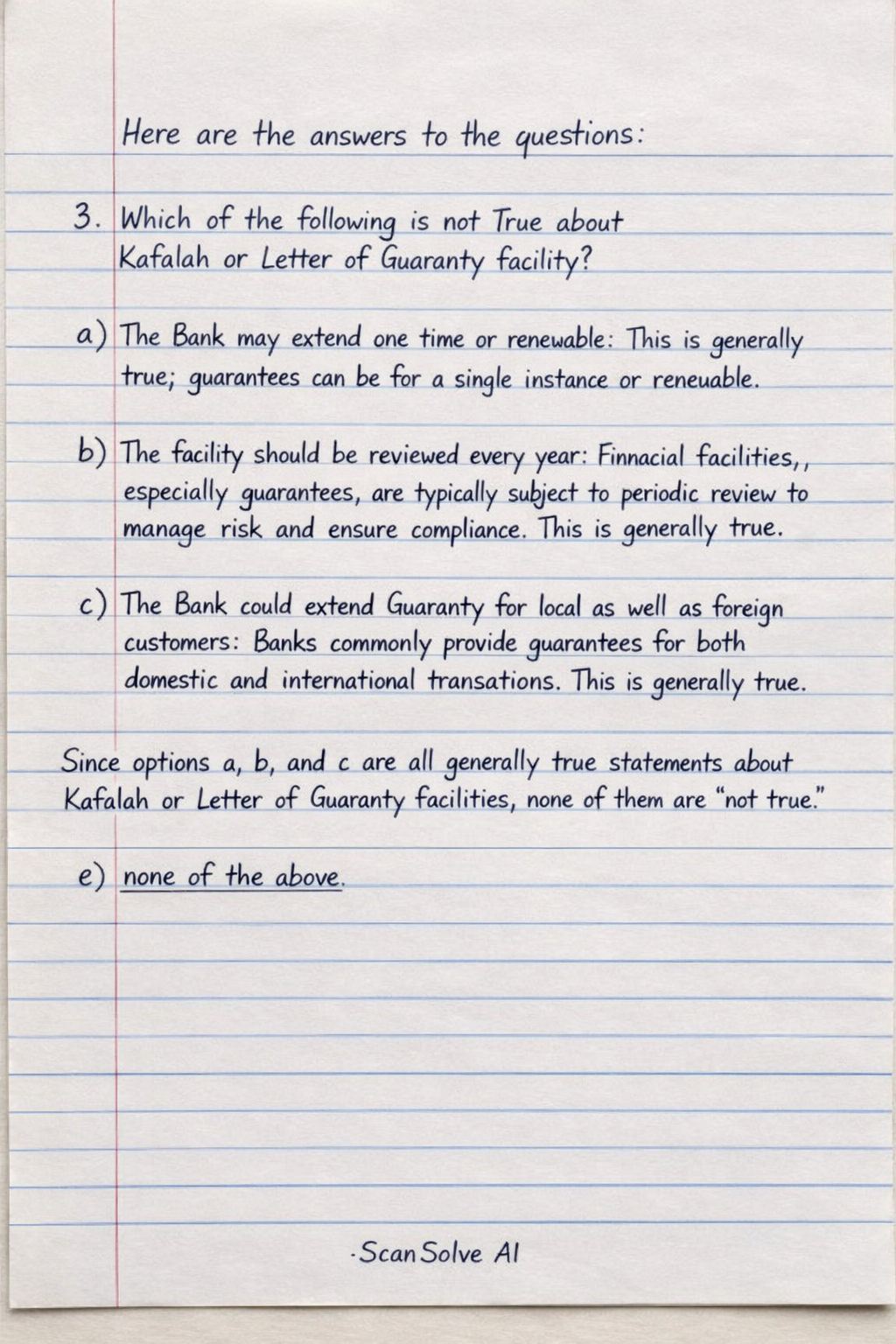
Here are the answers to the questions:
3. Which of the following is not True about Kafalah or Letter of Guaranty facility?
- a) The Bank may extend one time or renewable: This is generally true; guarantees can be for a single instance or renewable.
- b) The facility should be reviewed every year: Financial facilities, especially guarantees, are typically subject to periodic review to manage risk and ensure compliance. This is generally true.
- c) The Bank could extend Guaranty for local as well as foreign customers: Banks commonly provide guarantees for both domestic and international transactions. This is generally true. Since options a, b, and c are all generally true statements about Kafalah or Letter of Guaranty facilities, none of them are "not true."
- e) none of the above
4. Which of the following item is not condition as Sheria parameter on price of Murabaha?
- a) The basis of Murabaha sales price shall be determined based on acquisition cost with disclosed mark up added: This is a fundamental Sharia principle for Murabaha, requiring transparency of cost and profit.
- b) The determination of mark-up may be either be based on agreed percentage of agreed cost or specified for unknown currency: The phrase "specified for unknown currency" introduces uncertainty into the price, which is not permissible under Sharia for Murabaha contracts. The price must be fixed and known at the time of contract.
- c) The agreed mark up is not subject to price variation or affected by currency fluctuation: This is a Sharia condition for Murabaha; once the price is agreed, it is fixed and not subject to market or currency changes.
- d) Any mutual agreed bench mark used to determine mark up on Murabaha contract: While a benchmark might be used as a reference to agree on a fixed mark-up, if it implies a variable mark-up or one that is not fixed at the time of contract, it would not be a Sharia condition. However, the "unknown currency" in option b is a more direct and unambiguous violation of Sharia principles for Murabaha pricing certainty. Therefore, the statement containing "specified for unknown currency" describes something that is not a Sharia parameter.
- b) The determination of mark-up may be either be based on agreed percentage of agreed cost or specified for unknown currency
5. How does CRM enhance mobile banking for customers?
Customer Relationship Management (CRM) focuses on understanding customer data and preferences to improve interactions and service.
- a) By offering higher interest rates on mobile transactions: This is a product feature, not a direct enhancement from CRM.
- b) By providing a personalized, seamless user experience based on customer preferences: CRM systems collect data that allows banks to tailor the mobile banking interface, services, and offers to individual customer needs, making the experience more efficient and relevant.
- c) By restricting access to account details: This would hinder, not enhance, mobile banking.
- d) By limiting the types of transactions customers can perform: This would also hinder, not enhance, mobile banking.
- b) By providing a personalized, seamless user experience based on customer preferences
Was this helpful?
Still stuck on this one?
Ask a follow-up, and the answer starts from this question.
Got a different question?Ask your own question
More Business/Management Questions
QWhat is the maximum repayment period for motor vehicle Murabahah financing provided?QVerify the correctness of the following statements about Islamic jurisprudence and beliefs…QTrue or False - Credit sale/ Deferred payment. 3. Fill in the blank In Credit sale Agreement, the…QTrue or False: A rail consignment note can be used as a contract of carriage between consignor and…QWhich of the following documents serves as a means of payment?
Handwritten Step-by-Step Solution
Get this as a handwritten image on WhatsApp — like a tutor wrote it for you.
Try on WhatsApp