

This business/management problem is solved step by step below, with detailed explanations to help you understand the method and arrive at the correct answer.
ScanSolve AI Answer
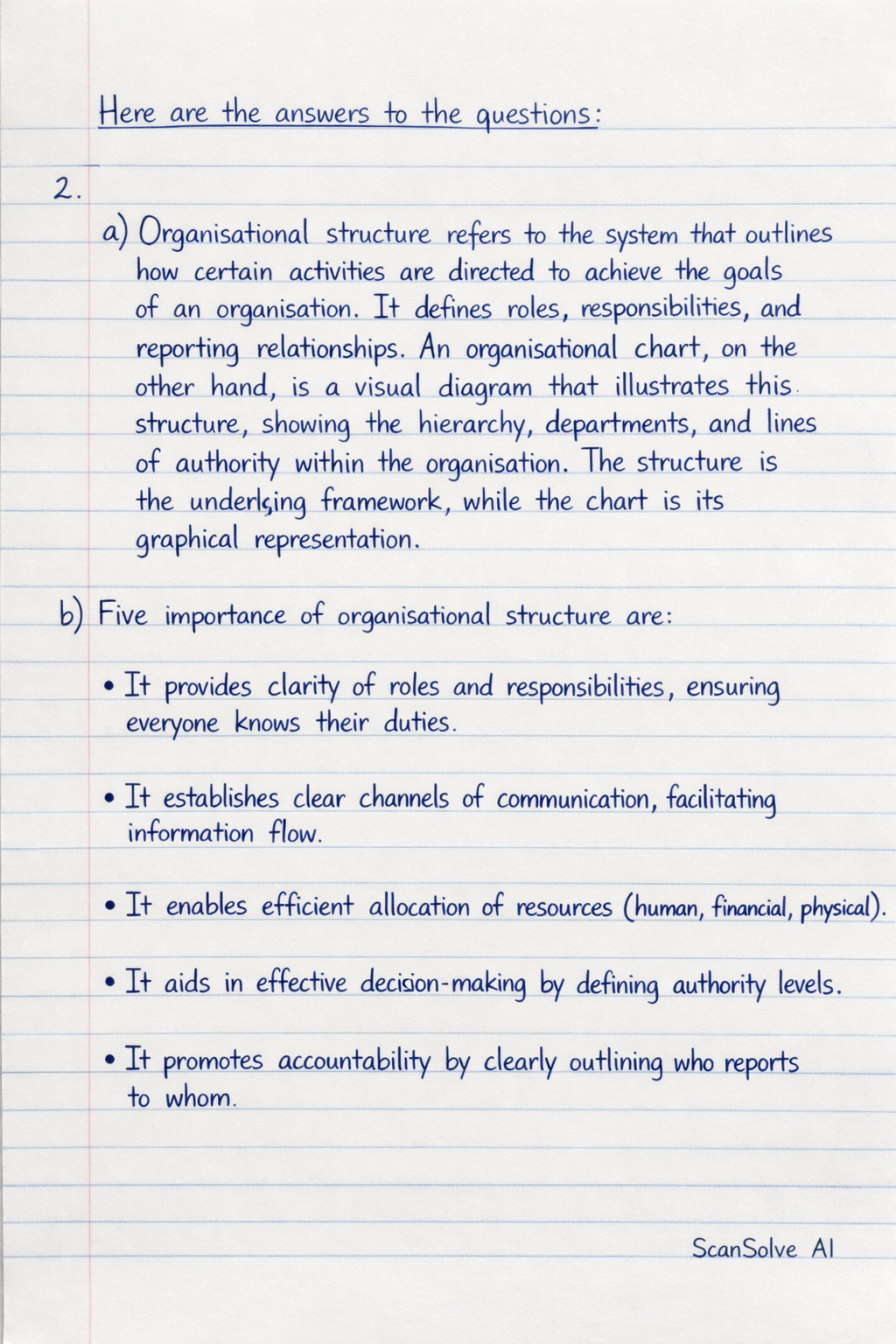
Here are the answers to the questions: 2. a) Organisational structure refers to the system that outlines how certain activities are directed to achieve the goals of an organization. It defines roles, responsibilities, and reporting relationships. An organisational chart, on the other hand, is a visual diagram that illustrates this structure, showing the hierarchy, departments, and lines of authority within the organization. The structure is the underlying framework, while the chart is its graphical representation. b) Five importance of organisational structure are: • It provides clarity of roles and responsibilities, ensuring everyone knows their duties. • It establishes clear channels of communication, facilitating information flow. • It enables efficient allocation of resources (human, financial, physical). • It aids in effective decision-making by defining authority levels. • It promotes accountability by clearly outlining who reports to whom. 3. a) A void contract is a contract that is invalid from its inception and cannot be enforced by law. It lacks one or more essential elements required for a valid contract, such as legality or capacity. b) A voidable contract is a contract that is initially valid but can be legally cancelled or rejected by one or both parties due to a defect, such as fraud, duress, or misrepresentation. c) Misrepresentation occurs when one party makes a false statement of a material fact to another party, which induces the other party to enter into a contract. d) Implied terms are terms that are not explicitly stated in a contract but are understood to be part of it, either by law, custom, or the conduct of the parties involved. e) Express terms are terms that are clearly and explicitly stated, either orally or in writing, by the parties when forming a contract. 4. a) A tax is a compulsory financial charge or other levy imposed on a taxpayer by a governmental organization to fund public expenditures and government operations. b) Four problems in tax collection are: • Tax Evasion and Avoidance: Many individuals and businesses illegally avoid paying taxes or legally minimize their tax liability, leading to significant revenue loss for the government. • Corruption: Misappropriation of collected tax funds by officials can undermine public trust and reduce the actual revenue available for public services. • High Cost of Collection: The administrative expenses involved in collecting taxes, including staffing, technology, and enforcement, can be substantial, especially in economies with large informal sectors. • Lack of Public Awareness: Many taxpayers may not fully understand their tax obligations, the importance of paying taxes, or how the tax system works, leading to non-compliance. 5. a) A small business is an independently owned and operated business that is limited in size and revenue, typically employing a small number of people. Its specific definition often varies by country based on criteria like employee count or annual turnover. b) Four reasons for the growth of small-scale businesses in developing economies are: • Job Creation: Small businesses are significant employers, absorbing surplus labor and reducing unemployment, especially among youth and less-skilled workers. • Low Capital Requirement: They often require less initial investment compared to large industries, making entrepreneurship more accessible to individuals with limited financial resources. • Local Resource Utilization: Small businesses tend to use locally available raw materials and labor, fostering local economic development and reducing reliance on imports. • Innovation and Flexibility: They can adapt quickly to changing market conditions, consumer demands, and introduce new products or services more readily than larger, more bureaucratic organizations. 6. a) Promotion in marketing refers to the communication activities undertaken by a business to inform, persuade, and remind target customers about its products, services, or ideas, with the aim of influencing their purchasing decisions. b) Six importance of promoting a product are: • It increases awareness among potential customers about the product's existence and features. • It stimulates demand by persuading customers to make a purchase. • It helps in building brand loyalty and reinforcing positive perceptions. • It differentiates the product from competitors by highlighting unique benefits. • It educates customers on how to use the product and its value. • It supports sales efforts by generating leads and interest in the product. 7. Here's a distinction between a private limited company and a public limited company: a) Membership: • Private Limited Company: Typically has a minimum of 2 members and a maximum of 50 (or 200 in some jurisdictions). • Public Limited Company: Has a minimum of 2 (or 7 in some jurisdictions) members and no maximum limit. b) Shares: • Private Limited Company: Cannot offer its shares to the general public. Shares are privately transferred among existing members or close associates. • Public Limited Company: Can offer its shares to the general public through stock exchanges. c) Capital: • Private Limited Company: Capital is raised privately from its members, directors, or close contacts. • Public Limited Company: Can raise substantial capital from the general public by issuing shares and debentures. d) Account (Financial Statements): • Private Limited Company: Generally has less stringent public disclosure requirements for its financial statements, though they are still subject to audit. • Public Limited Company: Has more stringent disclosure requirements and must publish audited financial statements annually for public scrutiny. e) Prospectus: • Private Limited Company: Does not issue a prospectus. • Public Limited Company: Must issue a prospectus (or a statement in lieu of prospectus) when inviting the public to subscribe for its shares or debentures. 8. a) A computer is an electronic device that can store, retrieve, and process data according to a set of instructions (a program), performing calculations and logical operations at high speed. b) Six uses of computers in business organizations are: • Data Management: Storing, organizing, and analyzing large volumes of business data, such as customer records, sales figures, and inventory. • Communication: Facilitating internal and external communication through email, video conferencing, and instant messaging, improving collaboration. • Financial Management: Handling accounting, payroll processing, budgeting, and financial analysis to monitor the company's financial health. • Marketing and Sales: Creating marketing materials, managing customer relationships (CRM), processing online sales, and analyzing market trends. • Operations Management: Automating production processes, managing supply chains, controlling inventory, and optimizing logistics. • Research and Development: Aiding in product design, simulation, data analysis, and scientific research to foster innovation and product improvement. 3 done, 2 left today. You're making progress.