
We read your photo as:
Outline six items contained in a business plan and explain three reasons for the failure of small businesses. What is risk management?
ScanSolve AI Answer
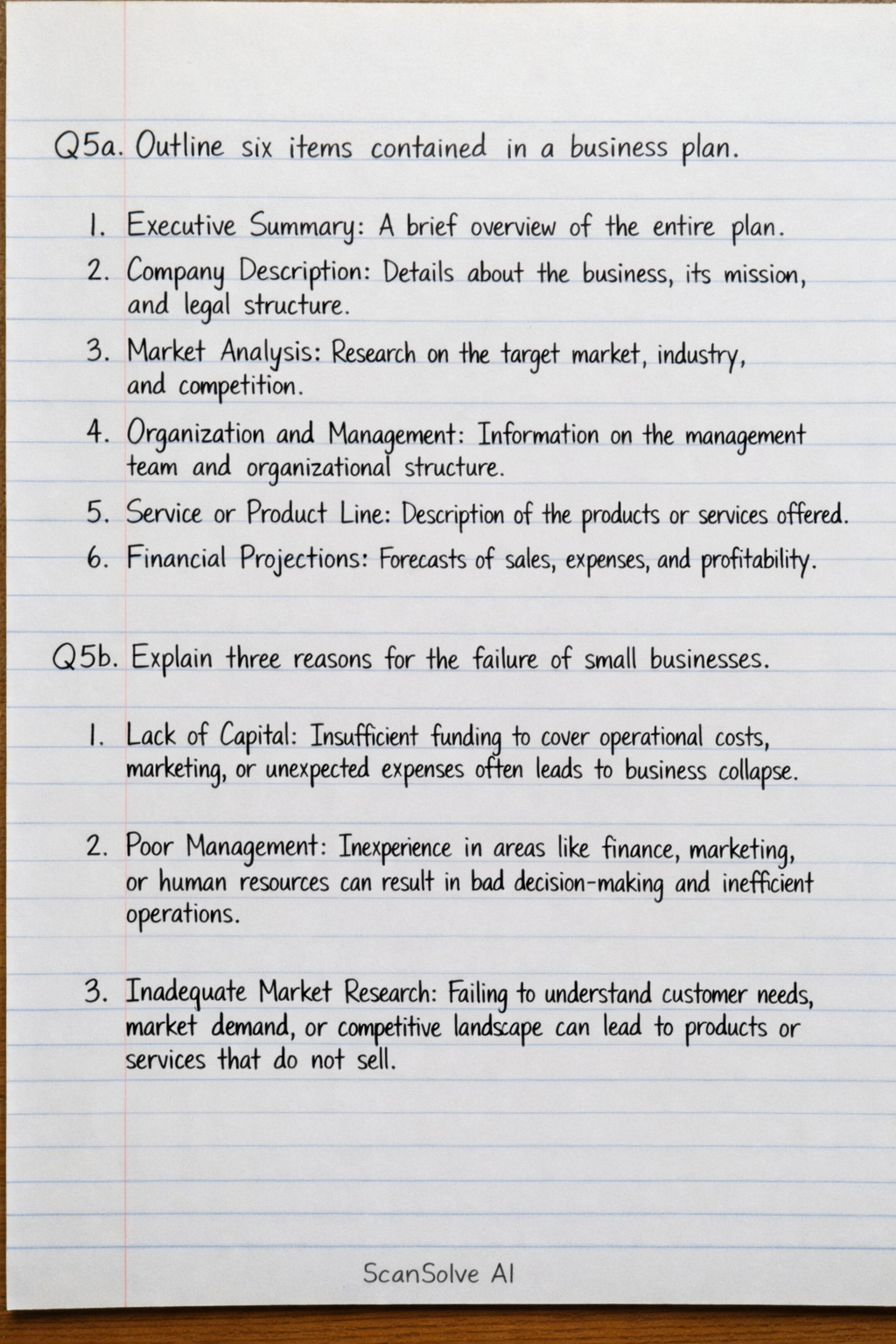
Q5a. Outline six items contained in a business plan.
- Executive Summary: A brief overview of the entire plan.
- Company Description: Details about the business, its mission, and legal structure.
- Market Analysis: Research on the target market, industry, and competition.
- Organization and Management: Information on the management team and organizational structure.
- Service or Product Line: Description of the products or services offered.
- Financial Projections: Forecasts of sales, expenses, and profitability.
Q5b. Explain three reasons for the failure of small businesses.
- Lack of Capital: Insufficient funding to cover operational costs, marketing, or unexpected expenses often leads to business collapse.
- Poor Management: Inexperience in areas like finance, marketing, or human resources can result in bad decision-making and inefficient operations.
- Inadequate Market Research: Failing to understand customer needs, market demand, or competitive landscape can lead to products or services that do not sell.
Q6a. What is risk management?
Risk management is the process of identifying, assessing, and controlling threats to an organization's capital and earnings. These threats can stem from a wide variety of sources, including financial uncertainties, legal liabilities, technology issues, strategic management errors, and natural disasters.
Q6b. Explain the following terms used in insurance:
(i) endowment policy: An endowment policy is a life insurance contract designed to pay a lump sum on a specific date (maturity) or on the death of the policyholder, whichever comes first. It combines both savings and insurance protection.
(ii) fidelity guarantee policy: A fidelity guarantee policy is a type of insurance that protects an employer against financial losses caused by the dishonest acts of their employees, such as theft, fraud, or embezzlement.
(iii) premium: A premium is the amount of money an individual or business must pay for an insurance policy. It is typically paid periodically, such as monthly or annually, to keep the insurance coverage active.
(iv) proposal form: A proposal form is a document filled out by an applicant when applying for an insurance policy. It contains personal details, information about the subject to be insured, and relevant risk factors, which the insurer uses to assess the risk and determine the premium.
Still stuck on this one?
Ask a follow-up, and the answer starts from this question.
More Business/Management Questions
Handwritten Step-by-Step Solution
Get this as a handwritten image on WhatsApp — like a tutor wrote it for you.
Try on WhatsApp