
We read your photo as:
Present the concept and types of departmentalization in an organization.
ScanSolve AI Answer
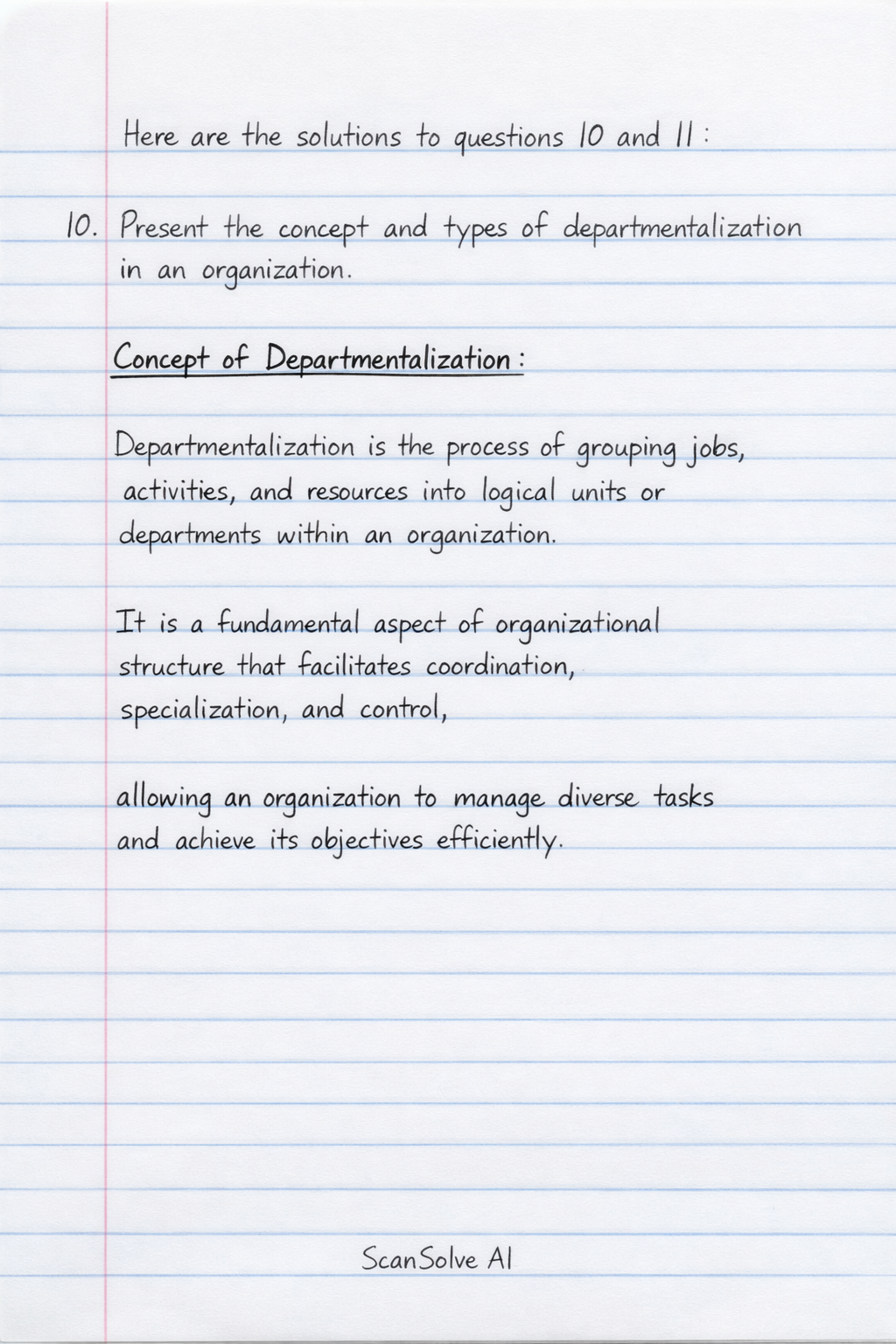
Here are the solutions to questions 10 and 11:
10. Present the concept and types of departmentalization in an organization.
Concept of Departmentalization:
Departmentalization is the process of grouping jobs, activities, and resources into logical units or departments within an organization. It is a fundamental aspect of organizational structure that facilitates coordination, specialization, and control, allowing an organization to manage diverse tasks and achieve its objectives efficiently.
Types of Departmentalization:
- Functional Departmentalization: Grouping activities based on common functions performed, such as marketing, finance, production, and human resources. This promotes specialization and efficiency within each function.
- Product Departmentalization: Grouping activities around specific products or product lines. This allows for focused attention on product development, manufacturing, and marketing for each product.
- Geographical Departmentalization: Grouping activities based on geographical regions or territories. This is suitable for organizations operating in diverse locations, allowing them to cater to local market needs and conditions.
- Customer Departmentalization: Grouping activities based on the type of customer served. This enables organizations to better understand and meet the specific needs of different customer segments.
11. Define leadership and examine any three leadership styles adopted in an organization.
Definition of Leadership:
Leadership is the process of influencing a group of individuals to achieve a common goal. It involves motivating, guiding, and inspiring people towards a shared vision, fostering collaboration, and enabling individuals and teams to perform effectively.
Leadership Styles:
- Autocratic Leadership: In this style, the leader makes decisions unilaterally without significant input from subordinates. They maintain strict control and expect compliance, often effective in situations requiring quick decisions or with inexperienced teams.
- Democratic (Participative) Leadership: This style involves the leader consulting with group members and encouraging their participation in decision-making. It fosters teamwork, boosts morale, and leverages the collective knowledge and skills of the team.
- Laissez-Faire Leadership: Here, the leader provides minimal guidance and allows subordinates to make most decisions independently. This style works best with highly skilled, self-motivated, and experienced teams who can manage their own tasks and responsibilities effectively.
Still stuck on this one?
Ask a follow-up, and the answer starts from this question.
More Business/Management Questions
Handwritten Step-by-Step Solution
Get this as a handwritten image on WhatsApp — like a tutor wrote it for you.
Try on WhatsApp