
We read your photo as:
Which pricing strategy is most suitable for selling a high-cost, innovative item to wealthy, price-insensitive consumers? A. Penetration pricing B. Skimming pricing C. Targeting price-sensitive custom
ScanSolve AI Answer
Step-by-step solution
14 stepsPart 6· 2 steps
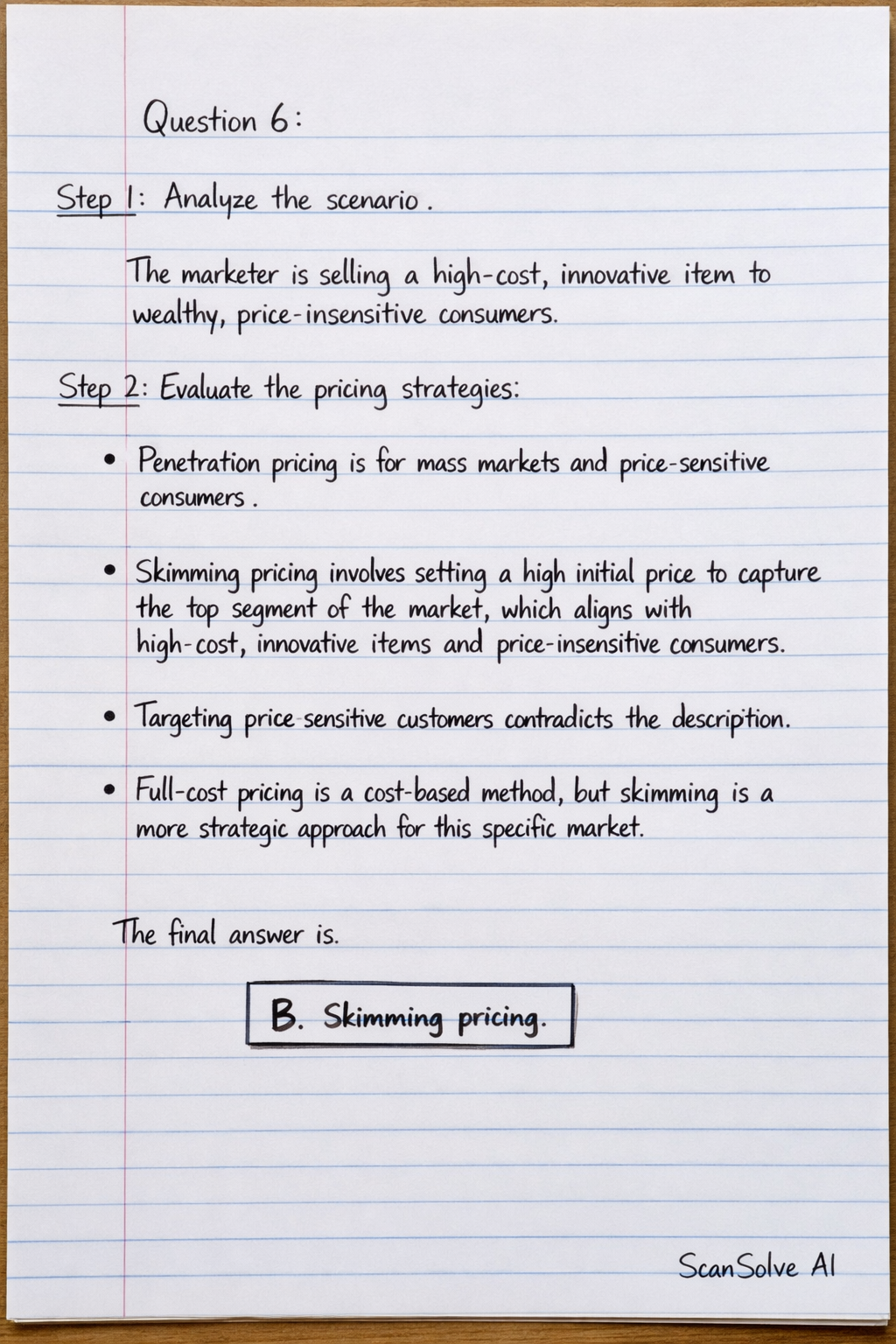
Analyze the scenario.
The marketer is selling a high-cost, innovative item to wealthy, price-insensitive consumers.
Evaluate the pricing strategies.
- Penetration pricing is for mass markets and price-sensitive consumers.
- Skimming pricing involves setting a high initial price to capture the top segment of the market, which aligns with high-cost, innovative items and price-insensitive consumers.
- Targeting price-sensitive customers contradicts the description.
- Full-cost pricing is a cost-based method, but skimming is a more strategic approach for this specific market.
The final answer is
Part 7· 2 steps
Identify the goal
minimize full costs and risks of setting up overseas operations.
Evaluate entry modes.
- Greenfield investment and Acquisition involve significant capital outlay and high risk.
- Joint ventures share costs and risks but still require substantial commitment.
- Franchising typically involves lower capital investment and risk for the franchisor, as the franchisee bears much of the operational cost and risk.
The final answer is
Part 8· 2 steps
Consider factors that increase the price of a product in a foreign market compared to the home market.
Evaluate the options.
- A. Host nation lowering tariffs would generally decrease the price.
- B. Transportation costs are an additional expense incurred when shipping goods internationally, leading to higher prices.
- C. Lowering distribution costs would generally decrease the price.
The final answer is
Part 9· 2 steps
Understand the definition
selling products abroad at a price lower than in the home market or below the cost of production.
Evaluate the terms.
- Reverse dumping is selling at a lower price in the home market.
- Price escalation refers to higher prices in foreign markets due to added costs.
- Skimming pricing is setting a high initial price.
- Dumping is precisely defined as selling products in a foreign country at a price below the price charged in the home market or below the cost of production.
The final answer is
Part 10· 2 steps
Identify the question
Which is not a reason for an exporting nation to engage in dumping?
Evaluate each option as a potential reason for dumping.
- A. To gain market share in the importing country: This is a common strategic reason for dumping.
- B. It helps the company to minimize its investment market share in the importing country: This statement is awkwardly phrased. If it means minimizing direct investment while still competing for market share through exports, it could be a reason. However, "minimize its investment market share" is contradictory.
- C. It helps to export country to clear their unsold inventory: Dumping is often used to offload surplus production.
- D. Encourage the local competition and industry in the importing country: Dumping is an anti-competitive practice that harms local competition, rather than encouraging it. This is the opposite of a reason for dumping.
- E. Helps an exporting nation to reap the benefits of economies of scale: Dumping can allow a company to increase production volume, leading to economies of scale.
Option D describes an outcome that is contrary to the purpose and effect of dumping.
The final answer is
Part 11· 2 steps
Identify the question
Which is not a purpose of international product standardization?
Evaluate each option as a purpose of standardization.
- A. If they think relatively homogenous market: Standardization is beneficial when markets are similar. This is a purpose.
- B. Economies of scale advantage: Standardization allows for mass production, reducing per-unit costs. This is a purpose.
- C. Creating consistent company and/or product: Standardization helps maintain brand image and product quality across different markets. This is a purpose.
- D. If the nation has differences in the standards: Differences in national standards are a barrier to standardization, not a purpose for it. If standards differ, products often need adaptation rather than standardization.
The final answer is
Part 12· 2 steps
Understand the definition
The influence of the country where a product is made or designed on consumer perception.
Evaluate the terms.
- A. Import country: Refers to the country receiving goods.
- B. Country of origin effect: This term specifically describes how consumers' perceptions of a product are influenced by its country of origin (manufacture, assembly, or design).
- C. Country of manufacture: This is a component of the effect, not the name of the effect itself.
- D. Global product: A product marketed worldwide.
The final answer is
Still stuck on this one?
Ask a follow-up, and the answer starts from this question.
More Business/Management Questions
Handwritten Step-by-Step Solution
Get this as a handwritten image on WhatsApp — like a tutor wrote it for you.
Try on WhatsApp