
This business/management problem is solved step by step below, with detailed explanations to help you understand the method and arrive at the correct answer.
ScanSolve AI Answer
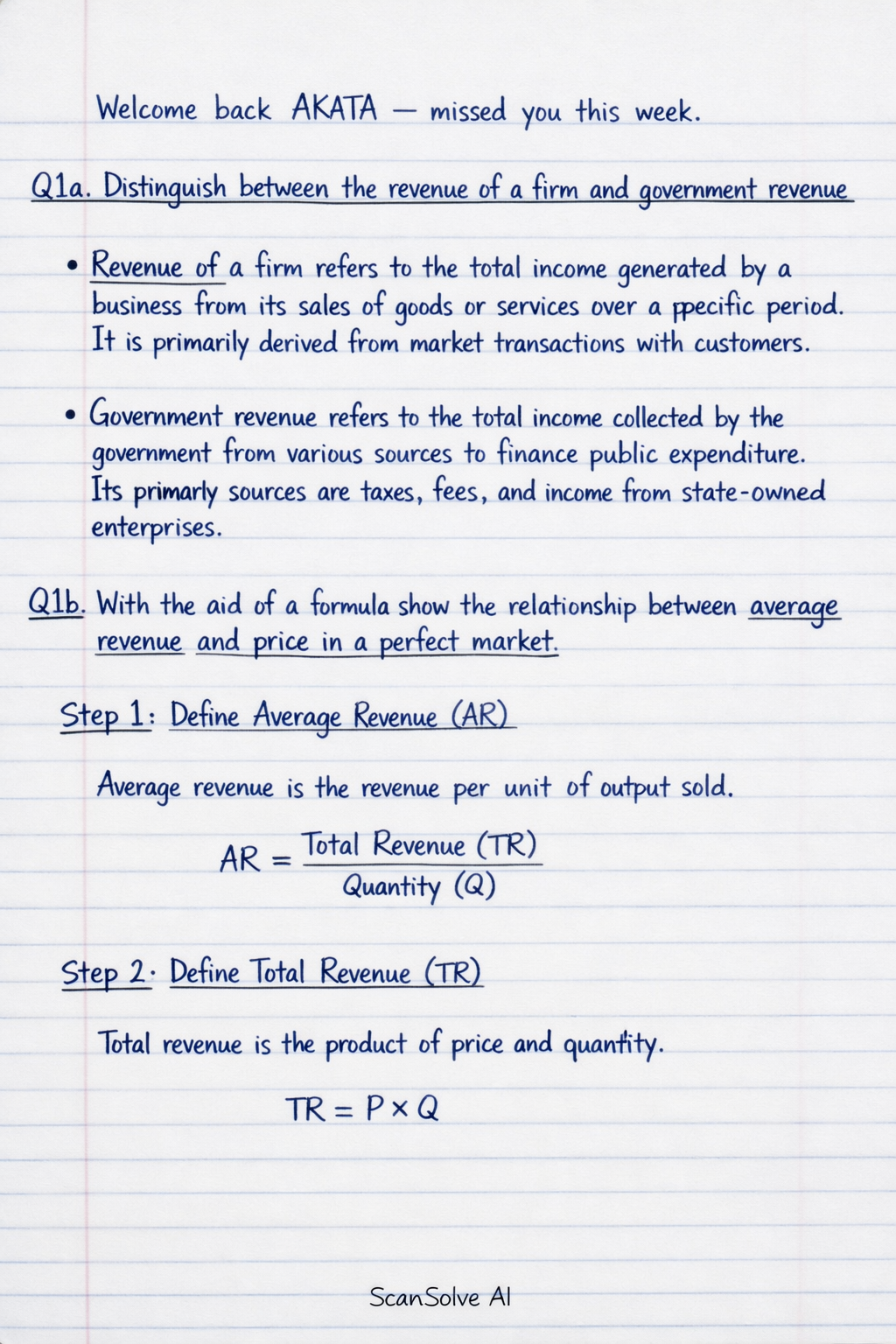
Q1a. Distinguish between the revenue of a firm and government revenue Revenue of a firm refers to the total income generated by a business from its sales of goods or services over a specific period. It is primarily derived from market transactions with customers. Government revenue refers to the total income collected by the government from various sources to finance public expenditure. Its primary sources are taxes, fees, and income from state-owned enterprises. Q1b. With the aid of a formula show the relationship between average revenue and price in a perfect market Step 1: Define Average Revenue (AR). Average revenue is the revenue per unit of output sold. AR = Total Revenue (TR)Quantity (Q) Step 2: Define Total Revenue (TR). Total revenue is the product of price and quantity. TR = P × Q Step 3: Substitute TR into the AR formula. AR = (P × Q)/(Q) AR = P In a perfectly competitive market, a firm is a price taker, meaning it sells all its output at the prevailing market price. Therefore, the average revenue received by the firm for each unit sold is equal to the market price. Q1c. Explain the reasons the marginal revenue of a monopolist is usually lower than its price A monopolist is the sole seller in a market and faces a downward-sloping demand curve. To sell an additional unit of output, the monopolist must lower the price not just for that extra unit, but for all units sold. This means that the revenue gained from selling the additional unit (its price) is partially offset by the reduction in revenue from all the previous units that are now sold at a lower price. Consequently, the marginal revenue (the additional revenue from selling one more unit) will always be less than the price of that unit. Q1d. Outline any four sources of government non-tax revenue Fees and Charges: Income from services like passport applications, driving licenses, court fees, and public utility charges. Fines and Penalties: Revenue collected from traffic violations, legal infractions, and other penalties. Profits from Public Enterprises: Earnings from state-owned companies or corporations (e.g., national oil companies, public transport services). Grants and Donations: Funds received from foreign governments, international organizations, or private entities. Sale of Government Assets: Revenue from selling public property, land, or shares in state-owned companies. Q2a. Define national income National income is the total value of all final goods and services produced within a country's borders in a specific period, usually a year, plus net factor income from abroad. It represents the total income earned by a nation's residents from their participation in production. Q2b. With an example each, explain national income concept I. Value added Explanation: Value added is the increase in the value of a good or service at each stage of production. It is calculated as the difference between the value of output and the value of intermediate consumption. Example: A baker buys flour for \1, sugar for \0.50, and eggs for \0.50 (total intermediate cost = \2). They bake a cake and sell it for \10. The value added by the baker is \10 - \2 = \8. II. Transfer payment Explanation: A transfer payment is a payment made without any goods or services being received in return. It represents a redistribution of income rather than payment for current production. Example: Government unemployment benefits paid to individuals, old-age pensions, or student grants. These payments do not reflect productive activity. III. Per capita income Explanation: Per capita income is the average income per person in a country, calculated by dividing the total national income by the total population. It is often used as an indicator of the average standard of living. Example: If a country has a national income of \100 billion and a population of 10 million, its per capita income is \100 billion / 10 million = \10,000. Q2c. Explain how net national product at factor cost is obtained from gross domestic product at market price Step 1: Adjust for Net Factor Income from Abroad. To move from Gross Domestic Product (GDP) to Gross National Product (GNP), we add Net Factor Income from Abroad (NFIA). NFIA is the difference between income earned by a country's residents from abroad and income earned by foreigners within the country. GNP_MP = GDP_MP + NFIA Step 2: Adjust for Depreciation. To move from Gross National Product (GNP) to Net National Product (NNP), we subtract Depreciation (also known as Consumption of Fixed Capital). Depreciation accounts for the wear and tear on capital goods used in production. NNP_MP = GNP_MP - Depreciation Step 3: Adjust for Indirect Taxes and Subsidies. To move from Net National Product at Market Price (NNP_MP) to Net National Product at Factor Cost (NNP_FC$), we subtract Indirect Taxes and add Subsidies. Market prices include indirect taxes and exclude subsidies, while factor cost reflects the actual income earned by factors of production. NNP_FC = NNP_MP - Indirect Taxes + Subsidies Q3a. Define barter trade Barter trade is a system of exchange where goods or services are directly exchanged for other goods or services without the use of money as a medium of exchange. Q3b. Explain any three problems associated with barter trade Double Coincidence of Wants: For a transaction to occur, both parties must simultaneously want what the other possesses and be willing to give up what they have. This is often difficult to achieve. Lack of a Common Measure of Value: There is no single unit to measure the value of different goods and services, making it hard to determine fair exchange ratios (e.g., how many chickens for one goat?). Indivisibility of Certain Goods: Some goods cannot be easily divided without losing their value (e.g., a cow). This makes it difficult to exchange them for smaller items of lesser value. Difficulty in Storing Wealth: Perishable goods cannot be stored for long periods, making it hard to save wealth for future consumption or investment. Q3c. Describe how the following factors will affect the transaction demand for money I. The individual level of income The transaction demand for money has a direct relationship* with an individual's level of income. As income increases, individuals tend to spend more on goods and services, requiring them to hold more money for daily transactions. II. The interval between pay-days The transaction demand for money has an inverse relationship* with the interval between pay-days. If the interval between pay-days is longer (e.g., monthly vs. weekly), individuals need to hold a larger average amount of money to cover their expenses until the next payday. Conversely, shorter intervals mean less money needs to be held at any given time. III. The general level of prices The transaction demand for money has a direct relationship* with the general level of prices. If prices for goods and services increase, individuals need to hold more money to purchase the same quantity of goods and services, thus increasing their demand for money for transactional purposes. Q4a. Differentiate between a free market and regulated market A free market is an economic system where prices for goods and services are determined by supply and demand, with minimal or no government intervention. Economic decisions are primarily made by individuals and private firms. A regulated market is an economic system where the government plays a significant role in controlling or influencing market activities through laws, policies, and agencies. This intervention aims to correct market failures, protect consumers, or achieve social objectives. Q4b. If labor is a major input in the production of hand-sanitizer, what will be the effects of a minimum wage on the I. Quantity of labor employed A minimum wage set above the equilibrium wage will increase the cost of labor for hand-sanitizer producers. To maintain profitability, firms will likely reduce the quantity of labor employed*, leading to job losses or slower hiring in the hand-sanitizer industry. II. Supply of the hand-sanitizer With higher labor costs due to the minimum wage, the overall cost of production for hand-sanitizer increases. This will make production less profitable, causing firms to reduce the supply of hand-sanitizer* at any given price. III. Price of the hand-sanitizer The reduced supply of hand-sanitizer (due to higher production costs) will shift the supply curve to the left. Assuming demand remains constant, this decrease in supply will lead to an increase in the price of hand-sanitizer*. Q4c. State any two effects of maximum price regulation Shortages (Excess Demand): If the maximum price (price ceiling) is set below the equilibrium price, the quantity demanded will exceed the quantity supplied, leading to a shortage of the good. Black Markets: Due to shortages, goods may be sold illegally at prices above the regulated maximum price, creating a black market. Reduced Quality: Producers may cut costs to remain profitable under a maximum price, leading to a reduction in the quality of the goods or services offered. Inefficient Allocation: The limited supply may not go to those who value it most, but rather to those who are first in line or have connections. Send me the next one 📸