Give a reason why each statement may be misleading: i. Our product will give you a perfect body ii. Our pain medicine will give you 24 hours of pain relief. iii. By reading this book, you will increas
|Business/Management
Give a reason why each statement may be misleading: i. Our product will give you a perfect body ii. Our pain medicine will give you 24 hours of pain relief. iii. By reading this book, you will increas
ScanSolve AI Answer
Answer
we reject the null hypothesis
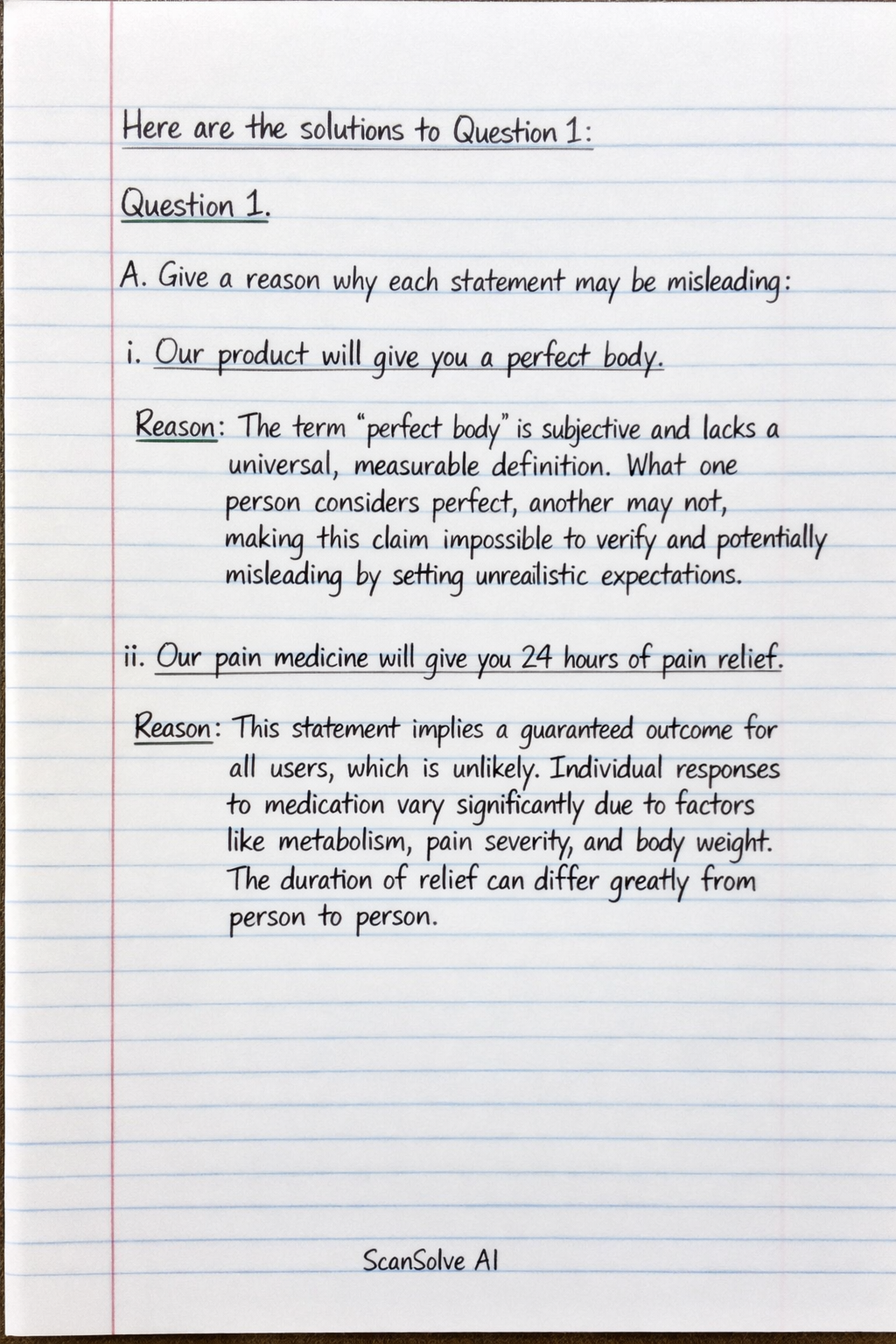
Here are the solutions to Question 1:
Question 1
A. Give a reason why each statement may be misleading.
i. Our product will give you a perfect body
Reason: The term "perfect body" is subjective and lacks a universal, measurable definition. What one person considers perfect, another may not, making this claim impossible to verify and potentially misleading by setting unrealistic expectations.
ii. Our pain medicine will give you 24 hours of pain relief.
Reason: This statement implies a guaranteed outcome for all users, which is unlikely. Individual responses to medication vary significantly due to factors like metabolism, pain severity, and body weight. The duration of relief can differ greatly from person to person.
iii. By reading this book, you will increase your IQ by 20 points.
Reason: IQ (Intelligence Quotient) is generally considered a relatively stable measure of cognitive ability, and a significant, fixed increase like 20 points from reading a single book is an unsubstantiated and highly improbable claim. Such a precise and large increase is not supported by scientific understanding of intelligence.
iv. An ad for an exercise product stated: "Using this product will burn 74% more calories"
Reason: This statement is misleading because it lacks a clear baseline for comparison. It does not specify "74% more calories than what?" (e.g., compared to not exercising, compared to another product, or compared to exercising without the product). Without a reference point, the claim is meaningless and cannot be evaluated.
B. Listed below are systolic blood pressure measurements (mm Hg) taken from the right and left arms of the same woman. Use a 0.01 significance level to test for a difference between the measurements from the two arms. What do you conclude?
This problem requires a paired t-test since the measurements are taken from the same individual.
Data:
Right arm (XR): [102,101,94,79,79]
Left arm (XL): [175,169,182,146,144]
Number of pairs (n) = 5
Significance level (α) = 0.01
Step 1: State the Hypotheses
Null Hypothesis (H0): There is no significant difference between the mean systolic blood pressure in the right and left arms (μd=0).
Alternative Hypothesis (H1): There is a significant difference between the mean systolic blood pressure in the right and left arms (μd=0).
This is a two-tailed test.
Step 2: Calculate the differences (d)
Let d=XL−XR:
d1=175−102=73
d2=169−101=68
d3=182−94=88
d4=146−79=67
d5=144−79=65
The differences are: [73,68,88,67,65]
Step 3: Calculate the mean of the differences (dˉ)dˉ=n∑d=573+68+88+67+65=5361=72.2
Step 4: Calculate the standard deviation of the differences (sd)
First, calculate ∑(d−dˉ)2:
Step 5: Calculate the t-statistict=sd/ndˉ−μd
Under the null hypothesis, μd=0:
t=9.311/572.2−0=9.311/2.23672.2=4.16472.2≈17.339
Step 6: Determine the degrees of freedom (df)df=n−1=5−1=4
Step 7: Find the critical t-value
For a two-tailed test with α=0.01 and df=4, the critical t-value (tα/2,df=t0.005,4) from the t-distribution table is ±4.604.
Step 8: Compare the calculated t-statistic with the critical t-value
The absolute value of the calculated t-statistic is ∣17.339∣.
Since ∣17.339∣>4.604, the calculated t-statistic falls into the rejection region. Therefore, we reject the null hypothesis.
Step 9: Conclusion
At a 0.01 significance level, there is sufficient evidence to conclude that there is a statistically significant difference between the systolic blood pressure measurements from the right and left arms of the woman. Specifically, the measurements from the left arm are significantly higher than those from the right arm.
Was this helpful?
Need help with your own homework?
Get instant step-by-step solutions to any question. Free to start.
Here are the solutions to Question 1: Question 1 A.
Give a reason why each statement may be misleading.
Our product will give you a perfect body Reason:* The term "perfect body" is subjective and lacks a universal, measurable definition.
Our pain medicine will give you 24 hours of pain relief.
Give a reason why each statement may be misleading: i. Our product will give you a perfect body ii. Our pain medicine will give you 24 hours of pain relief. iii. By reading this book, you will increas
This business/management problem is solved step by step below, with detailed explanations to help you understand the method and arrive at the correct answer.
ScanSolve AI Answer
Here are the solutions to Question 1: Question 1 A. Give a reason why each statement may be misleading. i. Our product will give you a perfect body Reason:* The term "perfect body" is subjective and lacks a universal, measurable definition. What one person considers perfect, another may not, making this claim impossible to verify and potentially misleading by setting unrealistic expectations. ii. Our pain medicine will give you 24 hours of pain relief. Reason:* This statement implies a guaranteed outcome for all users, which is unlikely. Individual responses to medication vary significantly due to factors like metabolism, pain severity, and body weight. The duration of relief can differ greatly from person to person. iii. By reading this book, you will increase your IQ by 20 points. Reason:* IQ (Intelligence Quotient) is generally considered a relatively stable measure of cognitive ability, and a significant, fixed increase like 20 points from reading a single book is an unsubstantiated and highly improbable claim. Such a precise and large increase is not supported by scientific understanding of intelligence. iv. An ad for an exercise product stated: "Using this product will burn 74% more calories" Reason:* This statement is misleading because it lacks a clear baseline for comparison. It does not specify "74% more calories than what?" (e.g., compared to not exercising, compared to another product, or compared to exercising without the product). Without a reference point, the claim is meaningless and cannot be evaluated. B. Listed below are systolic blood pressure measurements (mm Hg) taken from the right and left arms of the same woman. Use a 0.01 significance level to test for a difference between the measurements from the two arms. What do you conclude? This problem requires a paired t-test since the measurements are taken from the same individual. Data: Right arm (X_R): [102, 101, 94, 79, 79] Left arm (X_L): [175, 169, 182, 146, 144] Number of pairs (n) = 5 Significance level () = 0.01 Step 1: State the Hypotheses Null Hypothesis (H_0): There is no significant difference between the mean systolic blood pressure in the right and left arms (_d = 0). Alternative Hypothesis (H_1): There is a significant difference between the mean systolic blood pressure in the right and left arms (_d ≠ 0). This is a two-tailed test. Step 2: Calculate the differences (d) Let d = X_L - X_R: d_1 = 175 - 102 = 73 d_2 = 169 - 101 = 68 d_3 = 182 - 94 = 88 d_4 = 146 - 79 = 67 d_5 = 144 - 79 = 65 The differences are: [73, 68, 88, 67, 65] Step 3: Calculate the mean of the differences (d) d = ( d)/(n) = (73 + 68 + 88 + 67 + 65)/(5) = (361)/(5) = 72.2 Step 4: Calculate the standard deviation of the differences (s_d) First, calculate (d - d)^2: (73 - 72.2)^2 = (0.8)^2 = 0.64 (68 - 72.2)^2 = (-4.2)^2 = 17.64 (88 - 72.2)^2 = (15.8)^2 = 249.64 (67 - 72.2)^2 = (-5.2)^2 = 27.04 (65 - 72.2)^2 = (-7.2)^2 = 51.84 (d - d)^2 = 0.64 + 17.64 + 249.64 + 27.04 + 51.84 = 346.8 Now, calculate s_d: s_d = sqrt( (d - d))^2n-1 = sqrt((346.8)/(5-1)) = sqrt((346.8)/(4)) = sqrt(86.7) ≈ 9.311 Step 5: Calculate the t-statistic t = d - _ds_d / sqrt(n) Under the null hypothesis, _d = 0: t = (72.2 - 0)/(9.311 / sqrt(5)) = (72.2)/(9.311 / 2.236) = (72.2)/(4.164) ≈ 17.339 Step 6: Determine the degrees of freedom (df) df = n - 1 = 5 - 1 = 4 Step 7: Find the critical t-value For a two-tailed test with = 0.01 and df = 4, the critical t-value (t_/2, df = t_0.005, 4) from the t-distribution table is ± 4.604. Step 8: Compare the calculated t-statistic with the critical t-value The absolute value of the calculated t-statistic is |17.339|. Since |17.339| > 4.604, the calculated t-statistic falls into the rejection region. Therefore, we reject the null hypothesis. Step 9: Conclusion At a 0.01 significance level, there is sufficient evidence to conclude that there is a statistically significant difference between the systolic blood pressure measurements from the right and left arms of the woman. Specifically, the measurements from the left arm are significantly higher than those from the right arm.