
We read your photo as:
Explain the relationship between productivity, utilisation, and efficiency, and discuss the shift in focus from full utilisation to lean principles.
ScanSolve AI Answer
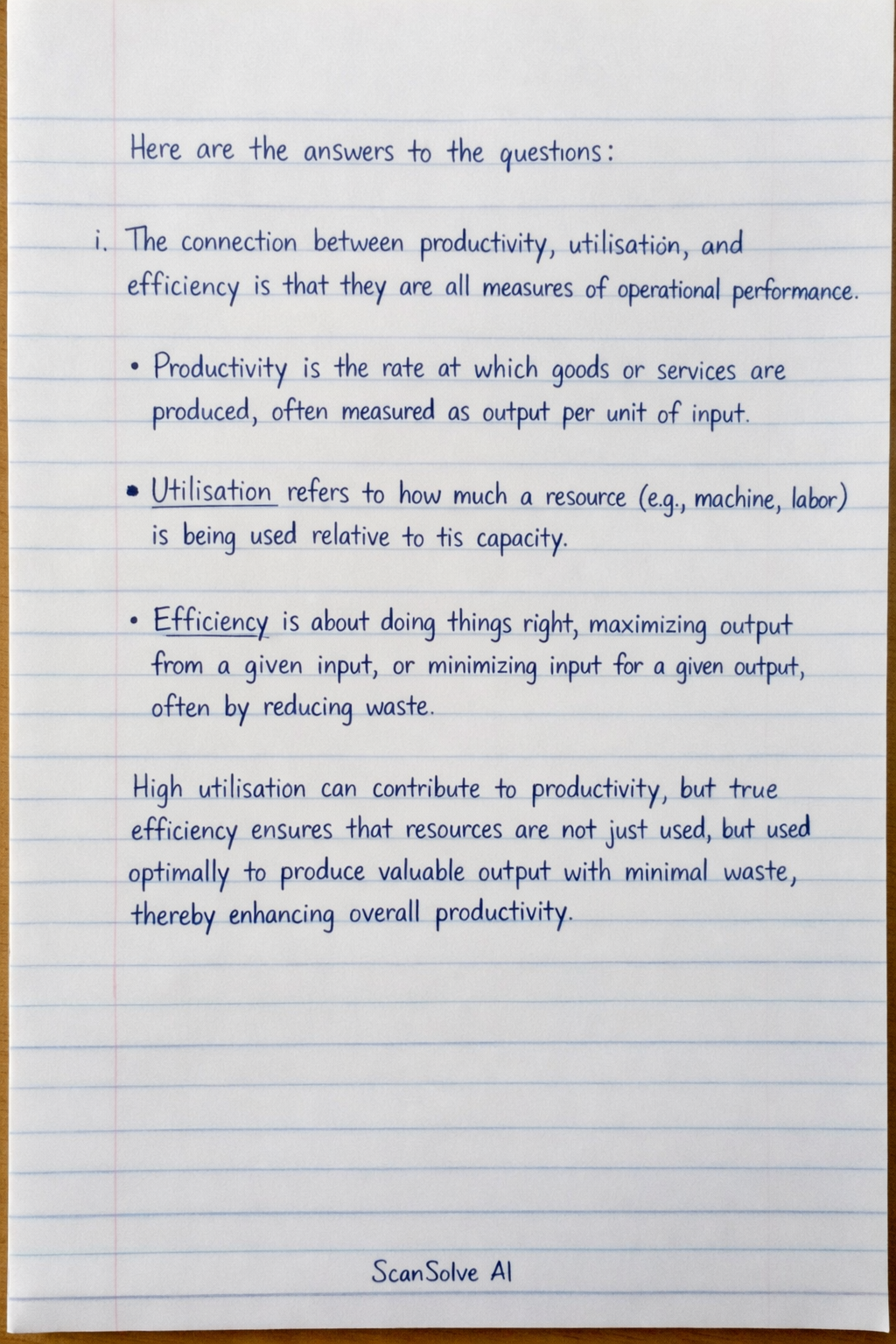
Here are the answers to the questions:
i. The connection between productivity, utilisation, and efficiency is that they are all measures of operational performance.
- Productivity is the rate at which goods or services are produced, often measured as output per unit of input.
- Utilisation refers to how much a resource (e.g., machine, labor) is being used relative to its capacity.
- Efficiency is about doing things right, maximizing output from a given input, or minimizing input for a given output, often by reducing waste. High utilisation can contribute to productivity, but true efficiency ensures that resources are not just used, but used optimally to produce valuable output with minimal waste, thereby enhancing overall productivity.
ii. Traditionally, 'full utilisation of resources' was seen as a prerequisite for productivity because it was believed that keeping all resources constantly busy would maximize output. However, the 'Lean manufacturing' philosophy places less emphasis on utilisation because it prioritizes the elimination of waste and the creation of value. Full utilisation can lead to overproduction, which creates excess inventory (a form of waste) and hides underlying problems. Lean focuses on producing only what is needed, when it is needed, emphasizing flow and pull systems over simply keeping machines running at full capacity. This means that some idle time might be acceptable if it prevents waste and allows for greater flexibility and responsiveness.
iii. The terms 'effectiveness' and 'efficiency' are distinct concepts:
- Efficiency means doing things right. It focuses on the process and how resources are used to achieve an outcome with minimal waste (e.g., producing a product using the least amount of materials and time).
- Effectiveness means doing the right things. It focuses on the outcome and whether the desired goal or objective is achieved (e.g., producing a product that meets customer needs and achieves sales targets). An operation can be efficient but not effective (e.g., efficiently producing a product nobody wants), or effective but not efficient (e.g., achieving a goal but wasting many resources in the process).
Still stuck on this one?
Ask a follow-up, and the answer starts from this question.
More Business/Management Questions
Handwritten Step-by-Step Solution
Get this as a handwritten image on WhatsApp — like a tutor wrote it for you.
Try on WhatsApp