

This business/management problem is solved step by step below, with detailed explanations to help you understand the method and arrive at the correct answer.
ScanSolve AI Answer
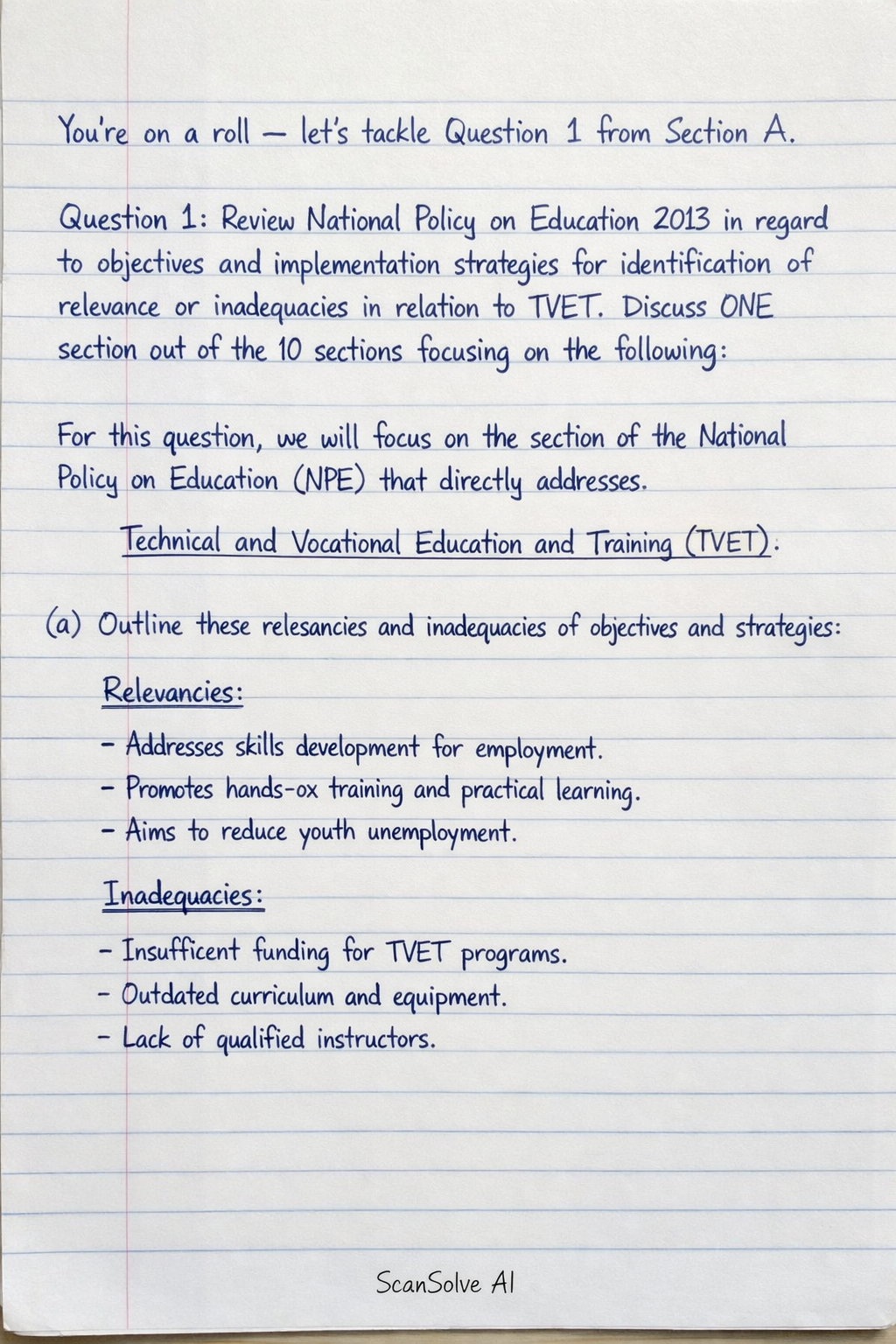
You're on a roll — let's tackle Question 1 from Section A. Question 1: Review National Policy on Education 2013 in regard to objectives and implementation strategies for identification of relevance or inadequacies in relation to TVET. Discuss ONE section out of the 10 sections focusing on the following: For this question, we will focus on the section of the National Policy on Education (NPE) that directly addresses Technical and Vocational Education and Training (TVET). (a) Outline these relevancies and inadequacies of objectives and strategies Relevancies of Objectives and Strategies: Skill Acquisition: The policy emphasizes equipping individuals with practical skills for employment and self-reliance, which is highly relevant to national development and reducing unemployment. Industry Linkage: It promotes collaboration between TVET institutions and industries to ensure curriculum relevance and provide practical experience, aligning education with labor market needs. Entrepreneurship Promotion: The policy aims to foster entrepreneurial skills among TVET graduates, encouraging job creation rather than just job seeking. Manpower Development: It recognizes TVET as crucial for producing the skilled workforce necessary for industrial growth and technological advancement. Access and Equity: The policy seeks to expand access to TVET for all citizens, including marginalized groups, promoting inclusive development. Inadequacies of Objectives and Strategies: Inadequate Funding: Despite policy objectives, TVET often suffers from insufficient and inconsistent funding, leading to poor infrastructure and outdated equipment. Curriculum Obsolescence: The curriculum review process can be slow, resulting in content that does not always align with rapidly evolving industry demands and technological advancements. Teacher Shortage and Quality: There is a persistent shortage of qualified TVET instructors, and existing ones may lack up-to-date industrial experience or pedagogical skills. Poor Public Perception: TVET often faces a societal stigma, with a preference for university education, leading to low enrollment and underappreciation of vocational skills. Weak Monitoring and Evaluation: Implementation strategies often lack robust monitoring and evaluation mechanisms, making it difficult to assess effectiveness and make timely adjustments. Infrastructure Deficit: Many TVET institutions operate with dilapidated facilities and a lack of modern workshops and laboratories essential for practical training. (b) Discuss how they could be used as a basis for policy reforms/revision The identified relevancies and inadequacies provide a critical foundation for reforming and revising the National Policy on Education concerning TVET. Leveraging Relevancies for Reinforcement: The policy's strong emphasis on skill acquisition, industry linkage, and entrepreneurship should be reinforced* with concrete implementation plans and dedicated resources. For instance, the relevance of industry collaboration can be strengthened by mandating and incentivizing partnerships, perhaps through tax breaks for companies that offer internships or co-develop curricula. The objective of manpower development can be enhanced by conducting regular labor market surveys* to identify critical skill gaps and then rapidly adjusting TVET programs to meet these needs. Addressing Inadequacies for Strategic Revision: Funding: Policy revision must include a clear, sustainable funding model* for TVET, possibly through dedicated levies, public-private partnerships, or increased budgetary allocation, with strict accountability measures. This would address the inadequacy of insufficient funding. Curriculum: A revised policy should establish a dynamic and responsive curriculum development framework* that involves continuous input from industry experts, professional bodies, and employers to prevent obsolescence. This directly tackles the issue of outdated curricula. Teacher Development: The policy needs to outline comprehensive strategies for attracting, training, and retaining qualified TVET instructors*, including competitive remuneration, continuous professional development, and pathways for industry professionals to transition into teaching. This addresses the shortage and quality of teachers. Public Perception: Policy reforms should include aggressive public awareness campaigns* to highlight the value, career opportunities, and economic benefits of TVET, thereby changing societal attitudes and increasing enrollment. Infrastructure: The revised policy should mandate a phased upgrade of TVET infrastructure and equipment*, ensuring that institutions have modern facilities that mirror industry standards. Monitoring and Evaluation: A robust monitoring and evaluation framework* with clear performance indicators and regular reporting mechanisms must be integrated into the policy to track implementation progress and ensure accountability. This will help bridge the gap between policy formulation and effective execution. By systematically addressing these points, policy reforms can transform TVET into a more effective, relevant, and respected pathway for national development and individual empowerment. Drop the next question! 📸