
We read your photo as:
Statements made in a share certificate under the common seal of the company are prima facie evidence of ....
ScanSolve AI Answer
Answer
here are the answers to the questions:
15. Statements made in a share certificate under the common seal of the company are prima facie evidence of ....
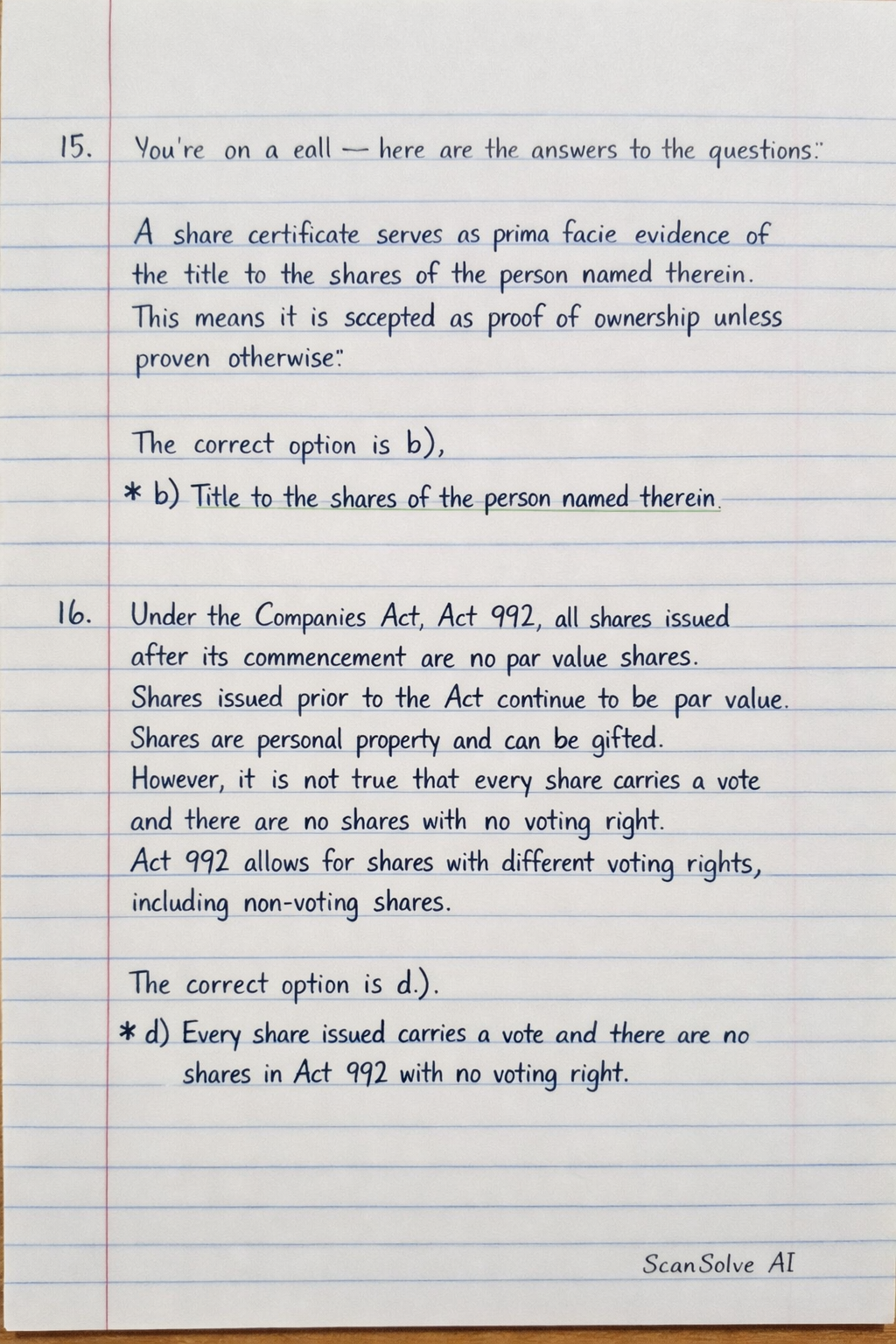
A share certificate serves as prima facie evidence of the title to the shares of the person named therein. This means it is accepted as proof of ownership unless proven otherwise.
The correct option is b).
b) Title to the shares of the person named therein
16. One of the following is not true about shares issued under the Companies Act, (Act 992)
Under the Companies Act, Act 992, all shares issued after its commencement are no par value shares. Shares issued prior to the Act continue to be par value. Shares are personal property and can be gifted. However, it is not true that every share carries a vote and there are no shares with no voting right. Act 992 allows for shares with different voting rights, including non-voting shares.
The correct option is d).
d) Every share issued carries a vote and there are no shares in Act 992 with no voting right.
17. The decision as to how many of the authorized shares of the company should be issued and the consideration thereof is made by:
The decision regarding the issuance of authorized shares and their consideration (what is received in exchange) is typically made by the shareholders of the company, often through resolutions.
The correct option is d).
d) The shareholders
18. All the following except one are non-cash payments for shares under the Act
Non-cash payments for shares involve receiving something other than direct cash. Options a, b, and d describe situations where shares are issued in exchange for services or property, which are non-cash considerations. Option c, payment of shares through mobile money transfer, is a form of cash payment, as mobile money is a digital equivalent of cash. Therefore, it is not a non-cash payment.
The correct option is c).
c) Payment of shares through mobile money transfer
19. Under which of the following Instances is the company not required to file returns of issues with the Registrar
Companies are generally required to file returns for new issues of shares (fresh issues), re-issues of treasury shares (treasurer shares), and capitalization issues (bonus shares). All the listed options (a, b, and c) are instances that typically require filing returns with the Registrar to reflect changes in the company's issued share capital. Therefore, if the question asks when the company is not required to file, and all the listed options do require filing, then "None of the above" is the correct answer.
The correct option is d).
d) None of the above
Try one yourself
A new problem that tests the same skill.
Still stuck on this one?
Ask a follow-up, and the answer starts from this question.
More Business/Management Questions
Handwritten Step-by-Step Solution
Get this as a handwritten image on WhatsApp — like a tutor wrote it for you.
Try on WhatsApp