
We read your photo as:
Will Sole trader/proprietor be suitable then a private company, motivate.
ScanSolve AI Answer
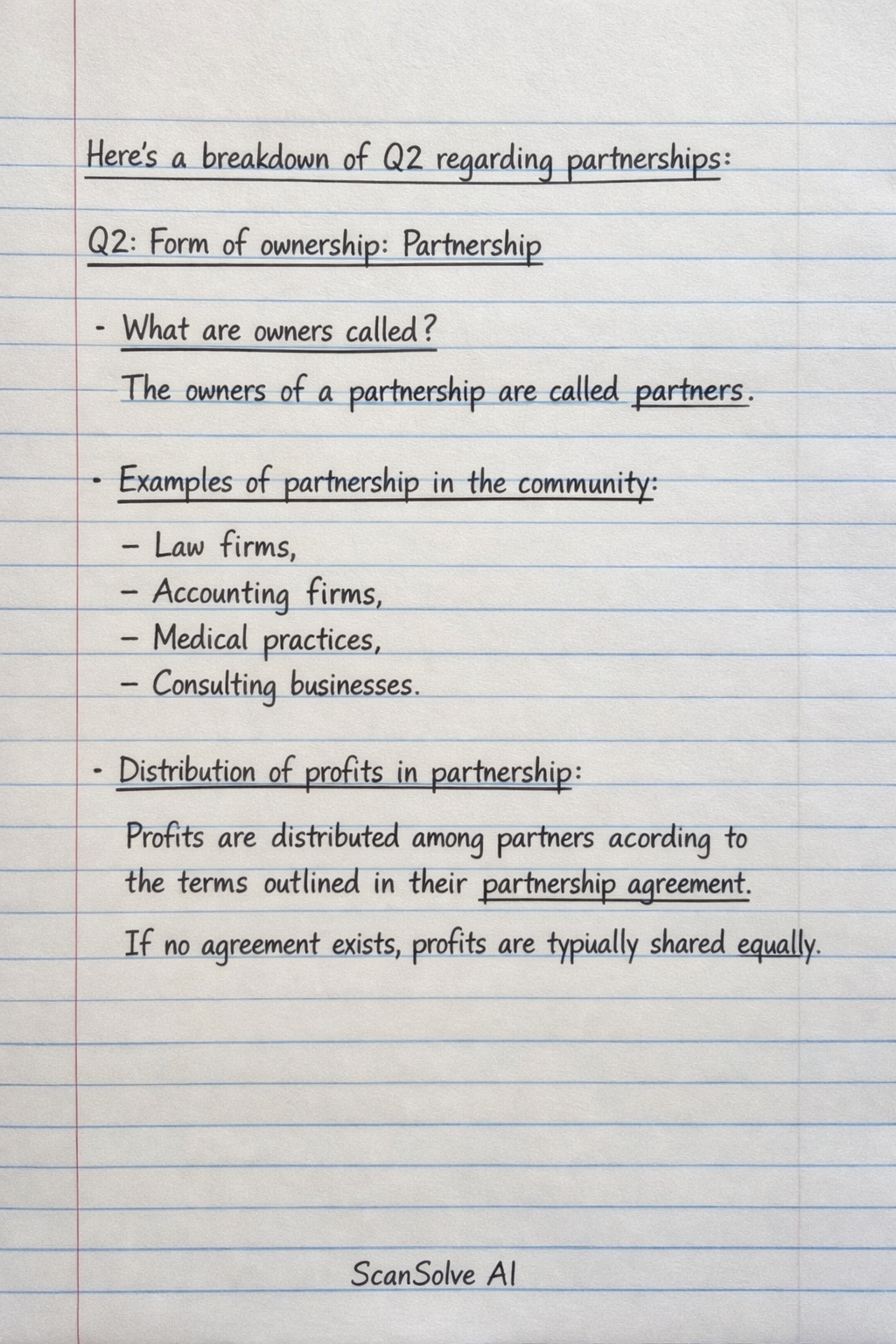
Here's a breakdown of Q2 regarding partnerships:
Q2: Form of ownership: Partnership
-
What are owners called? The owners of a partnership are called partners.
-
Examples of partnership in the community. Common examples include law firms, accounting firms, medical practices, and some consulting businesses.
-
Distribution of profits in partnership. Profits are distributed among partners according to the terms outlined in their partnership agreement. If no agreement exists, profits are typically shared equally.
-
Evaluate partnership (characteristics):
- a) Start up of partnership: Relatively easy and inexpensive to establish, requiring fewer legal formalities compared to a company. A written partnership agreement is highly recommended but not always legally mandatory.
- b) Continuity of the business: A partnership has limited continuity. It can be dissolved by the death, retirement, or withdrawal of a partner, or by mutual agreement.
- c) Capital contribution: Capital is contributed by the partners themselves, pooling their financial resources, skills, and expertise.
- d) Legal requirements: While a formal written agreement is advisable, the legal requirements for forming a partnership are generally less stringent than for companies. Registration may be required depending on the jurisdiction and nature of the business.
- e) Tax implication: In many jurisdictions, a partnership itself is not taxed as a separate entity. Instead, the partners' share of the profits is taxed as their individual income.
-
How partnership could contribute to sustainable job creation in S.A. Partnerships can foster job creation by allowing individuals to combine diverse skills, capital, and networks to start and expand businesses that might be too large or complex for a sole proprietor. This pooling of resources can lead to more robust and innovative ventures, thereby creating employment opportunities and contributing to economic growth.
-
Who would become responsible for debts of the business if partnership became insolvent? In a general partnership, all partners have unlimited liability. This means they are personally responsible for all the debts and obligations of the business, even if it means using their personal assets to cover the business's liabilities. They are also jointly and severally liable, meaning each partner can be held responsible for the full amount of the partnership's debts.
Still stuck on this one?
Ask a follow-up, and the answer starts from this question.
More Business/Management Questions
Handwritten Step-by-Step Solution
Get this as a handwritten image on WhatsApp — like a tutor wrote it for you.
Try on WhatsApp