
We read your photo as:
Distinguish between primary/secondary and direct/indirect production. Explain four advantages of a sole proprietorship.
ScanSolve AI Answer
here are the answers to the questions:
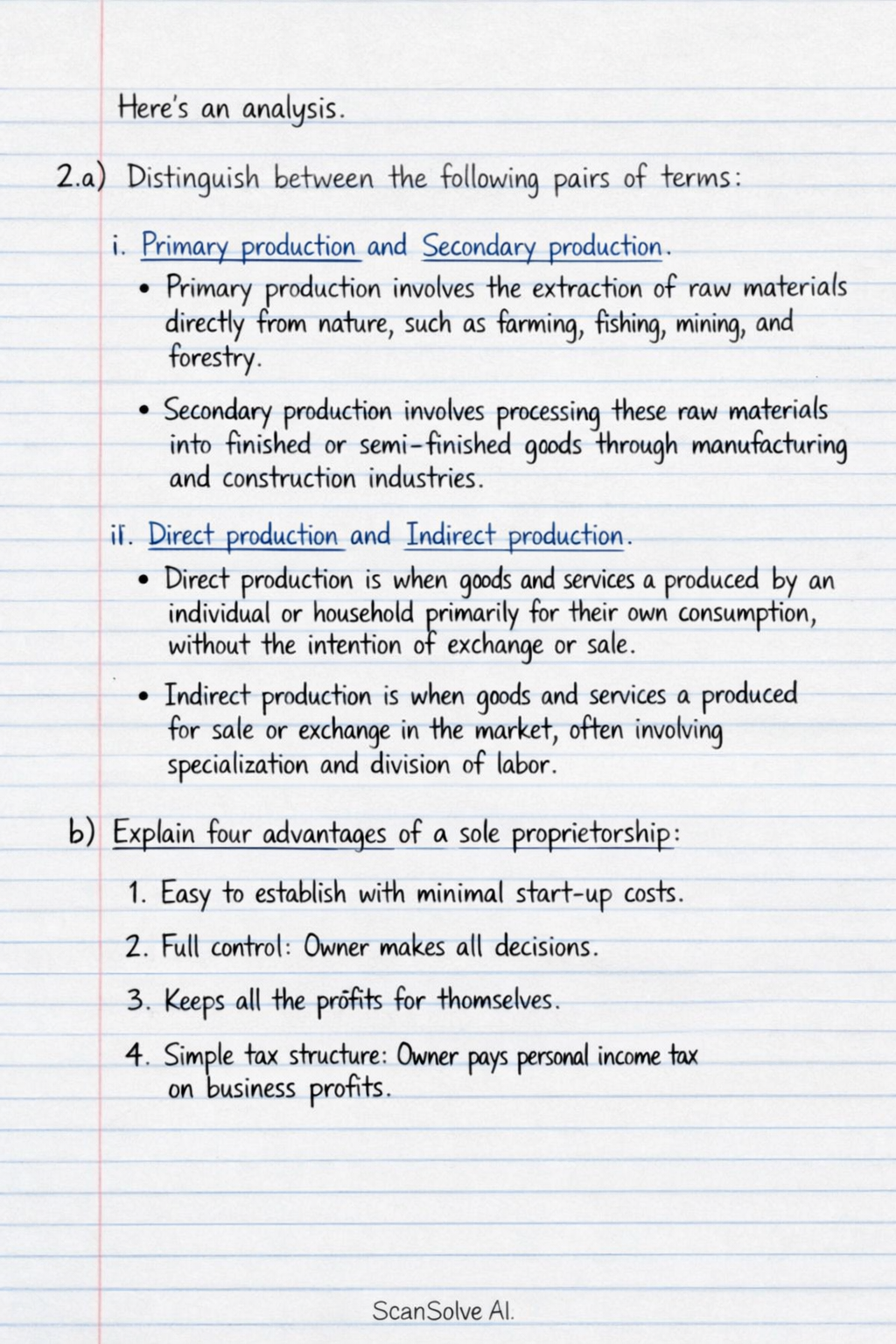
2.a) Distinguish between the following pairs of terms:
i. Primary production and Secondary production. * Primary production involves the extraction of raw materials directly from nature, such as farming, fishing, mining, and forestry. * Secondary production involves processing these raw materials into finished or semi-finished goods through manufacturing and construction industries.
ii. Direct production and Indirect production. * Direct production is when goods and services are produced by an individual or household primarily for their own consumption, without the intention of exchange or sale. * Indirect production is when goods and services are produced for sale or exchange in the market, often involving specialization and division of labor.
b) Explain four advantages of a sole proprietorship.
- Easy to set up: A sole proprietorship is relatively simple and inexpensive to establish, with minimal legal formalities and registration requirements.
- Owner retains all profits: The sole proprietor is entitled to all the profits generated by the business, providing a strong incentive for hard work and efficiency.
- Full control and quick decision-making: The owner has complete control over all business operations and can make decisions quickly without consulting partners or shareholders.
- Privacy of business affairs: The financial and operational details of a sole proprietorship are generally private and do not need to be disclosed to the public.
c) State four functions of money in the economy.
- Medium of exchange: Money facilitates transactions by acting as an intermediary for the exchange of goods and services, eliminating the need for barter.
- Measure of value (Unit of account): Money provides a common standard for expressing the value of different goods, services, and assets, making comparisons easier.
- Store of value: Money can be saved and held over time to be used for future purchases, allowing individuals to defer consumption.
- Standard of deferred payment: Money serves as a means of settling future debts and obligations, making credit transactions and long-term contracts possible.
3.a) Explain five characteristics of a private limited company.
- Separate legal entity: A private limited company has its own legal identity distinct from its owners (shareholders), meaning it can own assets, incur debts, and sue or be sued in its own name.
- Limited liability: The liability of shareholders is limited to the amount they have invested in the company's shares. Their personal assets are protected from business debts.
- Shares not offered to the public: Shares of a private limited company cannot be publicly traded or offered for sale to the general public. They are typically sold privately.
- Minimum and maximum number of members: A private limited company must have a minimum of two shareholders and a maximum of fifty shareholders.
- Perpetual succession: The company's existence is not affected by the death, insolvency, or withdrawal of its members. It continues to exist until legally dissolved.
b) Outline five challenges faced by entrepreneurs in Kenya today.
- Limited access to finance: Many entrepreneurs struggle to secure adequate capital from banks or investors due to stringent lending requirements and lack of collateral.
- High cost of doing business: This includes high taxes, expensive licenses, high utility costs (electricity, water), and high rental costs, which increase operational expenses.
- Stiff competition: Entrepreneurs face intense competition from established businesses, both local and international, making it difficult to gain market share.
- Inadequate infrastructure: Poor road networks, unreliable power supply, and limited access to internet in some areas hinder business operations and increase costs.
- Unstable political and economic environment: Political uncertainties, fluctuating exchange rates, and inflation can create an unpredictable business climate, making long-term planning difficult.
4.a) Explain five roles of entrepreneurship in economic development.
- Job creation: Entrepreneurs establish new businesses, which directly leads to the creation of employment opportunities for many people, reducing unemployment rates.
- Innovation and technological advancement: Entrepreneurs introduce new products, services, and production methods, fostering innovation and driving technological progress within the economy.
- Wealth creation and distribution: Successful entrepreneurial ventures generate wealth for the owners, employees, and the economy as a whole, contributing to higher national income.
- Improved standard of living: By offering a wider variety of goods and services at competitive prices, entrepreneurs enhance consumer choice and improve the overall quality of life.
- Regional development: Entrepreneurship often leads to the establishment of businesses in various regions, promoting balanced economic growth and reducing disparities between urban and rural areas.
Still stuck on this one?
Ask a follow-up, and the answer starts from this question.
More Economics Questions
Handwritten Step-by-Step Solution
Get this as a handwritten image on WhatsApp — like a tutor wrote it for you.
Try on WhatsApp