
We read your photo as:
Explain the terms procurement and tendering in quantity surveying and provide three reasons why nomination tendering may be used over competitive tendering.
ScanSolve AI Answer
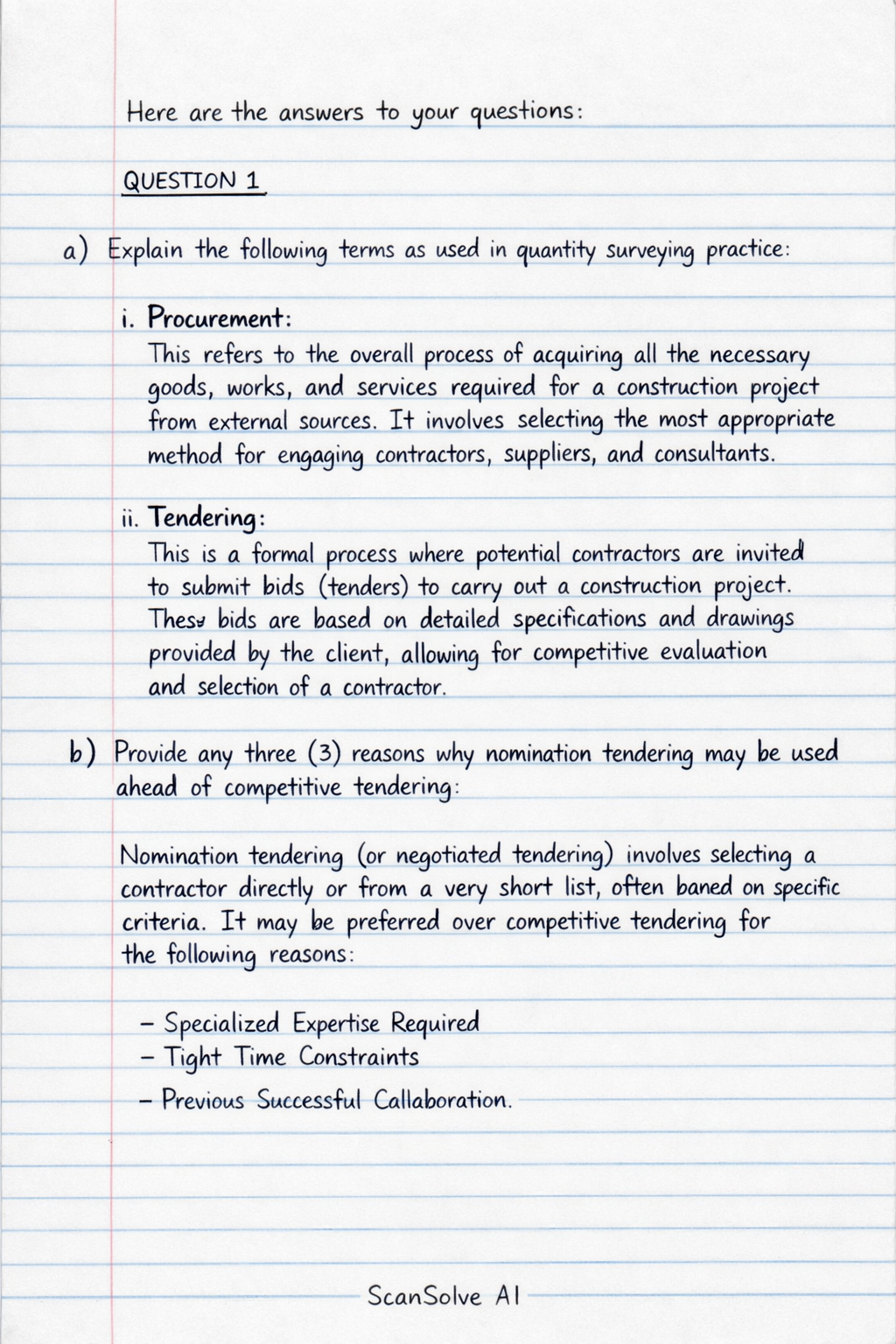
Here are the answers to your questions:
QUESTION 1
a) Explain the following terms as used in quantity surveying practice:
- i. Procurement: This refers to the overall process of acquiring all the necessary goods, works, and services required for a construction project from external sources. It involves selecting the most appropriate method for engaging contractors, suppliers, and consultants.
- ii. Tendering: This is a formal process where potential contractors are invited to submit bids (tenders) to carry out a construction project. These bids are based on detailed specifications and drawings provided by the client, allowing for competitive evaluation and selection of a contractor.
b) Provide any three (3) reasons why nomination tendering may be used ahead of competitive tendering.
Nomination tendering (or negotiated tendering) involves selecting a contractor directly or from a very short list, often based on specific criteria. It may be preferred over competitive tendering for the following reasons:
- Specialized Expertise: When a project requires highly specialized skills, unique technology, or specific experience that only a few contractors possess, nomination ensures the most qualified party is engaged.
- Urgency and Time Constraints: For projects with extremely tight deadlines, the lengthy process of competitive tendering can be bypassed, allowing construction to start much faster.
- Previous Successful Relationship: If a client has a proven track record with a particular contractor and trusts their reliability, quality of work, and ability to deliver, they may nominate them for a new project.
- Confidentiality: For sensitive projects where maintaining confidentiality is crucial, limiting the number of parties involved through nomination can be advantageous.
QUESTION 2
Which procurement method would you use in each of the following situations;
- a) Project duration is critical to the success of a project.
- Negotiated Tendering or Construction Management (due to fast-tracking potential).
- b) A limited client's budget.
- Traditional (Design-Bid-Build) with Competitive Tendering or Design and Build (for cost certainty).
- c) An emergency project such as bridge construction along major highways.
- Negotiated Tendering or Direct Appointment.
- d) High quality of building.
- Design and Build (with clear performance specifications) or Management Contracting / Construction Management (allowing for specialist input).
- e) Certain about the cost of construction before commencement.
- Design and Build (fixed price contract) or Traditional (Design-Bid-Build) with a Lump-Sum Contract.
QUESTION 3
Identify any three (3) similarities and any three (3) differences between "management contracting" and "construction management".
Similarities:
- Early Contractor Involvement: Both methods allow for the involvement of the management entity (Management Contractor or Construction Manager) early in the design phase, providing valuable buildability advice.
- Separate Trade Contracts: Both approaches involve breaking the project into numerous work packages, with separate contracts for each trade or specialist contractor.
- Fast-tracking Potential: Both methods facilitate fast-tracking, meaning construction can commence on early packages before the entire design is fully complete, potentially reducing overall project duration.
Differences:
- Contractual Relationship:
- Management Contracting: The Management Contractor enters into direct contracts with the individual trade contractors.
- Construction Management: The Client enters into direct contracts with the individual trade contractors.
- Risk Allocation:
- Management Contracting: The Management Contractor carries some contractual risk for the performance, coordination, and programming of the trade contractors.
- Construction Management: The Client retains the direct contractual risk for the performance and coordination of the trade contractors.
- Role and Liability:
- Management Contracting: The Management Contractor acts as a principal, taking responsibility for the overall execution of the works.
- Construction Management: The Construction Manager acts as an agent for the client, providing advice, coordination, and administration without taking direct responsibility for the works themselves.
Still stuck on this one?
Ask a follow-up, and the answer starts from this question.
More Business/Management Questions
Handwritten Step-by-Step Solution
Get this as a handwritten image on WhatsApp — like a tutor wrote it for you.
Try on WhatsApp