
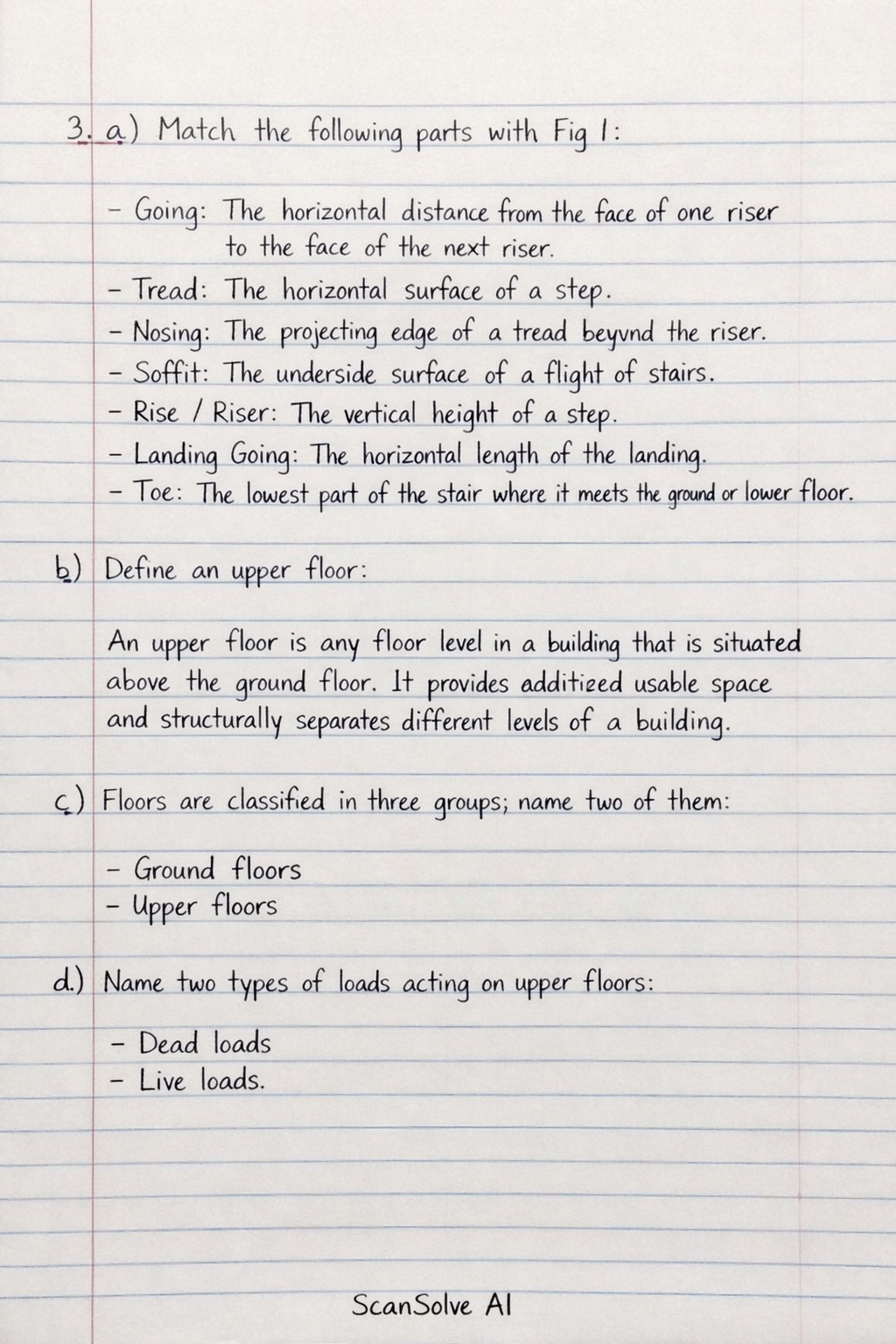
We read your photo as:
What are the key terms and concepts related to building construction, including stair components, floor classifications, and loads on floors?
ScanSolve AI Answer
Here are the answers to the questions about building construction:
3. a) Match the following parts with fig 1 (Tread, Rise, Nosing, Soffit, Riser, Landing Going, and Toe)
- Going: The horizontal distance from the face of one riser to the face of the next riser.
- Tread: The horizontal surface of a step.
- Nosing: The projecting edge of a tread beyond the riser.
- Soffit: The underside surface of a flight of stairs.
- Rise/Riser: The vertical height of a step.
- Landing Going: The horizontal length of the landing.
- Toe: The lowest part of the stair where it meets the ground or lower floor.
b) Define an upper floor
An upper floor is any floor level in a building that is situated above the ground floor. It provides additional usable space and structurally separates different levels of a building.
c) Floors are classified in three groups; name two of them
Two classifications of floors are:
- Ground floors
- Upper floors
d) Name two types of loads acting on upper floors
Two types of loads acting on upper floors are:
- Dead loads: These are permanent loads, including the weight of the floor structure itself, fixed partitions, and permanent fixtures.
- Live loads (or imposed loads): These are temporary and movable loads, such as people, furniture, and movable equipment.
e) State three functional requirements of an upper floor
Three functional requirements of an upper floor are:
- Strength and Stability: It must be strong enough to safely support all anticipated dead and live loads without excessive deflection or collapse.
- Sound Insulation: It should effectively reduce the transmission of airborne and impact sound between different levels of the building.
- Fire Resistance: It must provide a specified period of resistance to fire to prevent its spread and allow for safe evacuation.
f) Sketch a suspended timber ground floor and name the following parts:
i. Concrete foundation
ii. Over-site concrete
iii. Honey comb
\begin{tikzpicture}[scale=0.7]
    % Ground level
    \draw[thick] (-5,0) -- (10,0) node[right] {Ground Level};

    % Strip foundation for external wall
    \fill[gray!30] (-4,-1) rectangle (-2,-2.5);
    \draw[thick] (-4,-1) rectangle (-2,-2.5);
    \node at (-3,-1.75) {\small Concrete Foundation};
    \draw[thick] (-4,-1) -- (-4,0); % Wall above foundation
    \draw[thick] (-2,-1) -- (-2,0);

    % Strip foundation for sleeper wall
    \fill[gray!30] (1,-1) rectangle (3,-1.5);
    \draw[thick] (1,-1) rectangle (3,-1.5);
    \node at (2,-1.25) {\small Concrete Pad};

    % Sleeper wall (honeycomb)
    \draw[thick] (1.2,-0.5) rectangle (1.8,-1); % Brick 1
    \draw[thick] (2.2,-0.5) rectangle (2.8,-1); % Brick 2
    \draw[thick] (1.2,0) rectangle (1.8,-0.5); % Brick 3
    \draw[thick] (2.2,0) rectangle (2.8,-0.5); % Brick 4
    \node at (2,0.2) {\small Honeycomb Brickwork};

    % Over-site concrete (blinding)
    \fill[gray!10] (-3.5,-0.5) rectangle (9,-0.7);
    \draw[thick] (-3.5,-0.5) -- (9,-0.5);
    \draw[thick] (-3.5,-0.7) -- (9,-0.7);
    \node at (5,-0.6) {\small Over-site Concrete (Blinding)};

    % Timber joists
    \fill[brown!50] (-3.5,0.5) rectangle (-3,0.7);
    \draw[thick] (-3.5,0.5) rectangle (-3,0.7);
    \node at (-3.25,0.6) {\small Joist};

    \fill[brown!50] (0.5,0.5) rectangle (1,0.7);
    \draw[thick] (0.5,0.5) rectangle (1,0.7);
    \node at (0.75,0.6) {\small Joist};

    \fill[brown!50] (3.5,0.5) rectangle (4,0.7);
    \draw[thick] (3.5,0.5) rectangle (4,0.7);
    \node at (3.75,0.6) {\small Joist};

    \fill[brown!50] (6.5,0.5) rectangle (7,0.7);
    \draw[thick] (6.5,0.5) rectangle (7,0.7);
    \node at (6.75,0.6) {\small Joist};

    % Floorboards
    \draw[thick] (-3.5,0.7) -- (7,0.7);
    \draw[thick] (-3.5,0.8) -- (7,0.8);
    \node at (1.75,0.9) {\small Floorboards};

    % External wall
    \draw[thick] (-3.5,0) -- (-3.5,0.5);
    \draw[thick] (-2,0) -- (-2,0.5);
    \node at (-2.75,0.25) {\small External Wall};

    % Air brick
    \draw[fill=gray!50] (-3.75,0.2) rectangle (-4.25,0.4);
    \node at (-4,0.3) {\small Air Brick};

    % Arrows for labels
    \draw[->] (-3,-1.75) -- (-3,-1.2);
    \draw[->] (2,0.2) -- (2,0.05);
    \draw[->] (5,-0.6) -- (5,-0.55);
    \draw[->] (1.75,0.9) -- (1.75,0.75);
    \draw[->] (-3.25,0.6) -- (-3.25,0.65);
\end{tikzpicture}Still stuck on this one?
Ask a follow-up, and the answer starts from this question.
More Business/Management Questions
Handwritten Step-by-Step Solution
Get this as a handwritten image on WhatsApp — like a tutor wrote it for you.
Try on WhatsApp