
We read your photo as:
The operations manual (b) in its entirety is typically left on the ground, with only the parts relevant to the flight (c) carried on board. The aeroplane noise certificate (a) and operational fl
ScanSolve AI Answer
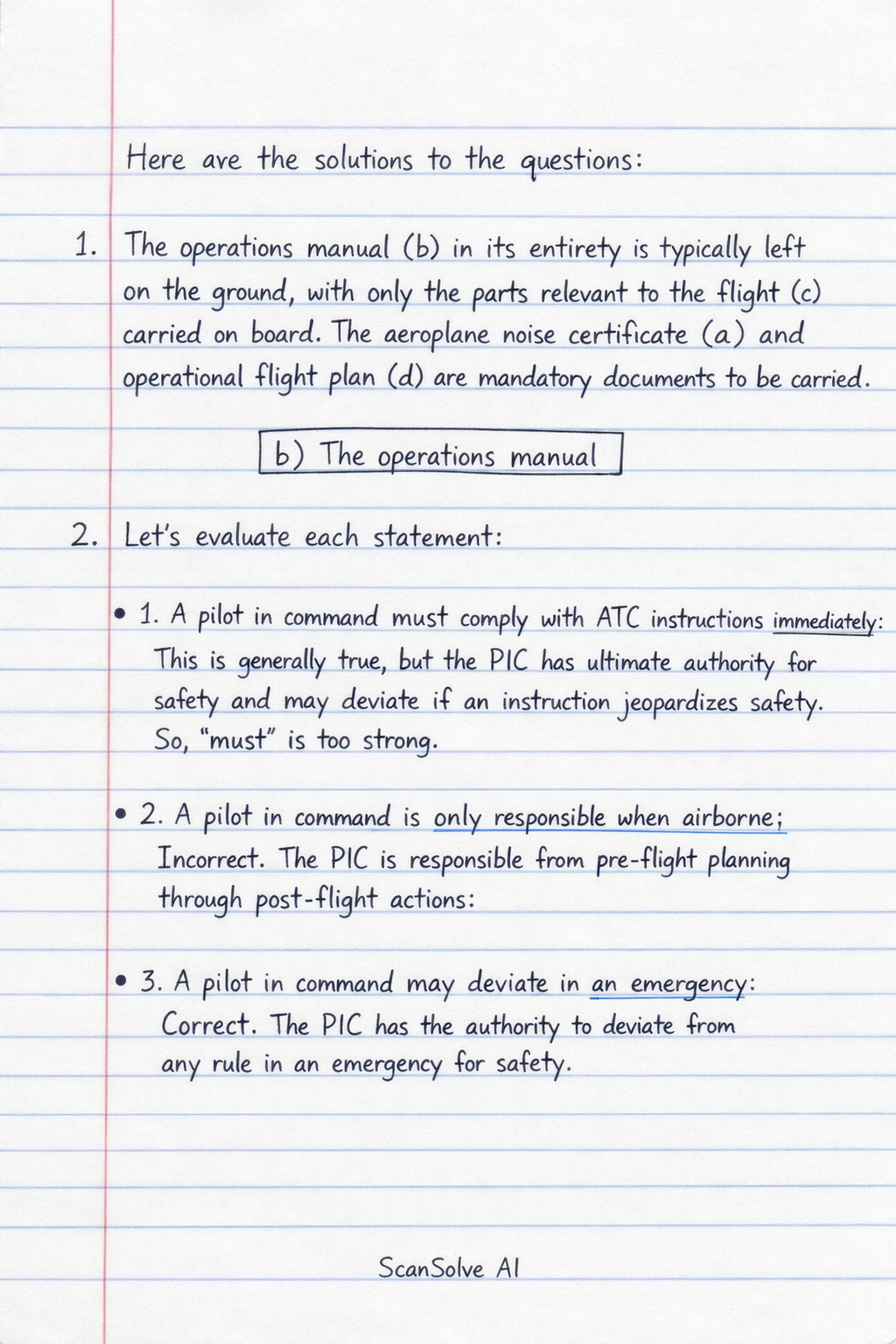
Here are the solutions to the questions:
-
The operations manual (b) in its entirety is typically left on the ground, with only the parts relevant to the flight (c) carried on board. The aeroplane noise certificate (a) and operational flight plan (d) are mandatory documents to be carried.
-
Let's evaluate each statement:
-
- A pilot in command must comply with ATC instructions immediately: This is generally true, but the PIC has ultimate authority for safety and may deviate if an instruction jeopardizes safety. So, "must" is too strong.
-
- A pilot in command is only responsible when airborne: Incorrect. The PIC is responsible from pre-flight planning through post-flight actions.
-
- A pilot in command may deviate in an emergency: Correct. The PIC has the authority to deviate from any rule in an emergency for safety.
-
- A pilot in command may deviate from complying with rules of the air in order to comply with an ATC instruction: Incorrect. The PIC must not deviate from rules of the air to comply with an ATC instruction if it compromises safety. The PIC's primary responsibility is safety and adherence to regulations.
-
- A pilot in command may request a new clearance if unsatisfied: Correct. Pilots can always request amendments to clearances.
Therefore, statements 3 and 5 are correct.
-
-
According to aviation regulations (e.g., ICAO Annex 6, EASA OPS), in a pressurized aircraft, if cabin depressurization occurs, supplemental oxygen must be available for all crew members and a portion of passengers when the pressure altitude is greater than 10,000 ft for more than 30 minutes, or if it exceeds 13,000 ft at any time. For continuous supply to all crew and part of the passengers, the critical threshold is 13,000 ft.
-
A destination alternate aerodrome is generally not required if the weather forecast for the destination aerodrome indicates good conditions (e.g., Visual Meteorological Conditions - VMC) for a specified period around the Estimated Time of Arrival (ETA).
- a) If there is a reasonable certainty that at the ETA at the destination aerodrome and a reasonable time before and after you can expect VMC - This is the standard regulatory condition for not needing a destination alternate.
- Other options do not accurately reflect the conditions for waiving an alternate.
-
The phenomenon where a layer of water builds up between an aircraft tire and the runway surface, causing the tire to be lifted off the runway and lose traction, is known as hydroplaning (or aquaplaning).
-
In the context of dangerous goods, a UN number is a four-digit number used internationally to identify hazardous substances and articles during transport.
Still stuck on this one?
Ask a follow-up, and the answer starts from this question.
More Business/Management Questions
Handwritten Step-by-Step Solution
Get this as a handwritten image on WhatsApp — like a tutor wrote it for you.
Try on WhatsApp