A patient is experiencing severe difficulty digesting fats but proteins and carbohydrates digestion appear hotly unaffected. Which part of the digestive system is most likely malfunctioning or blocked leading to this specific problem?

Biology
A patient is experiencing severe difficulty digesting fats but proteins and carbohydrates digestion appear hotly unaffected. Which part of the digestive system is most likely malfunctioning or blocked leading to this specific problem?

ScanSolve AI Answer

8 steps

Answer

C

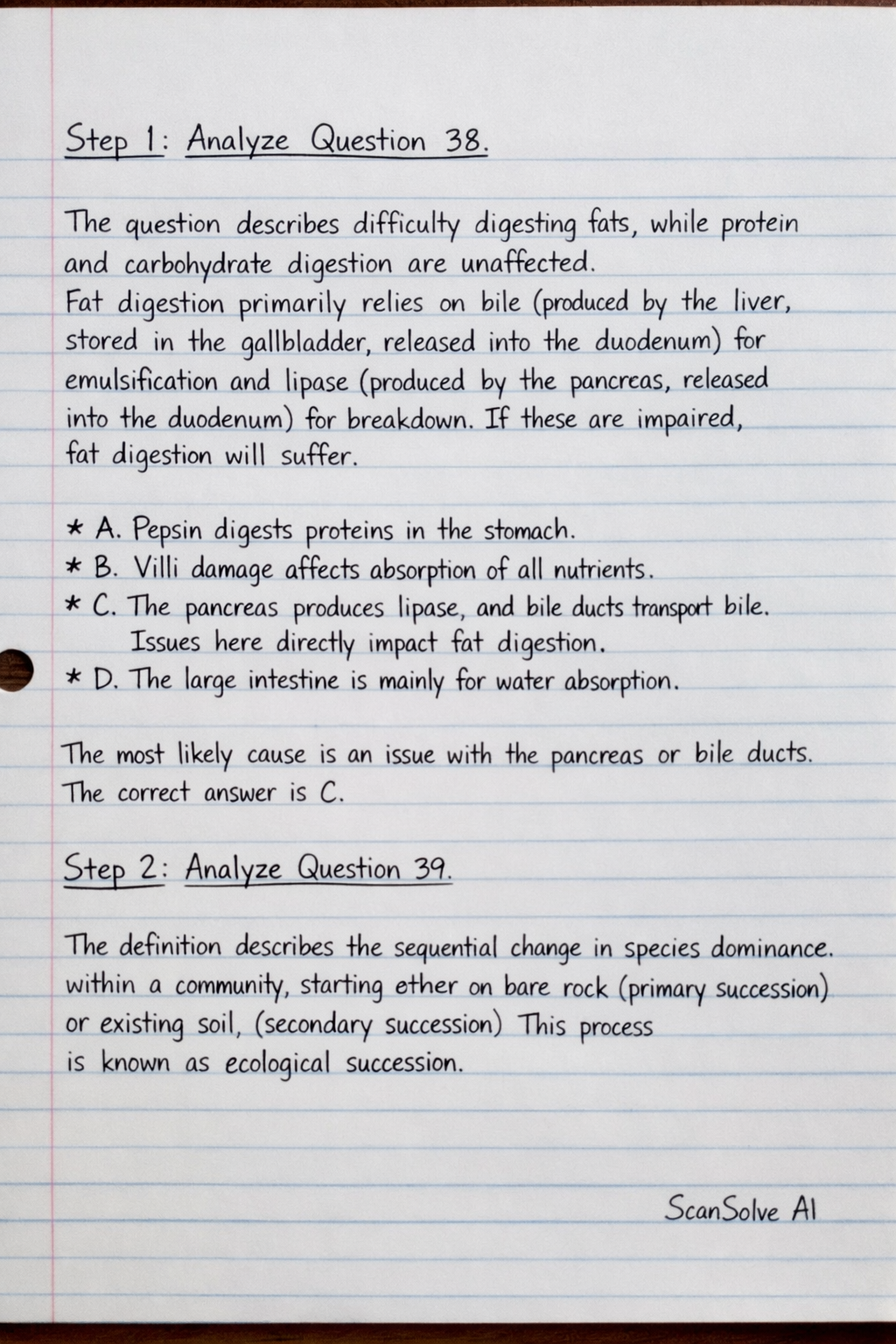
Step 1: Analyze Question 38. The question describes difficulty digesting fats, while protein and carbohydrate digestion are unaffected. Fat digestion primarily relies on bile (produced by the liver, stored in the gallbladder, released into the duodenum) for emulsification and lipase (produced by the pancreas, released into the duodenum) for breakdown. If these are impaired, fat digestion will suffer.

  • A. Pepsin digests proteins in the stomach.
  • B. Villi damage affects absorption of all nutrients.
  • C. The pancreas produces lipase, and bile ducts transport bile. Issues here directly impact fat digestion.
  • D. The large intestine is mainly for water absorption.

The most likely cause is an issue with the pancreas or bile ducts. The correct answer is C.

Step 2: Analyze Question 39. The definition describes the sequential change in species dominance within a community, starting either on bare rock (primary succession) or existing soil (secondary succession). This process is known as ecological succession.

  • A. An ecological pyramid represents trophic levels.
  • B. Ecological succession matches the description.
  • C. Ecological diversity refers to the variety of life.
  • D. A climax community is the stable end stage of succession.

The correct answer is B.

Step 3: Analyze Question 40. The question asks for the cells specialized in transmitting electrical impulses. In the nervous system, these cells are neurons.

  • A. Receptors detect stimuli.
  • B. "Neertors" is a likely typo for Neurons, which transmit electrical impulses.
  • C. Effectors respond to stimuli.
  • D. Hormones are chemical messengers.

Assuming "Neertors" is a typo for "Neurons", the correct answer is B.

Step 4: Analyze Question 41. A fish suffocates on land because its gills, adapted for water, collapse in air. This collapse drastically reduces the surface area available for gas exchange, preventing efficient oxygen uptake, even though air has more oxygen than water.

  • A. Blood pressure changes are not the primary cause of immediate suffocation.
  • B. The collapse of gill filaments reduces surface area for gas exchange, which is the direct cause of suffocation.
  • C. While fish cannot pump air, the structural collapse of the gills is the more fundamental problem.
  • D. Temperature difference is not the immediate cause of suffocation.

The correct answer is B.

Step 5: Analyze Question 42. In the starch test, a leaf is boiled in water to kill the cells, break down cell membranes, and denature enzymes. This makes the starch granules accessible to the iodine solution and stops further metabolic activity.

  • A. Chlorophyll is removed by boiling in alcohol, not water.
  • B. Boiling denatures enzymes, it does not activate them.
  • C. Glucose is converted to starch during photosynthesis, not by boiling.
  • D. Boiling denatures enzymes, which is a correct reason.

The correct answer is D.

Step 6: Analyze Question 43. Decomposers (bacteria and fungi) are crucial for breaking down dead organic matter and recycling nutrients back into the soil. If their population is drastically reduced, nutrients will remain locked in dead material, leading to a cessation of nutrient cycling and loss of soil fertility.

  • A. An immediate decrease in producers is less likely than a long-term nutrient depletion.
  • B. A decrease in herbivores is a secondary effect, following producer decline.
  • C. Cessation of nutrient cycling and loss of soil fertility is the most critical long-term consequence.
  • D. Reduced decomposers would lead to less CO2 release from decomposition, not an increase.

The correct answer is C.

Step 7: Analyze Question 44. Water moves by osmosis from an area of higher water potential to an area of lower water potential across a semi-permeable membrane. The question states soil water has a higher water potential than the root hair cell cytoplasm. Therefore, water will move from the soil into the root hair cells by osmosis.

  • A. Water moves by osmosis from soil solution into root hair cells, which is consistent with water potential gradients.
  • B. Active transport requires energy and is not the primary mechanism for bulk water movement.
  • C. Water moving from root hair cells to soil would occur if soil water potential were lower.
  • D. Water moves from soil into root hair cells, not primarily from cortex cells into root hair cells as the initial entry.

The correct answer is A.

Step 8: Analyze Question 45. Presbyopia is an age-related condition where the eye loses its ability to focus on close objects. This is primarily due to the natural hardening and loss of elasticity of the eye's lens, making it less able to change shape (bulge) to increase its refractive power for near vision.

  • A. Cloudy lens describes cataracts.
  • B. While ciliary muscles are involved, the primary issue in presbyopia is the lens's elasticity.
  • C. The lens losing elasticity and becoming less able to bulge (thicken) is the correct explanation for presbyopia.
  • D. Corneal changes are not the primary cause of presbyopia.

The correct answer is C.

The final answers are: 38. C\boxed{C} 39. B\boxed{B} 40. B\boxed{B} 41. B\boxed{B} 42. D\boxed{D} 43. C\boxed{C} 44. A\boxed{A} 45. C\boxed{C}

Was this helpful?

Need help with your own homework?

Get instant step-by-step solutions to any question. Free to start.

Ask Your Question
Handwritten step-by-step solution preview

Handwritten Step-by-Step Solution

Get this as a handwritten image on WhatsApp — like a tutor wrote it for you.

Try on WhatsApp

Still have questions?

Quick Answer

Analyze Question 38. The question describes difficulty digesting fats, while protein and carbohydrate digestion are unaffected.

A patient is experiencing severe difficulty digesting fats but proteins and carbohydrates digestion appear hotly unaffected. Which part of the digestive system is most likely malfunctioning or blocked leading to this specific problem?
Biology

This biology question covers important biological concepts and processes. The step-by-step explanation below helps you understand the underlying mechanisms and reasoning.

ScanSolve AI Answer
Step 1: Analyze Question 38. The question describes difficulty digesting fats, while protein and carbohydrate digestion are unaffected. Fat digestion primarily relies on bile (produced by the liver, stored in the gallbladder, released into the duodenum) for emulsification and lipase (produced by the pancreas, released into the duodenum) for breakdown. If these are impaired, fat digestion will suffer. A. Pepsin digests proteins in the stomach. B. Villi damage affects absorption of all nutrients. C. The pancreas produces lipase, and bile ducts transport bile. Issues here directly impact fat digestion. D. The large intestine is mainly for water absorption. The most likely cause is an issue with the pancreas or bile ducts. The correct answer is C. Step 2: Analyze Question 39. The definition describes the sequential change in species dominance within a community, starting either on bare rock (primary succession) or existing soil (secondary succession). This process is known as ecological succession. A. An ecological pyramid represents trophic levels. B. Ecological succession matches the description. C. Ecological diversity refers to the variety of life. D. A climax community is the stable end stage of succession. The correct answer is B. Step 3: Analyze Question 40. The question asks for the cells specialized in transmitting electrical impulses. In the nervous system, these cells are neurons. A. Receptors detect stimuli. B. "Neertors" is a likely typo for Neurons*, which transmit electrical impulses. C. Effectors respond to stimuli. D. Hormones are chemical messengers. Assuming "Neertors" is a typo for "Neurons", the correct answer is B. Step 4: Analyze Question 41. A fish suffocates on land because its gills, adapted for water, collapse in air. This collapse drastically reduces the surface area available for gas exchange, preventing efficient oxygen uptake, even though air has more oxygen than water. A. Blood pressure changes are not the primary cause of immediate suffocation. B. The collapse of gill filaments reduces surface area for gas exchange, which is the direct cause of suffocation. C. While fish cannot pump air, the structural collapse of the gills is the more fundamental problem. D. Temperature difference is not the immediate cause of suffocation. The correct answer is B. Step 5: Analyze Question 42. In the starch test, a leaf is boiled in water to kill the cells, break down cell membranes, and denature enzymes. This makes the starch granules accessible to the iodine solution and stops further metabolic activity. A. Chlorophyll is removed by boiling in alcohol, not water. B. Boiling denatures enzymes, it does not activate them. C. Glucose is converted to starch during photosynthesis, not by boiling. D. Boiling denatures enzymes, which is a correct reason. The correct answer is D. Step 6: Analyze Question 43. Decomposers (bacteria and fungi) are crucial for breaking down dead organic matter and recycling nutrients back into the soil. If their population is drastically reduced, nutrients will remain locked in dead material, leading to a cessation of nutrient cycling and loss of soil fertility. A. An immediate decrease in producers is less likely than a long-term nutrient depletion. B. A decrease in herbivores is a secondary effect, following producer decline. C. Cessation of nutrient cycling and loss of soil fertility is the most critical long-term consequence. D. Reduced decomposers would lead to less CO2 release from decomposition, not an increase. The correct answer is C. Step 7: Analyze Question 44. Water moves by osmosis from an area of higher water potential to an area of lower water potential across a semi-permeable membrane. The question states soil water has a higher water potential than the root hair cell cytoplasm. Therefore, water will move from the soil into the root hair cells by osmosis. A. Water moves by osmosis from soil solution into root hair cells, which is consistent with water potential gradients. B. Active transport requires energy and is not the primary mechanism for bulk water movement. C. Water moving from root hair cells to soil would occur if soil water potential were lower. D. Water moves from soil into root hair cells, not primarily from cortex cells into root hair cells as the initial entry. The correct answer is A. Step 8: Analyze Question 45. Presbyopia is an age-related condition where the eye loses its ability to focus on close objects. This is primarily due to the natural hardening and loss of elasticity of the eye's lens, making it less able to change shape (bulge) to increase its refractive power for near vision. A. Cloudy lens describes cataracts. B. While ciliary muscles are involved, the primary issue in presbyopia is the lens's elasticity. C. The lens losing elasticity and becoming less able to bulge (thicken) is the correct explanation for presbyopia. D. Corneal changes are not the primary cause of presbyopia. The correct answer is C. The final answers are: 38. C 39. B 40. B 41. B 42. D 43. C 44. A 45. C