
We read your photo as:
How would you address concerns as a leader of the Kyaliwajala community?
Business/Management
ScanSolve AI Answer
a) Addressing concerns as a leader of Kyaliwajala community
If I were the leader of Kyaliwajala community, I would address the concerns of the residents during my term of office through the following practical steps:
- Establish Open Communication Channels: I would set up regular community meetings (e.g., monthly town halls) and create accessible feedback mechanisms (e.g., suggestion boxes, a community WhatsApp group, or a dedicated office hour) to ensure residents can easily voice their concerns and feel heard.
- Conduct Needs Assessments: I would initiate surveys or focus group discussions to systematically identify and prioritize the most pressing issues affecting the community, such as sanitation, security, infrastructure (roads, water), or youth unemployment.
- Form Community Action Committees: I would empower residents by forming specialized committees (e.g., a security committee, a sanitation committee, a youth development committee) composed of community members and local experts to collaboratively brainstorm solutions and implement projects.
- Liaise with Local Authorities and NGOs: I would actively engage with local government officials, non-governmental organizations (NGOs), and other stakeholders to advocate for resources, funding, and technical support to address identified concerns that are beyond the community's direct capacity.
- Promote Community Self-Help Initiatives: I would encourage and facilitate community-led projects, such as communal clean-up drives, neighborhood watch programs, or skill-sharing workshops, to foster self-reliance and collective responsibility in solving local problems.
b) Five roles played by Hon. Nganda in his area of jurisdiction
Assuming Hon. Nganda is a local representative (e.g., a Member of Parliament or a local council leader), here are five roles he would play in his area of jurisdiction:
- Representation: Hon. Nganda would act as the voice of his constituents, bringing their issues, needs, and aspirations to relevant decision-making bodies, whether at the local council or national parliament level.
- Advocacy: He would advocate for the allocation of resources, development projects, and policies that benefit his area, such as improved infrastructure, healthcare facilities, educational opportunities, or economic development initiatives.
- Oversight and Accountability: Hon. Nganda would monitor the implementation of government programs and projects within his jurisdiction, ensuring that public funds are used effectively and that services are delivered as promised. He would also hold local government officials accountable for their performance.
- Legislation/Policy Input: If a Member of Parliament, he would participate in the legislative process by debating bills, proposing amendments, and voting on laws that affect the entire country, including his constituency. If a local councilor, he would contribute to local ordinances and policies.
- Community Mobilization and Development: He would work to unite the community, encourage participation in local development initiatives, and facilitate partnerships between residents, local businesses, and external organizations to address local challenges and promote progress.
Was this helpful?
Still stuck on this one?
Ask a follow-up, and the answer starts from this question.
Got a different question?Ask your own question
More Business/Management Questions
QAs a member of the Youth Advisory Committee, what solution would you propose for the public health…QHow do leaders at different levels of society, from the president to village chairmen, fulfill their…QWhat are the key issues to present during the talk show regarding the proposed ethanol manufacturing…QMzee Kenga anatumia mithali hii kueleza msimamo gani kuhusu changamoto za jamii?QDescribe the key challenges and public sentiment regarding Uganda's water crisis, and propose survey…
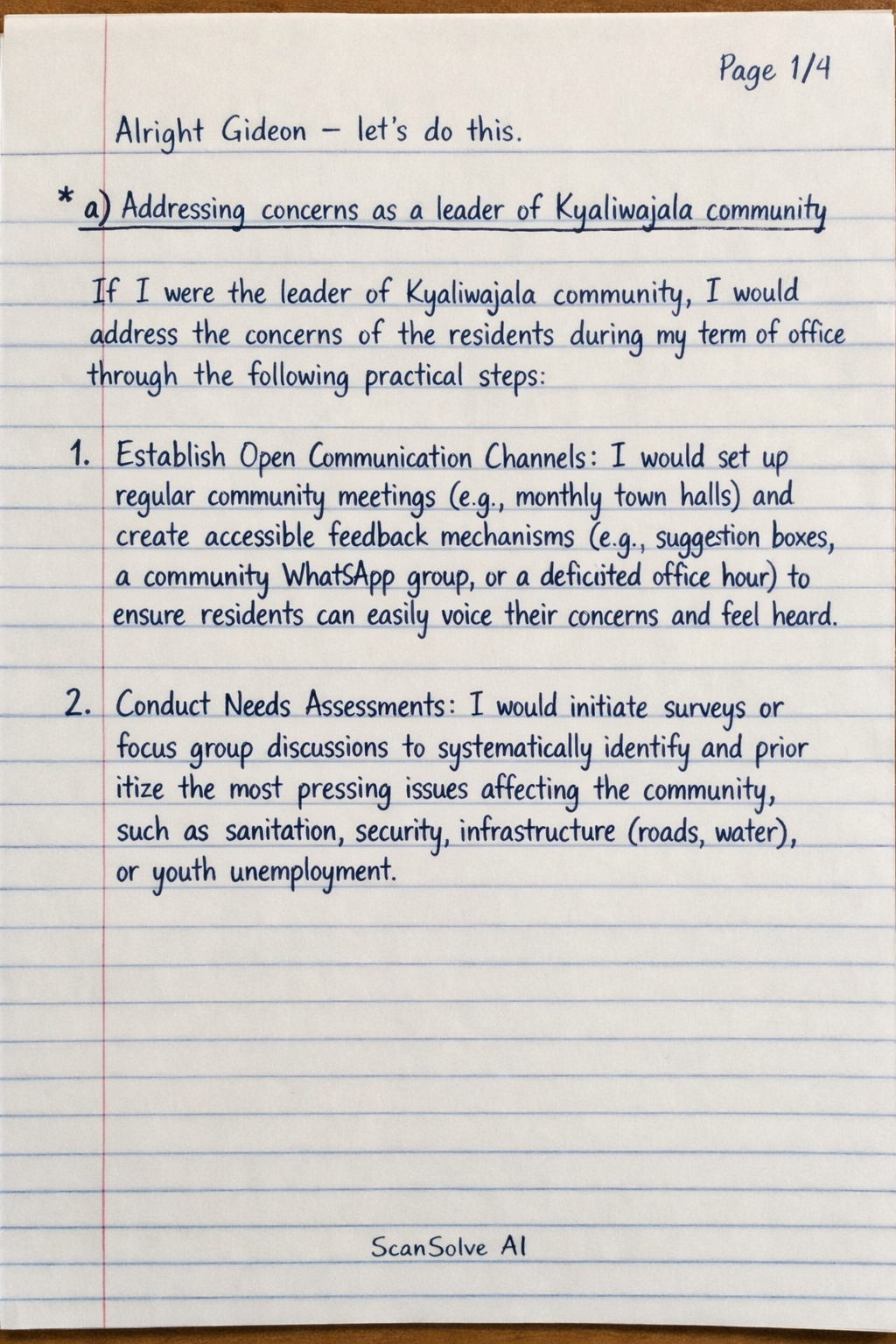
Handwritten Step-by-Step Solution
Get this as a handwritten image on WhatsApp — like a tutor wrote it for you.
Try on WhatsApp