
We read your photo as:
Explain how you would apply the four steps of the print production plan to produce the proposed programme. You must use Austin and Doust's (2007) explanation of the four steps to demonstrate your ability to apply their insights to a realistic print production plan.
ScanSolve AI Answer
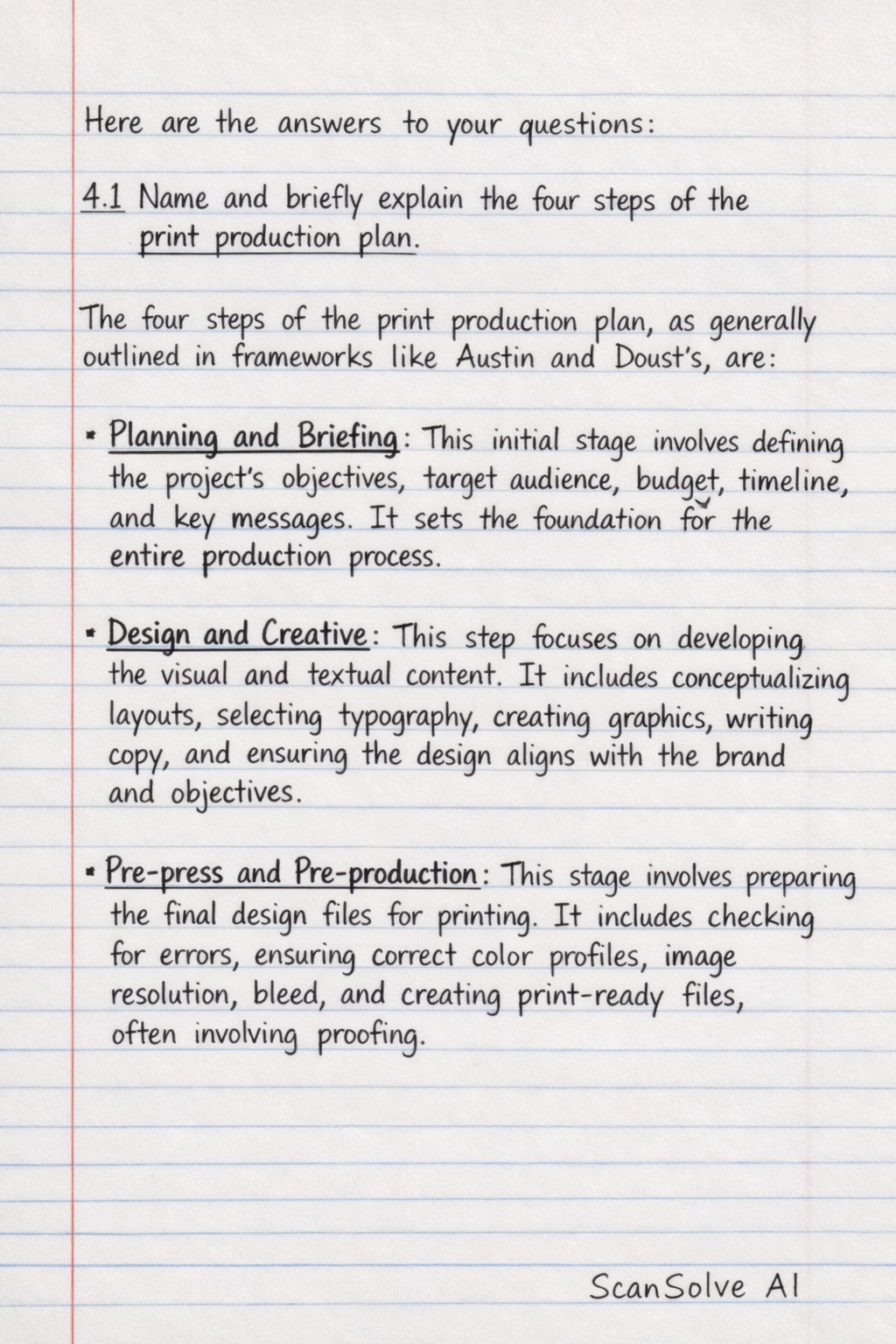
Here are the answers to your questions:
4.1 Name and briefly explain the four steps of the print production plan
The four steps of the print production plan, as generally outlined in frameworks like Austin and Doust's, are:
- Planning and Briefing: This initial stage involves defining the project's objectives, target audience, budget, timeline, and key messages. It sets the foundation for the entire production process.
- Design and Creative: This step focuses on developing the visual and textual content. It includes conceptualizing layouts, selecting typography, creating graphics, writing copy, and ensuring the design aligns with the brand and objectives.
- Pre-press and Pre-production: This stage involves preparing the final design files for printing. It includes checking for errors, ensuring correct color profiles, image resolution, bleed, and creating print-ready files, often involving proofing.
- Printing, Production, and Distribution: This final stage encompasses the actual printing of the material, including paper selection, binding, and quality control. It concludes with the delivery and distribution of the finished print product to its intended audience.
4.2 Explain how each step would be applied to the creation of the event programme. Justify your answer by providing at least one relevant example for each step
Here's how each step would be applied to the Scorpion Kings concert programme:
-
Planning and Briefing:
- Application: As the PR specialist, you would meet with the concert organizers to establish the programme's dual purpose: commemorating the successful past concert and promoting the next one. You would define the target audience (attendees, sponsors, media), content requirements (artist features, photos, sponsor acknowledgements, next event details), budget for design and printing, and a production timeline.
- Example: A key decision would be to allocate specific pages for high-quality photos from the recent concert to serve the commemorative function, alongside a dedicated section for early bird ticket information and a QR code for the upcoming event.
-
Design and Creative:
- Application: This involves developing the visual concept for the programme. Designers would create layouts for the cover and internal pages, select appropriate fonts, incorporate high-resolution images from the past concert, and design promotional elements for the next event. The design must reflect the Scorpion Kings' brand identity and appeal to their audience.
- Example: The cover might feature a dynamic photo of DJ Maphorisa and Kabza De Small performing, with a sleek, modern design. Inside, pages would include artist biographies, a retrospective of the recent concert with fan testimonials, and a visually engaging spread detailing the vision for the next event.
-
Pre-press and Pre-production:
- Application: Once the design is finalized, all files would be prepared for commercial printing. This includes converting all images to CMYK color mode, ensuring all fonts are embedded, checking for correct bleed and trim marks, and verifying image resolutions. A critical part is thorough proofreading of all text to catch any errors.
- Example: A digital proof (PDF) of the entire programme would be sent to the Scorpion Kings management and key stakeholders for final approval. This proof would be meticulously checked for any typos in artist names, dates, sponsor logos, and overall layout before being sent to the printer.
-
Printing, Production, and Distribution:
- Application: This step involves selecting the appropriate paper stock (e.g., glossy for photos, matte for text), overseeing the printing process to ensure color accuracy and quality, and managing the binding (e.g., saddle-stitched or perfect bound). Finally, the finished programmes would be delivered and distributed.
- Example: You would coordinate with the printing company to ensure the programmes are printed on a high-quality, durable paper stock that enhances the visual appeal of the concert photos. The printed programmes would then be delivered to the concert venue or designated distribution points for attendees, VIPs, and media.
4.3 Explain why the programme is an appropriate print product for this purpose, considering other possible print products such as posters, billboards and flyers
A programme is the most appropriate print product for this purpose because it uniquely fulfills both the commemorative and promotional functions required. Unlike posters or billboards, which are primarily for broad, short-term awareness and lack space for detailed content, a programme offers ample room for rich information. It can include detailed artist profiles, high-quality event photos, sponsor acknowledgements, and comprehensive information about the next concert, making it a valuable souvenir that attendees will keep. Flyers, while good for quick distribution, are too limited in space and often discarded quickly, failing to provide the depth needed for commemoration or detailed future promotion. The programme's ability to provide detailed content and serve as a tangible keepsake ensures a lasting impression and sustained engagement with both the past and future events.
Still stuck on this one?
Ask a follow-up, and the answer starts from this question.
More Business/Management Questions
Handwritten Step-by-Step Solution
Get this as a handwritten image on WhatsApp — like a tutor wrote it for you.
Try on WhatsApp